
Please note: this article contains Amazon affiliate links. As an Amazon Associate a commission may come our way if you buy, and never out of your pocket.
Portable TIG Welders
A good portable TIG welder gives you clean, controlled arcs on steel and stainless, wherever your work happens to be.
Picture this: it’s Saturday morning, you’ve got a cracked stainless steel bracket off the trailer, and you want it fixed before lunch. The bench is clear, the garage door is open, and you just need a machine that starts an arc without a fight. That’s the moment a portable TIG welder earns its place.
A portable TIG welder brings the control of a shop machine to a size you can carry. It gives you a stable arc, low spatter, and a foot pedal or trigger to fine-tune the heat as you go. The picks below cover the main jobs, so you can match one to your own work.
1. YESWELDER 205A Tig Welder Pulse STICK/DC TIG/PULSE TIG 3

Best for: hobbyists and pros who mostly weld steel and stainless
The YESWELDER TIG-205P is a 3-in-1 machine that runs STICK, DC TIG, and PULSE TIG. It delivers up to 200 amps and weighs 4.85kg (10.7lb), so it moves between the workshop and the truck without much effort. Auto-sensing dual voltage input covers 110V and 220V with no manual switching.
The listing states one clear limit: this machine can’t weld aluminum. That single fact decides who buys it, because aluminum work needs AC output. For stainless and mild steel, the HF non-touch arc start and Hot Start mean less tungsten touching and fewer stuck electrodes. The auto memory saves your settings between jobs, which saves time on repeat work.
Pros
- 3-in-1: STICK, DC TIG, and PULSE TIG modes
- Auto-sensing 110V/220V input, no manual switching
- Weighs 4.85kg (10.7lb) for easy carrying
- Auto memory keeps your settings after power-off
- 5-pin foot pedal interface reserved for later
Cons
- Can’t weld aluminum, per the listing
Why this one: Take this if your work is stainless and mild steel and you want pulse control for thin material. Skip it if aluminum is on your list, and look at the Weldpro 200A AC/DC instead.
2. Weldpro 200A AC/DC TIG Welder with Pulse

Best for: anyone welding aluminum or mixed metals
The Weldpro 200A is a 5-in-1 machine: AC TIG, DC TIG, AC Pulse TIG, DC Pulse TIG, and Stick MMA. It’s built around aluminum, with fully adjustable AC balance and frequency to handle thin and thick aluminum, magnesium, and other non-ferrous metals. Pulse frequency runs 0.5-200HZ.
A rocker-style foot pedal comes in the box, so you adjust amperage in real time without stopping. The listing describes a full accessory kit: torch, rocker-style foot pedal, ground clamp, stick electrode holder, gas hose and flow meter, tungsten electrodes, ceramic nozzles, collets, and back caps.
Pros
- AC and DC modes cover aluminum and steel
- Foot pedal included, not a separate buy
- Full accessory kit in the box
- Adjustable AC balance and frequency
- Overheat and voltage protections built in
Cons
- 40% duty cycle at full 200A limits long runs
- More settings to learn than a basic TIG
Why this one: This is the pick for aluminum and for anyone who wants one machine for every metal. If you never touch aluminum, the YESWELDER or TOOLIOM covers steel work with less setup.
3. ARCCAPTAIN 200A TIG Welder

Best for: entry-level welders who want simple dual voltage
The ARCCAPTAIN 200A is a 2-in-1 TIG and Stick machine with HF non-contact arc starting. It runs up to 200 amps and handles stainless and mild steel, with Stick mode for outdoor work or thicker material.
Post gas time is adjustable from 1-10s, which keeps shielding gas flowing after you switch off the torch to protect the weld and cool the torch head. Down-slope runs 0-10s as well. The cooling fan only runs when needed, so it isn’t buzzing the whole time you work.
Pros
- HF arc starting reduces tungsten consumption
- Post gas 1-10s protects the weld and torch
- Shoulder strap included for carrying
- 2 year quality service from the brand, per the listing
Cons
- Listed at less than 12lb, which anyone with a fixed bench setup has to plan around.
Why this one: Choose this if you want a straightforward TIG and Stick machine for steel and you’re new to welding. If you want pulse for thin sheet, the TOOLIOM 200A has it.
4. TOOLIOM 200A TIG Welder with Pulse
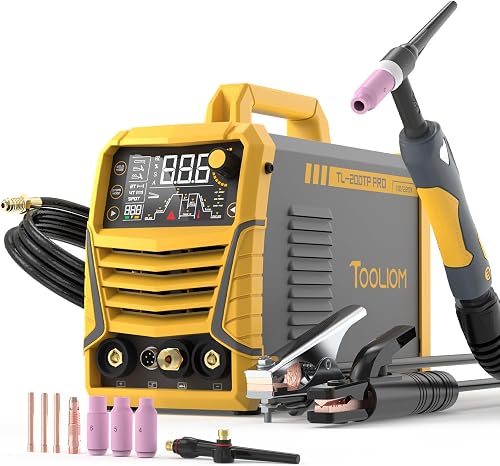
Best for: thin sheet work and repeatable spot welds
The TOOLIOM 200A is a 4-in-1 machine covering STICK, DC TIG, PULSE TIG, and TIG SPOT modes. It puts out up to 200 amps with low spatter and a high-success arc start, and it handles stainless steel, alloy steel, iron, and other non-ferrous metals.
Pulse TIG gives independent control of frequency, duty cycle, and current, which matters on thin material where heat builds fast. TIG Spot mode makes precise, repeatable spot welds, useful for tacking panels before a full seam. Smart sensing circuitry adapts to 110V or 220V automatically, and a 5-pin foot pedal interface is reserved for arc ON/OFF and current adjustment.
Pros
- 4 modes including Pulse TIG and TIG Spot
- Independent pulse frequency and duty control
- Auto-adapts between 110V and 220V
- Thermal protection with fan-assisted cooling
- Large display shows amperage and mode
Cons
- Spot mode suits tacks, not long seams
Why this one: This suits thin sheet, tack work, and anyone who wants pulse without paying for AC aluminum capability. If aluminum is your goal, step up to the Weldpro.
5. S7 200A TIG Welder

Best for: garage DIY users who want the simplest setup
The S7 200A is a DC TIG and Stick machine with a digital current display and simple controls. Output goes up to 200 amps.
Dual voltage design covers 110V and 220V input.
Pros
- Simple controls with digital current display
- 110V/220V dual voltage input
- Takes standard TIG torch consumables
- Overheat and overload protection built in
- Complete package with torch and clamp
Cons
- DC TIG only, so no aluminum welding
Why this one: Take this if you want the least complicated path into TIG for garage repairs on steel. If you want pulse or spot modes, the TOOLIOM is the better fit.
Also Worth Considering
The Sunstac Aluminum TIG Welder brings AC/DC capability with pulse and foot pedal control, so it’s another route into aluminum work if the Weldpro doesn’t suit your setup. The ARCCAPTAIN TIG Pro Welder is a 5-in-1 machine running 120/240V, adding more modes for mixed-metal shops.
How to Choose Yours
Pick on your own routine, not on the longest feature list. The machine that fits your garage, your power, and the metal you actually weld will get used far more than one packed with modes you never touch.
- What metal do you weld most: steel, stainless, or aluminum?
- Do you have a 220V outlet, or only standard household power?
- Will you weld thin sheet, or thicker plate and brackets?
- Do you want a foot pedal for hands-free heat control?
- How far will you carry it, and does weight matter to you?
- Are you learning, or do you need fine control over pulse settings?
Related guides
- Pulse MIG Welding Stainless Steel Settings: Optimal Parameters
- TIG Pulse Settings for Aluminum (Amps & Frequency Guide)
- Can You Spot Weld Aluminum to Steel? Proven Tips.
Frequently Asked Questions
Can a portable TIG welder run on a normal household outlet?
Yes, if it has dual voltage input. Several machines here sense 110V and 220V automatically and switch without manual adjustment, so they run from a standard home outlet or a workshop supply.
Is TIG hard to learn for a beginner?
TIG takes practice because you control the arc and the filler separately. The machines here help with HF non-contact arc starting, which avoids touching the tungsten to the work, and Hot Start for stable ignition.
Do I need a foot pedal?
Not always. A foot pedal lets you adjust amperage in real time without stopping, which helps on long seams and intricate work. If you mostly run short beads, a torch switch is often enough.
What safety gear do I need for TIG welding?
You need a welding helmet with the right shade, gloves, and proper ventilation, because TIG produces UV radiation and shielding gas can displace air in a closed space. The Occupational Safety and Health Administration publishes guidance on welding safety and ventilation that’s worth reading before you set up in a garage.
What comes in the box?
It varies by machine. Some arrive as a complete kit with torch, ground clamp, gas hose, flow meter, tungstens, and consumables, plus a foot pedal. Others include the torch and clamp but leave the foot pedal as a separate buy. Read the included-items list on each listing so you know what else you need.
Are these machines worth owning instead of renting?
If you weld more than a few times a year, owning makes sense. A machine in your garage means you fix the bracket the same day instead of driving to a shop.
The Verdict for Most People
For most readers, the YESWELDER TIG-205P is the pick.
Take the Weldpro 200A AC/DC TIG instead if aluminum is part of your work, since it’s the one here built for it with AC balance and frequency control. Everyone else can decide on one question: what metal is on your bench most weeks.
Hi, I’m Zachary Ford. I’m passionate about welding and dedicated to helping both beginners and experienced welders make informed decisions. I research, test, and write about welding helmets, welding machines, safety equipment, and essential workshop tools. My goal is to provide honest reviews, practical buying guides, and easy-to-follow tutorials that help you weld more safely, work more efficiently, and choose the right gear with confidence.