
A vevor spot welder is designed for specific metal joining tasks, ranging from auto body dent repair to custom battery pack assembly. These applications require distinct power outputs and control methods, as a mismatch between the tool and the task often leads to damaged materials or weak connections. Some units provide high-current precision for electronics, while others offer the brute force necessary for heavy metal panels.
1. VEVOR Stud Welder Kit

Best for: Auto body technicians performing dent repair on vehicle panels.
This stud welder kit features a durable ABS body and a pure copper electrode for steady performance. It includes a heavy-duty slide hammer to pull dents back to their original state.
Strengths:
- Durable ABS shell resists heat up to 118°C.
- Thermal protection engages when the transformer hits 95°C.
- Quick-release chuck holds welding pins firmly in place.
- Cast iron slide hammer provides a solid grip.
- Includes a carry box for organized tool storage.
Trade-offs:
- Limited to dent repair and stud welding tasks.
- Requires manual handling of the slide hammer assembly.
Keep the accessories organized to ensure you have the right tip for the dent size.
| Best for | Why |
|---|---|
| Auto repair | Designed specifically for sheet metal dents |
| Beginners | Simple one-handed trigger operation |
| Mobile work | Compact size and included storage case |
2. 11500W Battery Spot Welder

Best for: DIY enthusiasts building high-capacity cylindrical battery packs.
This 11.5KW welder delivers 1,380 A for robust battery assembly. You can switch between a foot pedal for hands-free operation or a manual trigger for more control.
Strengths:
- High 11.5KW output for demanding battery projects.
- Dual control options via foot pedal or trigger.
- Precision 100-level power adjustment for delicate tasks.
- Automatic shutdown after 8 minutes of inactivity.
- Intelligent thermal protection monitors internal temperatures.
Trade-offs:
- Requires charging before initial use.
- Manual adjustment needed for different battery types.
Monitor your power settings when switching between battery types.
| Best for | Why |
|---|---|
| Battery builders | 100 levels of precise power control |
| Diverse tasks | Handles both small and large cells |
| Safety-conscious | Automatic thermal protection and shutdown |
3. AWithZ UF20B Spot Welder
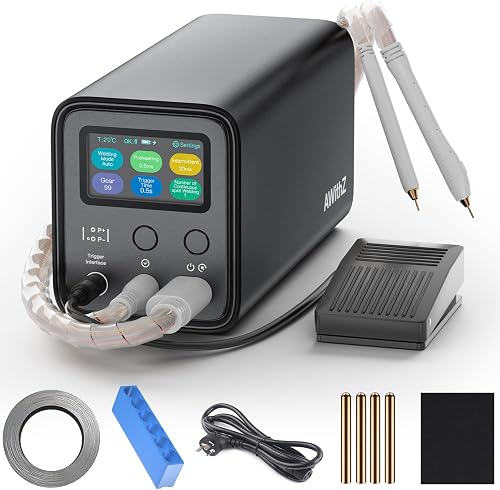
Best for: Professional-grade battery pack building and industrial spot welding.
This unit delivers 10KW of pulse power. It features automatic, manual, and foot pedal modes for flexible battery configuration. The flame-retardant aluminum alloy shell is rounded for safety, and the 40cm welding pen optimizes current flow.
Strengths:
- Rapid 5-minute startup time for quick operation.
- 3-in-1 welding mode for versatile project setups.
- Flame-retardant aluminum alloy housing for safety.
- 99 adjustable power gears for material thickness.
- High-current adapter included for fast charging.
Trade-offs:
- Must remain connected to power while welding.
- Limited capacitor storage for standalone battery usage.
Keep the welder plugged into a wall outlet, as the capacitors are designed for rapid discharge.
| Best for | Why |
|---|---|
| Professionals | Stable 10KW pulse power output |
| Complex builds | Foot pedal mode eases probe positioning |
| Versatility | Welds nickel, stainless, and iron sheets |
4. 10000W Cordless Spot Welder
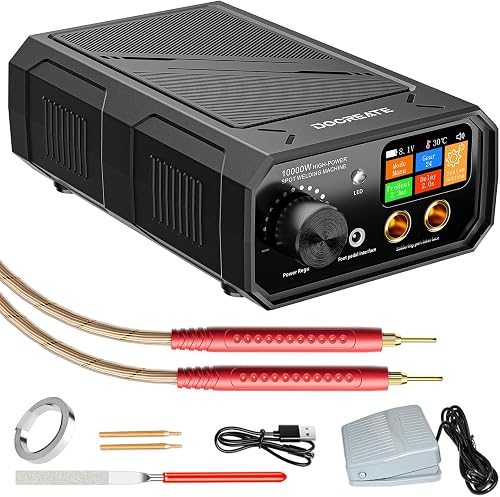
Best for: Users needing total freedom from cables during mobile battery repairs.
This 10,000W cordless welder features a large, built-in rechargeable battery. It includes an LCD screen to monitor voltage and working status in real time, along with 10–90 adjustable power levels. Its compact, lightweight design is ideal for home projects or field repairs.
Strengths:
- Fully cordless design for maximum portability.
- Integrated rechargeable battery eliminates external power needs.
- LCD display provides real-time status monitoring.
- Adjustable power levels for 0.1–0.25mm nickel strips.
- Includes foot pedal for safer, efficient welding.
Trade-offs:
- Requires full charging before the first use.
- Power is dependent on the built-in battery capacity.
Track your battery level to ensure you have enough charge for your project.
| Best for | Why |
|---|---|
| Field repairs | Cordless design works without outlets |
| Beginners | Clear LCD display for status monitoring |
| DIY projects | Compact size fits in most toolboxes |
5. FNRSI SWM-20 Battery Spot Welder

Best for: Users requiring high-definition monitoring and precise pulse control.
This handheld welder uses double-pulse technology to produce consistent welds while minimizing heat damage. Its 2.4-inch HD display allows precise adjustment of pre-heat and pulse width parameters.
Strengths:
- Industrial-grade double pulse for consistent welding.
- HD color display for detailed parameter adjustments.
- Wide welding capacity from 0.1mm to 0.5mm.
- Dual-purpose 5000mAh battery and power bank.
- Compact design fits easily into pockets.
Trade-offs:
- Requires careful adjustment of multiple parameters.
- Max capacity limited to 0.5mm sheets.
Navigate the HD screen to set the pulse width for your project.
| Best for | Why |
|---|---|
| Delicate cells | Double pulse minimizes heat damage |
| Tech-focused users | HD display for precise parameter tuning |
| On-the-go | Doubles as a 5000mAh mobile charger |
6. 220V Portable Spot Welder

Best for: Fabricating and repairing sheet metal for home or light industrial use.
This heavy-duty handheld welder provides 6750A for carbon steel, aluminum, and sheet metal fabrication. The tool is operated by pulling a lever to apply pressure, making it a simple solution for users who need to join metal sheets quickly.
Strengths:
- High 6750A output for efficient sheet metal work.
- Includes replaceable copper tips for longevity.
- Simple lever-action operation for consistent pressure.
- Compact and portable with an attached handle.
- Suitable for both light industrial and home fabrication.
Trade-offs:
- Requires a 220V power source.
- Limited to sheet metal and fabrication tasks.
Apply manual pressure via the lever, using a steady hand to keep the tips in place.
| Best for | Why |
|---|---|
| Sheet metal | Designed for steel and aluminum fabrication |
| DIY fabrication | Lever-action is simple to use |
| Long-term use | Easily replaceable copper electrode tips |
7. AWithZ Handheld Spot Welder

Best for: Quick battery repairs and hobbyists who want a simple, all-in-one solution.
This handheld welder combines the power supply and probes into a single unit. It features 11 adjustable gears for tasks like battery repairs or nickel plates. The device includes temperature and short-circuit protection for secure operation.
Strengths:
- All-in-one design with no external pens needed.
- Simple 2-button interface for gear and mode adjustment.
- 11 power levels for diverse battery tasks.
- Multiple safety features including temperature and short-circuit alarms.
- Compact enough for easy transport and storage.
Trade-offs:
- Limited to 0.15mm maximum nickel plate thickness.
- Requires manual handling of the entire unit.
This welder is easy to use because there are no cables to manage or pens to lose.
| Best for | Why |
|---|---|
| Simple tasks | Integrated design with no external cables |
| Beginners | Only 2 buttons for all adjustments |
| Portability | Compact, all-in-one handheld form factor |
Side by Side
This table allows you to compare the key specifications of each spot welder to determine which model aligns with your specific technical requirements and project needs.
- ABS body with pure copper electrode
- Thermal protection at 95°C (203°F)
- Heavy duty slide hammer with vinyl handle
- Touch switch for one-handed operation
- 1,380 A max current, 11.5 KW power
- Thermal protection and 8 minute auto-shutoff
- 100-level power control for delicate tasks
- Modes for cylindrical, phone, and button batteries
- 100-240V input with 15amp adapter
- Automatic, manual, and foot pedal modes
- Welds [18650, 14500, 21700](https://batteryuniversity.com/article/bu-202-new-formats-for-lithium-ion), and LiFePO4 batteries
- 10KW max pulse power with super capacitors
- 10000W output cordless design
- Large-capacity rechargeable battery
- 10–90 adjustable power levels
- LCD display with foot pedal control
- 1200A max output double pulse technology
- 2.4" HD color display with encoder tuning
- Welds 0.1mm-0.5mm nickel, iron, stainless steel
- Built-in 5000mAh battery with fast charging
- Used for automotive and electronics assembly
- 2.5KVA rated input, 6750A max output
- Includes extra pair of welding tips
- Copper welding tips for long-lasting performance
- Handheld design with integrated welding pen
- For 18650, 26650, 36650 and phone batteries
- Two-button interface for easy operation
- 11 adjustable power gears
What to Look for in a Vevor Spot Welder
Power and Current Output
Power is the most critical factor for determining what materials you can join. A higher current allows you to weld thicker nickel strips or denser steel sheets without creating weak, brittle connections. Check the manufacturer’s chart to correlate nickel strip thickness with the necessary power setting.
Control and Trigger Flexibility
How you initiate the weld can change the quality of the result. Foot pedal operation is generally preferred for battery work because it leaves both hands free to position the welding probes accurately. Manual triggers on the pens themselves are helpful for quick, one-off welds but require more dexterity to keep the probes steady. 3-in-1 models are the most versatile for complex battery pack layouts.
Portability and Power Source
Choose between cordless and corded models based on your workspace. Cordless units with internal batteries offer complete freedom but are limited by the capacity of the battery itself, meaning you must manage recharge times. Corded models, especially those using large capacitors, provide stable, high-power output but keep you tethered to a wall outlet.
Conclusion
Ultimately, your success comes down to matching the machine’s output with your specific project goals. Don’t rush into a purchase; instead, test your chosen settings on some scrap metal first. You’ll find that a little practice goes a long way toward getting those clean, reliable welds you’re looking for.

Hi, I’m Zachary Ford. I’m passionate about welding and dedicated to helping both beginners and experienced welders make informed decisions. I research, test, and write about welding helmets, welding machines, safety equipment, and essential workshop tools. My goal is to provide honest reviews, practical buying guides, and easy-to-follow tutorials that help you weld more safely, work more efficiently, and choose the right gear with confidence.