
Choosing the right gear for welding nickel strips involves balancing power, control, and portability. You’re deciding between high-capacity, multi-mode machines built for heavy DIY projects and simpler, more precise tools for fine electronics work. Your best choice depends on whether you value raw performance or ease of handling.
As an Amazon Associate, we earn from qualifying purchases. This post contains affiliate links – if you buy through them, we may earn a commission at no extra cost to you.
Best overall: AWithZ 10000mAh Spot Welder, which offers a powerful 1650A output and versatile welding modes for most battery pack projects. Best for precision: AWithZ HD2 Spot Welder, featuring 90-level power adjustment and replaceable tips for fine-tuned work on smaller battery cells. Best value materials: Battery Welding Nickel Strips, providing a 10-meter roll of reliable nickel-plated material for large-scale assembly and repair tasks.
The rest of this guide is for makers and hobbyists who need reliable equipment to build or repair custom battery packs safely.
How We Picked
A product had to state its power output, adjustment levels, and included accessories to earn a place here. We prioritized models that offer multiple operation modes, as this flexibility is essential for different battery types. Any product that lacked clear technical data or failed to list its core components was excluded to ensure you have the most accurate information.
1. AWithZ 10000mAh Spot Welder

Best for: Heavy-duty DIY battery pack builders.
This model stands out for its high 1650A output and 13.8KW power, allowing it to handle nickel and steel up to 0.3mm thick. The 10000mAh battery supports long sessions, meaning you can complete larger projects without stopping to recharge.
You can switch between auto, manual, and foot pedal modes. This flexibility is vital when you’re working on delicate cells versus thicker busbars. It isn’t for someone looking for a pocket-sized tool, as the unit is designed for professional-grade stationary work.
Pros
- High 1650A output current.
- Three flexible welding modes.
- Large 10000mAh battery capacity.
Cons
- Larger size than handheld models.
2. SEESII 10KW Battery Spot Welder
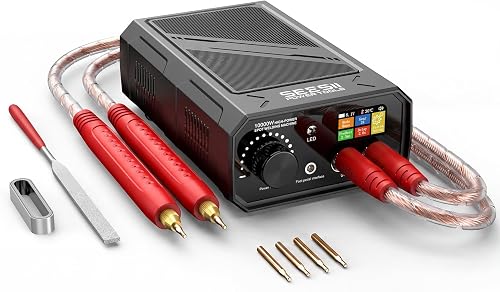
Best for: Users who want a clear, informative interface.
The SEESII 10KW Spot Welder uses a color LCD screen to show real-time voltage, which helps you track your welding quality. It offers 25 power levels, making it simple to match the heat to the thickness of your nickel strips.
Its compact design, with the longest side around 6.5 inches, makes it easy to store in a small workspace. While it’s powerful, it isn’t recommended for copper or aluminum materials due to their difficulty in welding.
Pros
- Clear color LCD display.
- Compact and portable size.
- Simple 25-level power adjustment.
Cons
- Not for copper or aluminum.
3. HD2 AWithZ Battery Spot Welder with Double-Ended & Replaceable Tips

Best for: Precision work on small batteries.
This welder features 90-level power control, giving you excellent precision for 18650 cells and phone batteries. The double-ended, replaceable tips are a smart addition that simplifies long-term maintenance.
Weighing only 140g, it’s highly portable for quick repairs on the go. This model isn’t suited for users who need to weld very thick steel or industrial-grade battery plates beyond 0.2mm.
Pros
- Precise 90-level power adjustment.
- Replaceable double-ended welding tips.
- Very lightweight at 140g.
Cons
- Limited to 0.2mm material thickness.
4. Battery Welding Nickel Strips

Best for: Large-scale battery pack projects.
These strips are 0.15mm thick and 7mm wide, which is a standard size for most lithium-ion battery assembly. With a 10-meter roll, you have plenty of material for multiple projects or repairs.
The nickel-plated surface is designed to balance conductivity and durability. Note that this is a consumable material, so ensure your welder is set to the correct gear to avoid burn-through.
Pros
- Generous 10-meter roll length.
- Strong conductivity and corrosion resistance.
- Suitable for 18650 and 21700 cells.
Cons
- Material thickness is fixed.
5. 100pcs 99.6% Pure Nickel Strips Nickel Tapes Nickel Sheet Soldering

Best for: Small, specific battery connector tasks.
These 99.6% pure nickel tabs are pre-cut to 25mm lengths, saving you time on measuring and cutting during assembly. They’re specifically shaped for 18650 and 21700 lithium battery packs.
Because the listing specifies no additional technical parameters, these are best for users who know exactly what size and purity they need for their specific build. They’re a simple, no-fuss solution for standard battery cell connections.
Pros
- 99.6% pure nickel composition.
- Pre-cut for immediate use.
- Ideal for 18650/21700 cells.
Cons
- No listed technical features.
How to Choose in Sixty Seconds
Which power settings should I prioritize?
Look for a model with adjustable power gears. Precise control prevents you from burning through thin nickel strips or failing to create a strong bond on thicker metal. Higher gear counts generally allow for finer tuning.
Does the welding mode matter?
Yes, dual-mode welders are more versatile. Automatic mode is great for fast, repetitive tasks, while foot pedal control gives you the stability needed for more complex or delicate welding positions on battery packs.
What should I check before buying?
Verify the maximum thickness of nickel the welder supports. Ensure your chosen strips match the welder’s capability. Following UL battery safety standards is essential when handling lithium-ion cells to ensure your custom builds remain stable and secure.
Related guides
Frequently Asked Questions
What does proper maintenance look like?
Most welders require you to keep the tips clean and free of oxidation. Periodically check if your tips are replaceable, like those on the AWithZ HD2, and swap them out when they show signs of wear.
Is the simplest welder enough for me?
Yes, if you’re only working on standard 18650 battery packs. Simple units like the Pure Nickel Soldering Tabs paired with a basic welder will handle most hobbyist tasks without the need for complex, high-power features.
What causes a weak weld?
A weak weld often results from incorrect power settings or poor contact between the tip and the strip. Always perform a test weld on a scrap piece of nickel to ensure the nugget formation is solid before working on your actual batteries.
What happens if the battery runs low?
Most portable welders have intelligent alerts to tell you when the voltage drops. Always charge your unit fully before starting a long session to ensure consistent power delivery and prevent potential welding quality issues.
Closing
The AWithZ Spot Welder is the best all-around choice for most builders, while the AWithZ HD2 Spot Welder is perfect for high-precision tasks. Check your battery dimensions, pick your strips, and start your project.

Hi, I’m Zachary Ford. I’m passionate about welding and dedicated to helping both beginners and experienced welders make informed decisions. I research, test, and write about welding helmets, welding machines, safety equipment, and essential workshop tools. My goal is to provide honest reviews, practical buying guides, and easy-to-follow tutorials that help you weld more safely, work more efficiently, and choose the right gear with confidence.