
A Homemade Custom Welding Table is more than a convenience—it directly affects weld accuracy, joint fit-up, and overall fabrication efficiency. Inconsistent surfaces, poor grounding, or lack of clamping options can lead to arc instability, distortion, and costly rework.
For welders working in small shops or on custom projects, a purpose-built table solves these issues by providing a flat, rigid, and adaptable workspace tailored to specific welding processes and material types.
Unlike off-the-shelf options, a custom-built table allows control over plate thickness, hole patterns, grounding points, and load capacity—critical factors for maintaining alignment and heat control during welding.
This becomes especially important when dealing with high amperage applications or precision assemblies where even minor misalignment can compromise weld integrity.
Understanding how to design and build the right table ensures better weld consistency, improved workflow, and long-term durability in real fabrication conditions.
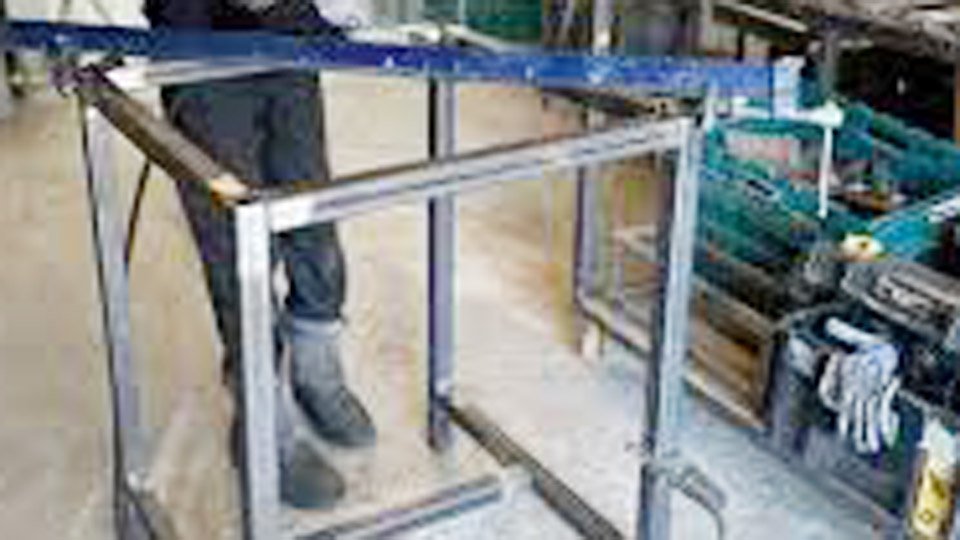
Image by zhouxianggroup
What Size Should Your Homemade Custom Welding Table Be?
Matching Top Surface Area to Typical Project Scales
Standard shop practice points to 4 ft × 6 ft or 4 ft × 8 ft as the sweet spot for most fabricators. A 4 × 6 ft top accommodates full-length truck frames or 8 ft rail sections with room for clamps on all sides. Smaller 3 × 5 ft tables work for motorcycle or light fab but limit simultaneous multi-part builds.
Larger than 4 × 8 ft demands reinforced framing and increases material cost without proportional gains unless you routinely handle 10 ft+ assemblies. Overhang of 2–3 in on all edges is non-negotiable for edge clamping without leg interference.
Establishing Working Height for Precision and Comfort
Set the finished table height at 36–40 in from floor to top surface. This aligns with elbow height for most adults during MIG or TIG work and keeps the weld pool at optimal viewing angle without back strain.
Measure your primary welder stance—add 1 in for shoe sole and ½ in for any anti-fatigue mat. Lower heights (34 in) suit heavy hammering; higher (42 in) favors detailed layout on thin sheet.
Planning Leg Configuration for Clamp Access and Stability
Position legs inset 4–6 in from each corner to leave full perimeter clear for C-clamps and dog-hole fixtures. Use four corner legs plus one center support on the long side for spans over 6 ft.
Cross-brace with X or K members at mid-height to eliminate twist under offset loads exceeding 500 lb. Casters rated 800 lb each (locking swivel type) add mobility without sacrificing level when parked.
Which Materials Deliver the Necessary Rigidity and Heat Resistance?
Top Plate Thickness and Grade Selection
Carbon steel plate (A36 or A572 Grade 50) at ⅜ in minimum thickness resists thermal bowing better than ¼ in under repeated 200 A MIG passes. At ½ in the table gains significant heat-sink mass, keeping surface temperature lower during long stringers.
Avoid mild sheet thinner than 5/16 in—it distorts permanently when heated above 800 °F. Source plate from scrap yards or mill drops; verify flatness with straightedge before purchase—warped plate cannot be corrected after welding.
| Component | Recommended Thickness / Spec | Load / Heat Performance | Notes |
|---|---|---|---|
| Tabletop | ⅜–½ in plate (A36/A572) | 300–800 lb distributed; 200 A sustained | ½ in for heavy structural work |
| Frame tubing | 2 × 3 × ¼ in or 60 × 40 × 4 mm box | Prevents >0.020 in deflection at center | Wall ≥0.120 in for 6 ft+ spans |
| Legs | 2 × 2 × 0.188 in square tube | 1,200 lb total capacity with bracing | 3 in square for 8 ft tables |
| Lower shelf | 40 × 5 mm flat bar slats @ 40 mm gap | Tool storage + light parts | Expanded metal alternative |
Frame and Leg Wall Thickness Guidelines
2 × 2 in square tube with 0.188–0.250 in wall provides torsional rigidity without excessive weight. For tables over 6 ft long, step up to 3 × 2 in C-channel or 60 × 40 × 4 mm rectangular tube. Thinner 0.120 in walls flex noticeably under 400 lb offset loads. Always run full-penetration fillet welds at leg-to-frame junctions—skip tacks alone.
Surface Preparation Requirements Before Assembly
Grind mill scale from all mating surfaces with 80-grit flap disc. Degrease with acetone or brake cleaner. Flatness tolerance target: 0.010 in across entire top after final weld. Pre-drill any grid holes in the plate before welding to the frame—drilling post-assembly risks binding the bit in a stressed assembly.
How Do You Add a Professional Grid System for Fixturing?
Selecting Hole Diameter and Spacing Standards
16 mm (⅝ in) diameter holes on 50 mm (2 in) centers is the current industry benchmark. This spacing accepts nearly all commercial hold-down clamps, stops, and 3D welding jigs. Drill or plasma-cut holes in a true grid pattern using a CNC or careful layout with digital calipers.
Offset the first row 25 mm from edges to maintain edge strength. Avoid 4 in centers unless your work is exclusively heavy structural—2 in grid supports smaller fixtures and tighter setups.
Integrating Slots and Modular Mounting Points
Cut ½ in × 4 in slots along two opposite edges for sliding T-track clamps. Weld ½ in nuts flush to the underside at strategic points for vise or rotisserie mounts. Add perimeter threaded inserts (M12) counterbored below surface for quick bolt-on accessories. These features turn the table into a true fixture station rather than a simple flat plate.
What Is the Correct Build Sequence to Prevent Warpage?
Fabricating and Squaring the Base Frame
Cut all frame members to length with a cold saw or band saw for square ends. Tack the rectangle on a certified flat surface (granite table or verified plate). Measure diagonals—equal within 1/16 in confirms squareness. Weld in short 1 in stitches alternating sides and corners, allowing 30–60 seconds cool time between passes. This distributes heat evenly and keeps distortion under 0.015 in.
Securing the Top Plate with Minimal Distortion
Place the plate upside down on the frame. Tack every 6–8 in around the perimeter first, then stitch inward in a star pattern. Use ⅛ in E7018 or ER70S-6 wire at 140–160 A with 75/25 gas. Alternate sides every three tacks.
Full weld only after all tacks cool to room temperature. If any crown appears, apply heat to the high side with an oxy torch and peen immediately with a hammer while hot.
Adding Mobility Options and Leveling Mechanisms
Bolt heavy-duty casters through reinforced plates welded to leg bottoms. Install four leveling feet at corners for final height adjustment once parked. Shim legs with ⅛ in stainless washers if minor twist remains after welding.
Which Welding Techniques Ensure Table Longevity?
Stitch and Alternate Welding Patterns
Never run continuous beads longer than 4 in on the top plate. Alternate direction and location—weld one corner, move to opposite, then adjacent. This counteracts shrinkage forces. Total weld time per section should stay under 20 seconds before cooling.
Post-Build Flatness Verification and Correction
Lay a precision straightedge across diagonals and both axes. Acceptable tolerance is 0.020 in maximum deviation. For minor high spots, heat the crown to dull red and quench with wet rag while applying downward pressure. Grind high welds flush only after flatness is confirmed—grinding first hides problems that reappear under heat.
How Can You Customize the Table for Your Specific Shop Tasks?
Incorporating Tool Storage and Accessory Mounts
Weld a lower shelf of 40 × 5 mm flat bar spaced 40 mm apart. Add vertical tubes for angle grinder holders and cable hooks. Mount a ½ in plate strip along one long edge for magnetic square storage.
Adding Electrical Grounding and Cable Routing
Weld multiple ½ in ground lugs around the perimeter. Run ½ in conduit along the underside for welder power and ground leads. This keeps cables off the floor and ensures consistent low-resistance earth regardless of workpiece location.
How Do You Validate Performance Before Putting It Into Service?
Load the center with 400 lb of evenly distributed weight and measure deflection with a dial indicator—target less than 0.015 in. Run a 10-minute continuous 200 A bead down the center and check for bowing after cool-down. Re-level and re-check flatness. Once it passes, the table is ready for daily use.
Final Thoughts
The decisions that matter most are plate thickness matched to your heaviest work, 2 in grid spacing for fixture compatibility, and disciplined stitch welding to preserve flatness. Choose ½ in plate and 0.250 in wall frame if you weld structural steel daily; ⅜ in plate and 0.188 in tube suffice for general fab and saves 30 % on material.
Either way, the table you build will outperform off-the-shelf models because every dimension serves your workflow instead of a generic catalog spec.
The advanced insight: a true custom table becomes an extension of your measuring system—once flat within 0.2 mm per meter and drilled to fixture standards, layout time drops by half because you clamp directly to known datums instead of fighting gravity and flex.
FAQs
What thickness of steel plate is best for a homemade custom welding table top?
⅜ in minimum for general use; step to ½ in if you regularly weld material thicker than ¼ in or run long beads on heavy sections. Anything under 5/16 in warps permanently under normal shop heat cycles.
How do you keep a DIY welding table flat during construction?
Tack in short stitches, alternate sides and corners, allow full cool-down between passes, and never run continuous beads longer than 4 in. Verify diagonals and surface with a straightedge after every major weld group.
What hole size and spacing should I use for a fixture-ready welding table?
16 mm (⅝ in) diameter holes on 50 mm (2 in) centers. This matches the majority of commercial 3D welding clamps and stops while keeping the plate structurally sound.
Can I build a professional-grade welding table on a hobbyist budget?
Yes—under $400 using scrap-yard plate and new tubing if you handle the cuts and welds yourself. The key expense is the top plate; everything else can use standard structural shapes. Focus budget on plate thickness and accurate grid drilling rather than fancy powder coat.

Hi, I’m Zachary Ford. I’m passionate about welding and dedicated to helping both beginners and experienced welders make informed decisions. I research, test, and write about welding helmets, welding machines, safety equipment, and essential workshop tools. My goal is to provide honest reviews, practical buying guides, and easy-to-follow tutorials that help you weld more safely, work more efficiently, and choose the right gear with confidence.