
As an Amazon Associate, we earn from qualifying purchases. This post contains affiliate links – if you buy through them, we may earn a commission at no extra cost to you.
Finding the right spot welder accessories often feels like a guessing game when you’re staring at dozens of similar-looking parts. Whether you’re building a custom battery pack or fixing a dent in your car, the quality of your consumables directly changes the safety and reliability of your work. Balance high-conductivity materials against the mechanical fit of your machine.
1. SHONAN Nickel Strip

Right for: Builders creating custom lithium-ion battery packs for e-bikes or tools.
This 99.6% pure nickel strip prevents corrosion.
What works:
- High 99.6% purity for better conductivity
- Corrosion resistance for long-term reliability
- Comes in a long 32-foot roll
- Suitable for various battery types
Where it gives ground:
- Requires careful current planning by the user
- Magnetic properties may affect some delicate tools
Skip it if: You need a wider or thicker strip for extremely high-amperage industrial applications.
2. QWORK Dent Puller Rings

Right for: Auto body shop enthusiasts performing sheet metal dent repairs.
These copper puller rings provide the strength needed to pull concave panels into shape.
What works:
- Durable copper construction for strength
- Large set of 100 pieces
- Designed for standard spot welding guns
- Useful for various sheet metal repairs
Where it gives ground:
- Requires a compatible stud welding machine
- Specific dimensions must match your equipment
Skip it if: You’re working on heavy-gauge industrial steel rather than standard car panels.
3. Shkalacar Integrated Type Spot Welding Pen

Right for: DIY builders who want a more ergonomic, one-handed welding experience.
This pen features an integrated limit switch, removing the need for a foot pedal. The handle includes dual springs, allowing each welding tip to expand and contract independently for better contact.
What works:
- Integrated design for one-handed use
- Built-in limit switch replaces foot pedals
- Independent spring movement for better contact
- Thick copper construction for efficiency
Where it gives ground:
- Designed specifically for 18650 battery welders
- Not intended for non-battery welding tasks
Skip it if: Your specific welder requires a specialized proprietary trigger or pedal system.
4. Heltec Adjustable Battery Welding Fixture
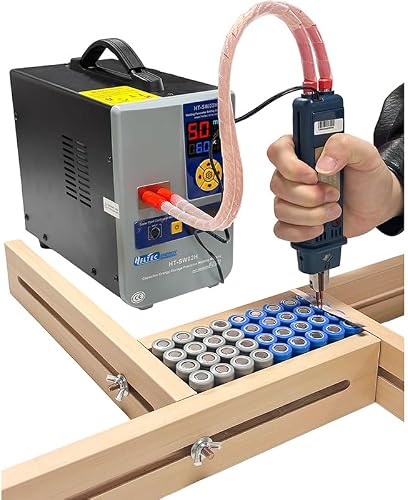
Right for: Anyone building large or complex battery packs who needs consistent alignment.
This modular fixture holds various cylindrical battery cells like 18650 or 21700 sizes.
What works:
- Supports many cylindrical battery sizes
- Adjustable layout for different pack sizes
- Stable positioning improves welding precision
- Simple to assemble and use
Where it gives ground:
- Wood material is less rigid than metal
- Requires manual assembly before first use
Skip it if: You’re only working on very small, fixed-size packs and don’t need modularity.
5. 10Pcs Copper Spot Welding Pins

Right for: Maintenance of handheld spot welders used for small-scale metal fabrication.
These 10-piece copper sets replace worn welding tips.
What works:
- Good conductivity from copper construction
- Focused tip for accurate welds
- Includes 10 pins for multiple replacements
- Easy to install in handheld welders
Where it gives ground:
- Not suited for heavy-duty industrial machines
- Must verify diameter against your welder
Skip it if: Your welder uses proprietary, non-standard tips that don’t accept 3 mm pins.
How to Think Before You Choose
Material Conductivity and Purity
Choose copper for conductivity and nickel for battery tabs. Nickel, however, is the standard for battery tabs because it resists corrosion and is easier to spot weld to battery cells. Check for high-purity nickel to avoid connection failures.
Mechanical Fit and Compatibility
Welding pens and pins are machine-specific. A 3 mm pin won’t work in a machine designed for a different diameter, and a welding pen’s trigger system may not be compatible with all control boards. Ensure your jig covers the specific cell sizes you plan to use.
Ergonomics versus Automation
Deciding between a standard pen and an integrated one with a limit switch changes your workflow. Integrated pens allow you to keep one hand free to hold cells in place, which is a significant advantage during the welding process. However, if your welder is already set up to work best with a foot pedal, adding an integrated pen might introduce compatibility issues.
Who Should Skip These Altogether
- Anyone who doesn’t own a spot welder and only needs to join wires occasionally should use a standard soldering iron instead.
- People who have never worked with lithium-ion batteries should avoid DIY pack building due to the risks of fire or short circuits.
- If your current welding setup is still producing clean, strong welds, you don’t need replacement pins or pens.
- Those who only need to fix one small dent in a car might find that hiring a professional is more efficient than buying specialized puller equipment.
Most buyers will find that the SHONAN Nickel Strip is the essential starting point for battery work, while the Shkalacar Spot Welding Pen offers the best upgrade for those struggling with manual triggers. Always double-check your machine’s manual for pin dimensions before ordering any replacement tips or pens.
Frequently Asked Questions
How do I know if these pins will fit my welder?
You must verify the diameter of your current pins using a pair of calipers. The Copper Spot Welding Pins are 3 mm in diameter, but many handheld welders use proprietary tips. Always check your welder’s original manual or the manufacturer’s website for the exact pin specifications before making a purchase.
Can I use these nickel strips for any battery type?
The SHONAN Nickel Strip is designed for 18650 and similar lithium-ion or nickel-metal hydride battery packs. Its 99.6% purity ensures low resistance and prevents overheating. Consult your manufacturer’s guidelines if using other battery chemistries.
Is the wooden welding fixture safe to use?
The Heltec Battery Welding Fixture is made from non-conductive wood, making it safe for use around battery terminals. It eliminates the risk of accidental short circuits caused by metal jigs.
How often should I replace my welding pins?
Replace your pins when the tips become pitted or flattened. Pitted pins cause inconsistent electrical contact, leading to weak welds that fail under load.
What should I check before using the dent puller rings?
Before using QWORK Dent Puller Rings, ensure your spot welder is set to the correct mode for stud welding. Test your settings on scrap metal first.
Conclusion
Investing in quality parts makes a world of difference, so don’t settle for cheap replacements that burn out quickly. Once you’ve updated your setup, try running a few test welds on scrap metal to dial in your settings. You’ll find that having the right gear makes every project feel much smoother.

Hi, I’m Zachary Ford. I’m passionate about welding and dedicated to helping both beginners and experienced welders make informed decisions. I research, test, and write about welding helmets, welding machines, safety equipment, and essential workshop tools. My goal is to provide honest reviews, practical buying guides, and easy-to-follow tutorials that help you weld more safely, work more efficiently, and choose the right gear with confidence.