
When you’re tasked with joining 30 mm or thicker steel plates on a tight deadline, whether it’s a pressure vessel seam or a bridge girder, manual or semi-automatic processes eat up hours in multiple passes while risking inconsistent penetration and slag inclusions.
Submerged arc welding (SAW) solves this by delivering deposition rates of 8–20 kg/h with single-pass capability on thick sections, but the real question is exactly where submerged arc welding is used and whether your job justifies the setup.
Professionals choose SAW when productivity, repeatability, and weld quality on long, straight seams in flat or horizontal positions outweigh the need for portability or out-of-position work. Understanding its targeted applications prevents wasted time and equipment investment on jobs where it underperforms.
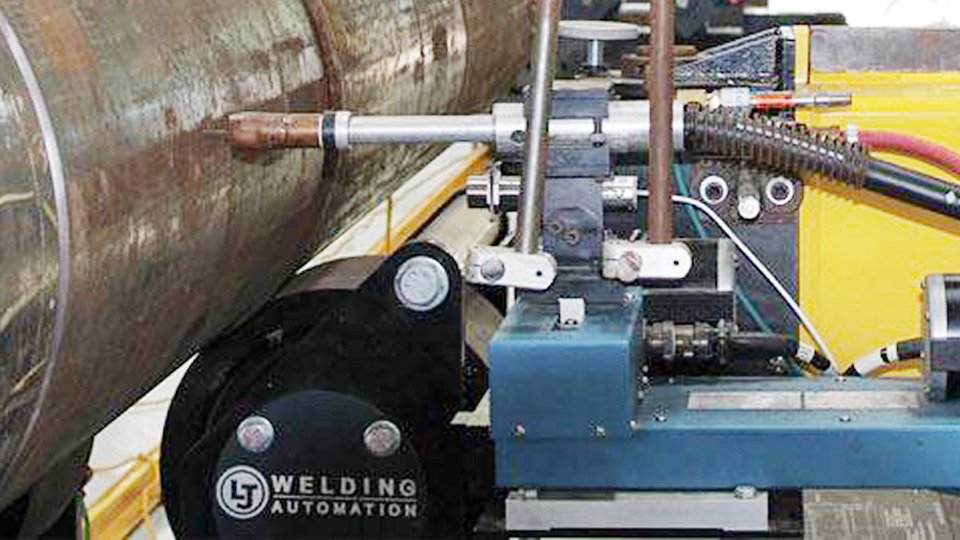
Image canadianmetalworking
Industries Where Submerged Arc Welding Delivers Maximum Productivity
SAW dominates environments demanding high-volume, high-thickness welding with minimal defect rates. Its flux blanket shields the arc completely, producing clean beads with deep penetration and low hydrogen levels—critical for code-compliant work in regulated sectors.
Shipbuilding and Marine Fabrication
Hull plating, deck beams, and longitudinal stiffeners on vessels use SAW almost exclusively for plates 20–80 mm thick. Yards rotate sections on positioners for circumferential seams on cylinders up to 3–4 m diameter, achieving travel speeds of 300–500 mm/min at 600–1200 A.
This process replaces multi-pass FCAW on framing girders, cutting labor by 60–70% while meeting ABS or DNV impact requirements at -40°C or lower.
Pressure Vessel and Storage Tank Manufacturing
ASME Section VIII vessels and API 650 storage tanks rely on SAW for longitudinal and circumferential seams on shells 25–150 mm thick. Fabricators run tandem heads on rotating positioners at 400–900 A per wire, producing full-penetration joints in 1–2 passes.
Flux recovery systems recycle 90%+ of the granular flux, keeping costs low on repeat orders for boilers, heat exchangers, and chemical reactors.
Pipeline and Large-Diameter Pipe Fabrication
Longitudinal seams on API 5L X60–X80 pipe (300–1500 mm diameter) use multi-wire SAW setups with speeds exceeding 1 m/min. Offshore spool pieces and onshore transmission lines benefit from consistent chemistry control, minimizing post-weld heat treatment time. Circumferential welds require pipe rotation; diameters below 200 mm risk flux runoff and poor bead shape.
Structural Steel, Bridges, and Offshore Platforms
Heavy beams, columns, and truss members in high-rise construction or bridge fabrication use SAW for fillet and butt welds on 25–100 mm plate. Offshore wind turbine monopiles and oil-rig jacket legs demand the process for its ability to handle high-strength S460–S690QL steels with CTOD-tested toughness. Piling sections up to 100 mm thick are welded in single passes on automated gantries.
Heavy Machinery and Power Generation Components
Mining equipment frames, crane booms, and wind-tower sections turn to SAW for its high deposition on low-alloy steels. Power plants use it for membrane wall panels and turbine casings where long, straight runs justify automated tractors.
Material Thickness and Joint Designs That Favor Submerged Arc Welding
SAW becomes the economical choice once base metal thickness exceeds the point where other arc processes require excessive passes.
Optimal Thickness Ranges and Single-Pass Capabilities
Single-pass butt welds with proper edge preparation reach 6–25 mm reliably. Above 25 mm, multi-pass or tandem configurations handle up to 150 mm without preheat in many carbon steels. Typical ranges:
| Thickness (mm) | Recommended Wire Diameter (mm) | Current Range (A) | Typical Travel Speed (mm/min) | Deposition Rate (kg/h) |
|---|---|---|---|---|
| 6–12 | 2.0–3.2 | 300–600 | 400–600 | 4–8 |
| 12–25 | 3.2–4.0 | 500–900 | 300–500 | 8–12 |
| 25–50 | 4.0–5.0 | 700–1200 | 250–400 | 12–18 |
| 50+ (multi-pass) | 4.0–6.4 | 900–1600 | 200–350 | 15–25+ (tandem) |
These values assume DCEP polarity on carbon steel with neutral or slightly active flux. Adjust downward 10–15% for stainless to control heat input.
Butt Joints vs Fillet Welds in SAW Applications
Butt joints with 60–70° included angles and 2–4 mm root gaps maximize penetration on plates over 20 mm. Fillet welds on T-joints or lap joints use 45–60° electrode angles and 1–1.5 inch stick-out to avoid undercut. Joints must allow flux containment; open gaps or irregular edges cause slag entrapment.
Key Process Parameters for Successful Submerged Arc Welding Deployments
Parameter selection directly controls penetration, bead shape, and mechanical properties.
Selecting Current, Voltage, and Travel Speed
Current primarily drives deposition and penetration: 1 A ≈ 0.01–0.015 kg/h per wire. Voltage (28–36 V typical) controls arc length and bead width—higher values flatten the bead but risk undercut.
Travel speed balances heat input; too slow causes excessive reinforcement, too fast risks lack of fusion. Example for 25 mm carbon steel butt weld: 750 A, 32 V, 350 mm/min yields 12 kg/h with 4 mm wire.
Polarity matters: DCEP maximizes penetration; variable-balance AC (70–80% DCEP) optimizes toughness in high-strength steels while maintaining deposition.
Wire Diameter and Flux Selection Strategies
Larger wires (4–6 mm) suit high-current, high-deposition jobs but require stiffer feeders. Common carbon steel wires include EM12K (AWS A5.17) paired with F7A2 or F7P2 fluxes for as-welded or PWHT conditions.
Stainless applications use EQ308L or EQ347 with basic or neutral fluxes to limit carbon pickup. Agglomerated fluxes offer better slag release on thick sections; fused fluxes provide smoother beads at higher speeds.
Automated Setups Versus Manual Adjustments in Large-Scale Projects
Most SAW runs on tractors, gantries, or column-and-boom systems with CNC controls for repeatable voltage, current, and speed. For one-off structural work, operators adjust stick-out (25–50 mm) and flux depth (25–50 mm) manually while monitoring bead profile.
Twin-wire or tandem heads increase deposition 50–100% without raising heat input per wire. Flux recovery units pay for themselves after 200–300 kg of welding.
When to Choose Submerged Arc Welding Over MIG or Flux-Cored Arc Welding
MIG or FCAW win on thin material (<6 mm), field work, or vertical positions. SAW outperforms once joint length exceeds 2–3 m and thickness hits 20 mm: deposition doubles, spatter drops to near zero, and operator exposure to fumes decreases.
Setup time favors MIG for prototypes under 10 m total weld length. For production runs of identical vessels or beams, SAW’s lower per-meter cost and fewer defects justify the initial investment.
Limitations: Scenarios Where Submerged Arc Welding Falls Short
SAW is position-restricted and setup-intensive.
Position and Geometry Constraints
Flux flows under gravity, confining the process to flat (1G/1F) or horizontal (2G/2F) positions. Vertical or overhead welding causes slag runoff and porosity. Small-diameter circumferential welds (<200 mm) lose flux containment and produce concave beads.
Material and Scale Limitations
Thin sections risk burn-through or distortion from the large weld pool. Aluminum and copper alloys lack compatible fluxes for reliable arc stability. Short, intermittent welds or complex 3D geometries increase downtime from flux loading and recovery.
Advanced Configurations for Enhanced Performance
Twin-wire setups (two wires in one pool at same potential) or tandem (separate power sources, leading wire DCEP for penetration, trailing DCEN or AC for fill) push travel speeds to 1–2 m/min on plate. Strip cladding variants restore worn surfaces on rolls or valves with minimal dilution (under 10%).
Modern inverters with waveform control let operators dial exact DCEP/D CEN balance for optimized toughness without sacrificing speed.
Choosing submerged arc welding correctly comes down to scale, thickness, and position. Match your project to long, flat or horizontal seams on 20 mm+ steel and you’ll see deposition rates and repeatability that no other arc process matches.
On the right job, tandem SAW with variable AC polarity delivers both productivity and Charpy values exceeding code minimums by 50%—the pro-level edge that separates high-output shops from the rest.
FAQs
What is the minimum thickness for submerged arc welding?
Typically 6 mm for reliable single-pass welds. Below this, heat input causes burn-through or distortion; switch to MIG or GTAW.
Can submerged arc welding be used on stainless steel?
Yes, with matching EQ3xx series wires and neutral or basic fluxes. Control heat input below 2.0 kJ/mm and use low-carbon variants to avoid sensitization.
Is submerged arc welding portable for field repairs?
No. The flux delivery system, tractor, and recovery unit require shop or fixed-position setups. Field jobs use FCAW or SMAW instead.
How does submerged arc welding compare to electroslag welding for thick plates?
SAW handles up to 150 mm with multiple passes and offers better control over chemistry and toughness. Electroslag is faster for vertical joints over 50 mm but produces coarser grain structure and requires more post-weld treatment.

Hi, I’m Zachary Ford. I’m passionate about welding and dedicated to helping both beginners and experienced welders make informed decisions. I research, test, and write about welding helmets, welding machines, safety equipment, and essential workshop tools. My goal is to provide honest reviews, practical buying guides, and easy-to-follow tutorials that help you weld more safely, work more efficiently, and choose the right gear with confidence.