
Welders frequently encounter projects where conventional TIG leaves excessive distortion on thin stainless sheets or requires multiple slow passes on quarter-inch plate, driving up time and post-weld cleanup. Plasma arc welding advantages and disadvantages enter the equation precisely at these decision points.
The process constricts the arc through a water-cooled copper nozzle, delivering energy densities far higher than standard GTAW while maintaining exceptional control. This matters because it directly affects penetration depth, heat input, travel speed, and final part integrity, critical factors when material costs are high and tolerances tight.
For DIY fabricators building custom exhausts, students learning advanced processes, or professionals in aerospace and pipe fabrication, understanding these trade-offs determines whether the switch from TIG pays off in productivity or creates workflow bottlenecks.
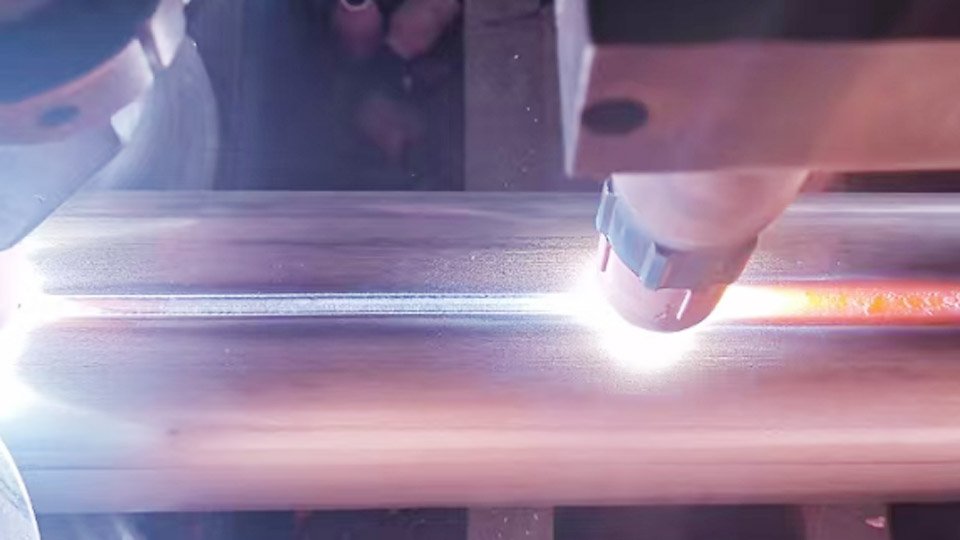
Image ourcladding
Plasma Arc Welding Process Fundamentals That Drive Real Results
Arc Constriction Mechanism and Energy Density Differences
The plasma arc forms between a tungsten electrode housed inside the torch body and the workpiece. Inert plasma gas—typically argon—passes through the arc and exits a fine-bore copper nozzle at high velocity. This constriction squeezes the arc column, raising current density and temperature to approximately 28,000 °C at the core, compared to TIG’s roughly 19,000 °C.
The result is a stiff, columnar jet that transfers heat over a narrow footprint rather than a diffuse cone. Energy density reaches levels between GTAW/GMAW and laser/electron beam processes, enabling deeper penetration with lower overall heat input per linear inch.
In practice, this means less base metal melting outside the joint line and reduced risk of burn-through on materials with high thermal conductivity.
Three Operational Modes and Their Thickness Capabilities
PAW operates in three distinct modes defined by current range and plasma gas flow. Microplasma (0.1–15 A) produces a stable columnar arc tolerant of standoff distances up to 20 mm, ideal for sheets down to 0.1 mm thick without filler.
Medium-current melt-in mode (15–200 A) behaves like enhanced TIG but with greater penetration from elevated plasma flow, handling up to 6 mm in many alloys. Keyhole mode (>100 A) generates a through-hole that the molten pool backfills under surface tension, delivering full penetration in single pass on stainless steel up to 10 mm (typically limited to 6 mm without joint preparation).
Each mode requires precise matching of nozzle bore diameter to current and gas flow; undersized nozzles erode rapidly, while oversized ones lose constriction and stability.
Measurable Advantages in Penetration, Speed, and Quality
Keyhole Mode Single-Pass Efficiency for Thicker Sections
Keyhole PAW eliminates the need for multi-pass welding on sections that would demand three or more TIG runs. On ¼-inch (6 mm) stainless pipe, travel speeds routinely double those of TIG while achieving complete root fusion without backing gas in many setups.
The plasma jet melts the leading edge and forces molten metal rearward, creating a narrow bead with depth-to-width ratios often exceeding 3:1. This single-pass capability cuts filler consumption by up to 50 % and reduces labor hours in high-volume tube production or pressure vessel work.
Automation compatibility further amplifies the gain: mechanized systems maintain consistent standoff and speed where manual TIG operators tire and vary technique.
Reduced Heat-Affected Zone and Distortion Control Data
Concentrated heat input produces HAZ widths typically 30–50 % narrower than equivalent TIG welds. On 3 mm 304 stainless, PAW keyhole limits HAZ to under 1.5 mm versus TIG’s 2.5–3 mm, preserving base metal mechanical properties and minimizing angular distortion.
Thin sheets (0.5–2 mm) require no preheat because the rapid, localized energy avoids warping that forces TIG users to clamp or fixture heavily.
Lower distortion also simplifies fit-up for subsequent machining or assembly, especially in aerospace turbine blades or medical instrument frames where dimensional accuracy is non-negotiable. Reduced spatter and cleaner bead surfaces further cut post-weld grinding time.
Arc Stability and Automation Potential
The constricted plasma column resists deflection from magnetic fields or drafts far better than TIG’s diffuse arc. Arc length tolerance reaches 20 mm in microplasma without wander, allowing operators to focus on torch travel rather than constant voltage correction.
This stability translates directly to repeatable parameters in robotic cells, where PAW torches integrate with vision systems for seam tracking.
Electrode life extends dramatically—often 8 hours of continuous operation versus frequent sharpening in TIG—because the electrode sits protected inside the torch body away from atmospheric contamination. These factors combine to boost uptime in production environments where downtime costs exceed equipment premiums.
Critical Disadvantages Impacting Daily Operations
Upfront and Ongoing Equipment Costs
PAW power supplies, torches, water-cooling systems, and gas consoles typically cost 2–3 times more than comparable TIG setups for 150–200 A capacity. A basic manual system starts around the price of a premium TIG machine plus console, while full mechanized packages add significant console and fixture investment.
Nozzle and orifice replacements occur more frequently due to erosion at high plasma flows, and water-cooling maintenance adds routine downtime. For small shops or hobbyists running occasional jobs, the capital outlay rarely amortizes unless volume justifies the throughput gains.
Maintenance requires qualified technicians; torch failure mid-weld poses safety risks that demand extra protective circuits and training.
Torch Design Limitations for Manual Welding
The water-cooled torch body is bulkier than gas-cooled TIG torches, restricting access in tight corners or complex geometries common in custom fabrication. Manual operators lose the fine feel of lighter TIG torches, and the added weight accelerates fatigue during long sessions.
Keyhole mode demands mechanization for most thicknesses over 3 mm because precise control of plasma flow and travel speed prevents undercut or keyhole collapse.
Positional welding (vertical or overhead) remains challenging even with pulsing; flat-position work dominates practical applications. These physical constraints push many users toward hybrid approaches rather than full conversion.
Skill, Maintenance, and Environmental Factors
Operators need specialized training to balance plasma gas flow (±0.14 L/min tolerance in keyhole), current slope, and filler addition to avoid defects. Incorrect parameters instantly destroy nozzles or produce porosity. The process generates noise levels approaching 100 dB at the torch, requiring hearing protection and often enclosure for shop compliance.
Ultraviolet radiation intensity exceeds TIG, and strict shielding gas purity (high-purity argon with 2–5 % hydrogen) is mandatory to prevent oxidation.
Not all materials respond equally—high-thermal-conductivity alloys like copper or magnesium show limited benefit and higher risk of burn-through. These factors elevate the barrier for students or part-time fabricators compared to straightforward TIG.
Optimizing PAW Parameters for Consistent Welds
Current Selection Across Modes and Materials
Current choice dictates mode and thickness capability. Microplasma below 15 A suits 0.1–2.5 mm stainless or titanium with minimal HAZ. Medium-current 50–150 A handles melt-in on 3–6 mm carbon or stainless steel. Keyhole begins reliably above 100 A and peaks around 200–400 A for 6–10 mm single-pass penetration in flat position.
For 304 stainless at 6 mm, typical settings run 140–180 A with travel speeds of 300–500 mm/min—roughly twice TIG rates. Pulsing (peak/base current ratios of 2:1) improves control on thinner sections or when bridging gaps up to 0.5 mm.
Plasma Gas Flow and Nozzle Configuration Essentials
Plasma gas flow (argon primary) controls constriction and keyhole formation. Typical rates range 1.5–4 L/min; keyhole demands tight ±0.14 L/min accuracy to prevent molten metal ejection or incomplete penetration. Nozzle bore diameter must match current: 0.8–1.2 mm for micro, up to 2.5 mm for higher currents.
Larger bores reduce velocity and stability; smaller ones accelerate erosion. Helium additions increase energy but lower nozzle current rating and complicate keyhole stability due to lower gas mass.
Shielding Gas Mixtures for Specific Alloys
Shielding gas (argon + 2–5 % hydrogen) protects the weld pool while the plasma jet does the melting. Hydrogen additions enhance fluidity on stainless and nickel alloys but are avoided on carbon steel to prevent hydrogen cracking.
Flow rates of 15–25 L/min provide adequate coverage without turbulence that entrains air. For titanium, pure argon or argon-helium blends minimize embrittlement. Precise flow control via dual-gas consoles prevents porosity; any deviation above 5 % hydrogen risks cracking in susceptible alloys.
| Mode | Current (A) | Thickness (mm) | Typical Plasma Gas Flow (L/min) | Travel Speed (mm/min) | Primary Use Case |
|---|---|---|---|---|---|
| Microplasma | 0.1–15 | 0.1–2.5 | 0.5–1.5 | 200–600 | Thin sheet, wire, electronics |
| Melt-in | 15–200 | 2–6 | 1.5–3.0 | 150–400 | Medium plate, manual alternative to TIG |
| Keyhole | >100 | 6–10 | 2.5–4.0 | 300–800 | Single-pass pipe, flat position |
Material and Application Decisions Where PAW Excels or Falls Short
Performance on Stainless, Titanium, and Aluminum
Stainless steels and titanium benefit most from PAW’s narrow HAZ and deep penetration. Aerospace ducting and medical implants achieve radiographic-quality welds with minimal post-processing. Aluminum requires careful hydrogen control to avoid porosity, yet keyhole speeds still outperform TIG on 4–8 mm plate.
Non-ferrous alloys with moderate thermal conductivity see the greatest productivity lift; high-conductivity copper shows marginal gains and higher burn-through risk, making TIG preferable for thin copper work.
Position and Fit-Up Constraints in Shop Environments
PAW demands excellent joint fit-up—gaps over 0.5 mm collapse the keyhole or cause undercut. Flat and horizontal positions dominate because gravity assists pool flow in keyhole mode; vertical or overhead work requires current pulsing and filler addition, reducing speed advantages.
Manual fit-up variations common in repair or prototype work favor TIG’s forgiveness. In production with CNC fixturing and laser seam tracking, these constraints disappear and PAW’s advantages compound.
Cost-Benefit Evaluation for Different Welder Levels
Break-Even Analysis for Hobbyists and Professionals
Hobbyists welding under 10 hours monthly rarely recover the 2–3× equipment premium through speed alone; TIG remains the practical choice for occasional precision work. Students gain deeper process understanding by mastering PAW parameters on school equipment but face steep learning curves without instructor guidance.
Professionals in high-volume stainless tube or aerospace shops break even within 6–12 months via reduced labor and rework. Automation integration further shortens payback when annual throughput exceeds 500 linear meters of critical joints.
Integration with Existing TIG Setups
Many power sources accept plasma consoles as add-ons, allowing shops to retain TIG torches for detail work while deploying PAW for production runs. Shared gas infrastructure and training programs minimize duplication. The decision hinges on workload split: if 70 % or more of welding involves 3 mm+ stainless or titanium requiring single-pass integrity, PAW upgrades deliver measurable ROI through faster cycle times and consistent quality.
Decision-making summary for choosing correctly
Plasma arc welding rewards operations where single-pass deep penetration, minimal distortion, and high automation potential offset higher capital and training costs—typically in controlled production environments on stainless, titanium, or aluminum thicknesses from 3–10 mm. For thin-sheet micro work or variable shop repairs, TIG’s simplicity and lower entry barrier still win.
The advanced insight professionals leverage is combining current pulsing with real-time plasma flow feedback in automated cells; this closes keyholes on circumferential pipe joints without defects, achieving radiographic acceptance rates above 98 % while maintaining travel speeds that push overall fabrication throughput 40–60 % higher than optimized TIG lines.

Hi, I’m Zachary Ford. I’m passionate about welding and dedicated to helping both beginners and experienced welders make informed decisions. I research, test, and write about welding helmets, welding machines, safety equipment, and essential workshop tools. My goal is to provide honest reviews, practical buying guides, and easy-to-follow tutorials that help you weld more safely, work more efficiently, and choose the right gear with confidence.