
Choosing the right welding process directly affects weld quality, productivity, and overall cost. When evaluating submerged arc welding advantages and disadvantages , the decision often comes down to balancing high deposition rates and deep penetration against limitations in flexibility and setup.
In real fabrication environments, especially with thick materials, factors like heat input, arc stability, slag control, and distortion can determine whether a process improves efficiency or creates rework and inspection issues.
Submerged arc welding (SAW) is widely used in heavy fabrication for its ability to deliver consistent, high-quality welds with minimal spatter. However, it also requires specific positioning, flux handling, and equipment investment that may not suit every application.
Understanding where SAW performs best, and where it introduces constraints, is critical for selecting the right process. This analysis will help clarify how these trade-offs impact real-world welding performance and production outcomes.
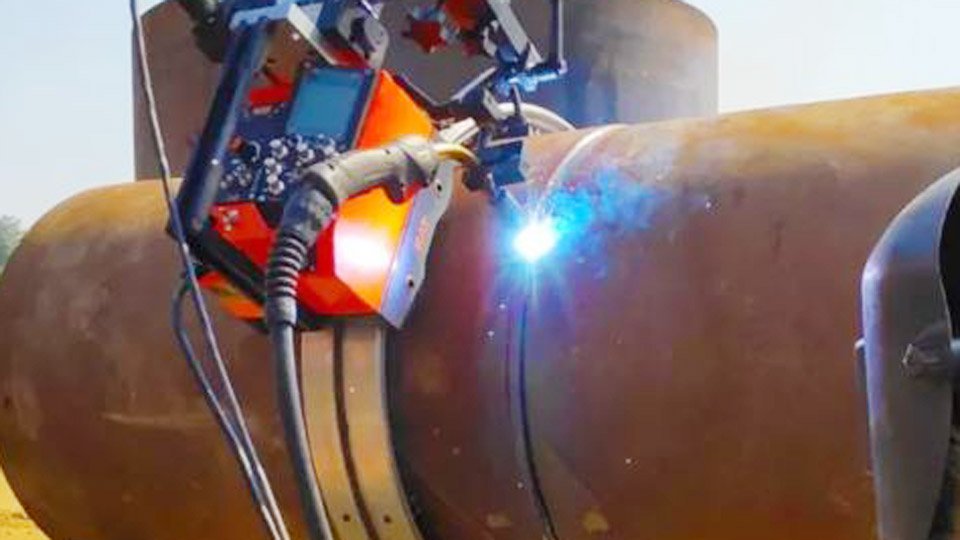
Image senlisweld
How Submerged Arc Welding Mechanics Enable Superior Productivity
Flux Blanket Dynamics and Arc Submersion Effects
The granular flux in SAW melts under arc heat to form a conductive slag layer that completely covers the weld pool. This blanket shields the molten metal from atmospheric oxygen and nitrogen while stabilizing the arc through ionized flux particles.
Arc voltage typically sits between 28-35 V, creating a stable, submerged plasma column that transfers energy directly into the workpiece without visible spatter or radiation loss. Resulting thermal efficiency reaches 90% plus, far higher than open-arc processes where heat dissipates into the air. Slag solidifies with low adhesion, allowing easy removal after cooling without aggressive chipping.
Wire Feed and Power Source Configurations
Continuous electrode wire feeds at rates tied to constant-voltage or constant-current power sources, typically DC electrode positive for deeper penetration or AC in multi-wire setups to balance heat input. Wire diameters range from 3/32 in. (2.4 mm) for lighter work to 5/32 in. (4 mm) for heavy deposition.
Stickout of 1-1.5 in. (25-38 mm) controls resistive heating and arc stability. Automated carriages or gantries maintain travel speeds of 15-40 ipm (380-1000 mm/min), eliminating manual inconsistencies that plague semi-automatic processes.
Measuring Submerged Arc Welding Advantages in Deposition and Speed
Deposition Rate Data and Comparisons
Single-wire SAW routinely achieves 20-40 lb/hr (9-18 kg/hr) deposition, with multi-wire tandem configurations exceeding 60 lb/hr under optimized parameters. These figures dwarf SMAW at 3-5 lb/hr and GMAW at 8-15 lb/hr for equivalent amperage.
Deposition efficiency hits 99% because flux prevents spatter and stub loss. In a 100-ft structural beam weld, SAW cuts arc-on time by 60-70% versus GMAW, translating to hours saved per assembly in crane or wind-tower fabrication.
| Process | Typical Deposition (lb/hr) | Efficiency (%) | Common Amperage Range |
|---|---|---|---|
| SAW (single-wire) | 20–40 | 99 | 400–1000 |
| SAW (multi-wire) | 60+ | 99 | 800–1500+ |
| GMAW | 8–15 | 92–98 | 200–400 |
| SMAW | 3–5 | 60–65 | 100–300 |
Penetration and Pass Reduction Benefits
Deep penetration stems from concentrated heat under the flux, allowing single-pass butt welds on plate up to 1.5 in. (38 mm) thick with proper beveling. Travel speed adjustments maintain bead width-to-depth ratios below 1.5 to avoid centerline cracking.
For 1-in. plate, SAW at 600 A / 32 V / 18 ipm delivers full fusion in one pass where GMAW requires 4-6 passes and SMAW up to 8. Reduced passes lower total heat input, minimizing distortion in large fabrications.
Automation Integration for Labor Efficiency Gains
Mechanized SAW integrates seamlessly with positioners, rotators, and CNC gantries, enabling one operator to monitor multiple heads. Labor costs drop 50-70% on long seams because operators avoid constant repositioning and arc monitoring. Flux recovery systems reclaim 50-70% of unused granules, further trimming material expenses in high-volume shops.
Weld Integrity Advantages Unique to Submerged Arc Welding
Defect Minimization Through Shielding
Flux chemistry scavenges impurities and deoxidizes the weld pool, producing porosity levels below 1% and virtually eliminating inclusions. Low-hydrogen potential (under 5 ml/100g) prevents cracking in high-strength steels.
Uniform cooling under the insulating slag layer yields fine grain structures with impact toughness often exceeding base metal requirements per AWS D1.1 or ASME codes.
Distortion and Hydrogen Control
Controlled heat input and flux insulation reduce thermal gradients, cutting distortion by up to 40% compared to open-arc methods on similar joints. This advantage proves decisive in pressure vessel or ship hull work where post-weld straightening consumes additional labor.
Position and Geometry Disadvantages of Submerged Arc Welding
Flat and Horizontal Limitations Explained
Molten flux and slag rely on gravity to stay in place, restricting SAW to flat (1G) and horizontal fillet (2F) positions. Vertical or overhead welding causes flux runoff and unstable pools, making the process impractical without specialized fixtures that add setup time and cost.
Impact on Complex Fabrications
Short welds, curved joints, or intricate geometries suffer from poor accessibility. Equipment bulk limits maneuverability in tight shop spaces or field repairs, forcing fabricators to switch to FCAW or GMAW for pipe fit-ups or maintenance work.
Equipment Investment and Operational Disadvantages
Initial Setup Costs vs Long-Term Savings
Power sources rated 600-1500 A, automated carriages, flux hoppers, and recovery units require $50,000-$150,000 upfront investment. Small job shops or hobbyists rarely recover this cost unless annual weld volume exceeds 10,000 lb of filler metal. Once implemented, per-foot welding costs drop 30-50% on repetitive thick-plate work.
Portability and Accessibility Issues
Fixed gantry or manipulator systems weigh hundreds of pounds and demand dedicated floor space with three-phase power. Field deployment becomes uneconomical except for large pipeline or offshore projects where portable SAW tractors justify mobilization.
Flux and Slag Management Challenges in Daily Use
Recovery Systems and Efficiency Losses
Post-weld slag must be chipped and flux screened for reuse. Contaminated flux introduces porosity or chemistry shifts, requiring strict housekeeping. Recovery rates average 50-70%; the remainder becomes waste requiring proper disposal to meet environmental regulations.
Contamination Prevention Protocols
Flux absorbs moisture rapidly, demanding sealed storage and baking at 250-300°F (120-150°C) before use. Even minor contamination from shop dust or oil raises hydrogen levels and risks delayed cracking in critical welds.
Parameter Optimization for Maximum SAW Advantages
Voltage-Current-Travel Speed Relationships
Current controls deposition and penetration: 400-600 A for 3/32 in. wire yields stable arcs with moderate bead width. Voltage adjustments of ±2 V widen or narrow the bead—higher values flatten profiles but risk undercut. Travel speed must balance fill and fusion; exceeding optimal rates produces convex beads prone to lack of fusion.
| Wire Diameter | Amperage | Voltage | Travel Speed (ipm) | Approx. Deposition (lb/hr) |
|---|---|---|---|---|
| 3/32 in. (2.4 mm) | 300–600 | 28–32 | 20–35 | 10–25 |
| 1/8 in. (3.2 mm) | 400–800 | 29–34 | 15–30 | 15–35 |
| 5/32 in. (4.0 mm) | 500–1000 | 30–36 | 12–25 | 20–45 |
Wire and Polarity Choices
Solid wires pair with neutral fluxes for multi-pass work; metal-cored wires boost deposition 20-45% at the same amperage through increased resistive heating. DC+ polarity maximizes penetration; AC in trailing heads reduces heat input for crack-sensitive alloys.
Flux Type Matching for Base Materials
Neutral fluxes maintain base-metal chemistry in multi-pass welds. Active fluxes add manganese and silicon for single-pass speed on mild steel but risk over-alloying in high-strength applications. Basicity index above 2.0 improves toughness in low-alloy steels; acidic fluxes suit high-speed fillet work.
Application-Specific Decision Framework for SAW Adoption
Ideal Projects for Submerged Arc Welding
Long straight seams in ship hulls, pressure vessels, wind-tower sections, and structural girders maximize SAW benefits. Offshore platforms and heavy equipment frames leverage deep penetration and low distortion for code-compliant joints with minimal rework.
When to Switch to Alternative Processes
Thin material below ¼ in. (6 mm), field repairs, vertical welding, or low-volume custom work favor GMAW or FCAW. Complex geometries or non-ferrous metals remain outside SAW capabilities.
Cost-Benefit Analysis: Balancing Submerged Arc Welding Advantages Against Disadvantages
Calculate payback by dividing equipment cost by annual labor and filler savings. A shop welding 20,000 lb of filler monthly recovers investment in 12-18 months through 60% faster throughput and 40% lower distortion-related rework. For lower volumes, renting automated SAW systems avoids capital lock-in while testing process fit.
In high-throughput fabrication of thick ferrous components, SAW’s deposition rates and consistent quality tip the scale toward adoption once equipment payback is calculated against project volume.
The advanced insight: tandem twin-wire AC leading/trailing setups with neutral flux allow independent control of penetration and bead profile, minimizing centerline cracking in high-strength low-alloy steels while exceeding 80 lb/hr deposition.
FAQs
Is submerged arc welding suitable for thin materials under 1/4 inch?
No. Heat input and molten pool size cause burn-through or warping on material thinner than 6 mm. Switch to GMAW or pulsed GMAW for sections below this threshold to maintain control.
How do deposition rates in SAW compare to GMAW for thick plate?
SAW delivers 2-4 times higher deposition (20-40 lb/hr single wire) versus GMAW’s 8-15 lb/hr, reducing passes and labor on plate over ½ in. thick while maintaining 99% efficiency.
Can you perform submerged arc welding outdoors effectively?
Yes, flux shielding eliminates gas disruption from wind, making SAW viable for pipeline or structural field work. Ensure flux remains dry and use portable tractors for long seams.
What flux type works best for multi-pass welds on high-strength steel?
Neutral or basic fluxes with basicity index >2.0 preserve toughness and chemistry across multiple layers. Avoid active fluxes that over-alloy and reduce impact properties in demanding service.

Hi, I’m Zachary Ford. I’m passionate about welding and dedicated to helping both beginners and experienced welders make informed decisions. I research, test, and write about welding helmets, welding machines, safety equipment, and essential workshop tools. My goal is to provide honest reviews, practical buying guides, and easy-to-follow tutorials that help you weld more safely, work more efficiently, and choose the right gear with confidence.