
Choosing between spot welding vs MIG welding is a practical decision that directly affects weld strength, production speed, and overall fabrication cost. These two processes operate on completely different principles, spot welding relies on pressure and electrical resistance to fuse sheet metal, while MIG welding uses a continuous wire feed and shielding gas to create a stable arc.
The wrong choice can lead to poor penetration, excessive heat distortion, weak joints, or unnecessary rework in both light-gauge and structural applications.
This comparison matters in real shop conditions where material thickness, joint design, and cycle time determine efficiency. For example, thin automotive panels demand controlled heat input, while heavier fabrication requires deeper fusion and arc stability.
Understanding how each method performs under load, heat, and production constraints helps prevent weld failure and optimize workflow. This guide breaks down the key differences so you can select the right process based on real welding demands, not assumptions.
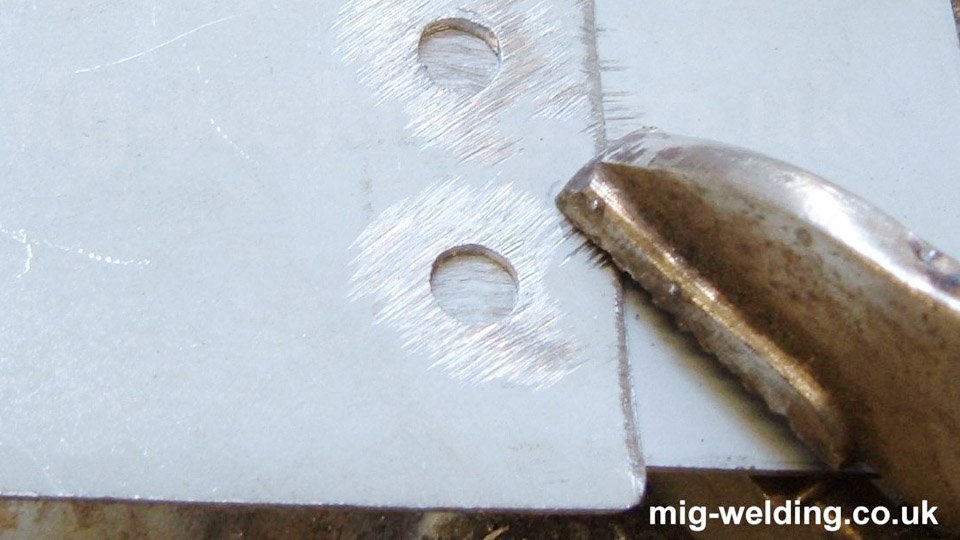
Image by mig-welding
Equipment Requirements and Setup Differences
Spot welding relies on a resistance welder—typically a portable tong-style unit or bench-mounted transformer delivering 3,000–10,000 amperes in short bursts. No wire feeder, no shielding gas cylinder, and no consumable spool. Electrodes (Class 2 copper for mild steel) clamp the sheets under 2–3 kN force while current flows.
Hobbyist units run on 110V or 220V single-phase; professional auto-body machines use water-cooled arms and digital timers for precise cycle control. Setup takes minutes: dress tips to 3/16–1/4 inch face diameter, set pressure gauge, and calibrate time/current. Total initial investment for a capable shop unit sits between $800 and $4,000.
MIG (GMAW) requires a power source with built-in or separate wire feeder, a torch, and a gas regulator. Common U.S. shop machines (Miller, Lincoln, or Hobart 180–250 amp class) run on 220V and push 0.023–0.035 inch wire at 100–300 ipm. Shielding gas—75% argon/25% CO₂ for mild steel—is mandatory.
Setup involves selecting wire diameter, setting voltage and wire-feed speed (WFS), and tuning inductance for short-circuit transfer on thin material. Entry-level machines start at $400; full shop packages with spool gun reach $2,500–$3,500. MIG demands more bench space for the gas bottle and regular tip/nozzle cleaning.
The performance edge is clear: spot welding needs zero consumables beyond occasional tip dressing, while MIG burns 1–2 lb of wire and 15–25 cfh gas per hour of arc time. For a shop running 50 spot welds daily on body panels, consumable cost stays under $10/month versus $40–$60 for equivalent MIG repair volume.
Material Thickness Ranges and Compatibility
Spot welding excels on thin sheet stacks up to approximately 3 mm total thickness (two sheets of 1.5 mm each). Optimal range for automotive mild steel and galvanized is 0.5–2.0 mm per sheet. Beyond that, heat dissipation drops and nugget formation becomes inconsistent.
It works only on lap joints; butt or fillet joints are impossible without additional fixturing. Galvanized coatings require 20–25% higher current or preheat cycles to vaporize zinc without expulsion. Aluminum demands even higher current (often double) and specialized electrodes because of its conductivity.
MIG handles 24-gauge (0.6 mm) to 1/4 inch (6.4 mm) and beyond with the same machine by swapping wire and voltage. It joins lap, butt, T-joint, and corner configurations without issue. On galvanized, MIG requires zinc removal or specialized wire/gas to avoid porosity. For structural mild steel or stainless in fabrication, MIG’s filler addition fills gaps up to 1/16 inch that spot welding cannot bridge.
Performance Comparison by Thickness
20–18 gauge (0.9–1.2 mm) auto body: Spot produces consistent 4–6 mm nuggets with <10% distortion; MIG risks burn-through unless short-circuit transfer and travel speeds exceed 15 ipm.
1/8 inch (3.2 mm) structural: MIG achieves full penetration at 125–175 A with 0.035 inch wire; spot welding is impractical without massive industrial machines.
>3/16 inch: MIG dominates—deposition rates reach 5–8 lb/hr versus spot’s inability to form continuous joints.
Joint preparation differs sharply. Spot demands clean, oil-free contact surfaces and precise alignment under electrode pressure. MIG tolerates light rust or mill scale better but still benefits from grinding for critical structural work.
Heat Input, Distortion, and Penetration Behavior
Spot welding concentrates resistance heat at the interface for 6–13 cycles (0.1–0.22 seconds at 60 Hz). Total heat input remains low because the copper electrodes quench the nugget instantly.
Distortion on 18-gauge panels stays minimal—typically <0.010 inch warpage across a 12-inch seam when electrodes are cooled and force calibrated. Penetration forms a cast nugget 4–5 times the sheet thickness in diameter with 70–80% penetration into each sheet.
MIG heat input scales with amperage and travel speed. At 1 amp per 0.001 inch rule of thumb, 20-gauge requires only 60–90 A, yet continuous arc still deposits more total energy than a spot. Short-circuit transfer (low voltage, high inductance) keeps heat low enough for thin metal, but globular or spray transfer on thicker plate increases distortion.
Travel speed directly controls this: 10–20 ipm prevents excessive heat buildup. Resulting beads show full penetration on butt joints but can create 1/16–1/8 inch heat-affected zones that pull thin panels out of flat.
Measured outcome: a 24-inch lap seam on 18-gauge steel shows 0.005–0.015 inch distortion with properly sequenced spot welds versus 0.030–0.060 inch with continuous MIG unless back-stepped or clamped heavily.
Weld Strength and Mechanical Performance
Tensile-shear testing on mild steel reveals application-specific winners. Properly formed spot nuggets on 1 mm galvanized sheet routinely exceed 4–6 kN pull strength per weld—matching or exceeding OEM specifications. The rapid quench creates a fine-grained structure with minimal softening.
On thicker material (>2 mm), MIG’s continuous fusion zone delivers higher overall joint strength because load distributes along the entire bead length rather than discrete points.
MIG fillet or groove welds on 1/8-inch plate achieve 70–90 ksi ultimate tensile strength with ER70S-6 wire, matching base metal. Spot welding cannot produce equivalent continuous strength without multiple overlapping nuggets that introduce heat overlap weaknesses.
For auto-body crash structures, engineers specify spot spacing (typically 20–40 mm centers) to achieve designed shear values; replacing those with MIG plug welds reduces fatigue life unless bead length and leg size compensate.
Key measurable difference: spot welding shear strength per unit area is higher on thin lap joints due to the forged nugget; MIG provides superior fatigue resistance on structural seams because of continuous filler reinforcement.
Speed, Productivity, and Labor Factors
Spot welding completes a single nugget in under one second after clamping. A technician can place 200–300 spots per hour on a door skin or quarter panel once fixtured. No post-weld cleanup beyond light grinding of electrode marks. Robotic lines in OEM plants hit thousands per shift.
MIG travel speeds average 8–18 ipm depending on transfer mode and thickness. A continuous 24-inch seam takes 15–30 seconds of arc time plus setup. Spatter cleanup and slag-free but still requires wire brushing or grinding for paint prep.
For low-volume repair, MIG wins because one setup handles multiple joint types; for high-volume panel replacement, spot welding’s cycle time advantage reduces labor hours by 40–60%.
Consumables, Cleanup, and Ongoing Costs
Spot electrodes last 5,000–15,000 welds before dressing or replacement ($0.50–$2 per tip pair). No gas. Total monthly consumable cost for a busy collision shop stays under $50.
MIG wire costs $1.50–$3 per pound; a 30-lb spool lasts 10–15 hours of arc time. Gas runs $0.25–$0.40 per cubic foot. Nozzle and contact tips add another $20–$40 monthly. Cleanup time per hour of MIG welding averages 10–15 minutes versus 2–3 for spot.
Over a 2,000-hour shop year, spot welding saves $800–$1,500 in consumables and labor on panel work alone, while MIG’s versatility justifies the expense on mixed structural and repair jobs.
Practical Decision Framework for U.S. Shops
Use this checklist to decide in under 30 seconds:
- Thickness ≤ 2 mm and lap joint only? → Spot welding (OEM appearance, zero distortion).
- Any butt, fillet, or gap >0.030 inch? → MIG.
- High-volume identical panels? → Spot (or robotic spot if scale justifies).
- One-off structural repair or thicker plate? → MIG.
- Galvanized auto body with factory seam access? → Spot with preheat cycle.
Two field-proven insights: First, maintain electrode face diameter within 0.030 inch of spec and dress every 500 welds—nugget consistency improves 25–30% and expulsion drops dramatically on galvanized stock.
Second, on 20–22 gauge with MIG, lock short-circuit transfer at 15–17 V and 180–250 ipm WFS with 0.023 or 0.030 inch wire; this combination cuts burn-through incidents to near zero while delivering acceptable bead profile for paint.
Advanced Performance Insight
Pushing either process further comes down to parameter synergy. For spot welding, combining digital preheat (1350 °F zinc vaporization) with exact force-current balance extends tip life 40% and raises nugget tensile by 15%.
For MIG, synchronizing WFS multipliers (2 ipm per amp for 0.030 inch wire) with travel speed yields deposition efficiency above 95% and heat-affected zone control that rivals factory laser welds on thin stock. Master those interactions and the “vs” question disappears—both processes become precision tools in the same toolbox.
Final Thoughts
Choose based on the numbers—thickness, joint geometry, and production volume—and both spot welding and MIG welding become predictable, repeatable assets instead of competing options.
FAQs
Can MIG welding replace spot welds on car body panels without losing strength?
Yes, but only with plug welds sized to match nugget diameter (minimum 4–5 times sheet thickness) and proper spacing. Continuous MIG beads on thin panels introduce more distortion and heat-affected softening; OEM crash testing validates spot patterns, so plug welds must replicate the designed shear area.
Is spot welding actually stronger than MIG on thin automotive steel?
On 18–20 gauge lap joints, a correctly formed spot nugget delivers higher shear strength per weld point than a single MIG plug of equal diameter because of the forged microstructure and rapid quench. MIG wins only when continuous length compensates for the difference.
What thickness range makes spot welding impractical?
Above 3 mm total stack thickness or when any joint requires filler or full penetration (butt or T-joints). At that point, electrode force and current demands exceed standard shop equipment, and distortion control becomes impossible without massive water-cooled industrial setups.
How much more expensive are MIG consumables compared to spot welding over time?
MIG consumables (wire + gas + tips) average $4–$6 per arc hour; spot welding electrodes cost $0.10–$0.30 per 1,000 welds. A shop doing 400 hours of panel work annually saves $1,200–$1,800 by using spot where possible.
Do I need special training or certification to switch between the two processes?
Basic AWS D1.3 sheet-metal qualification covers both, but spot welding requires separate electrode-force and timer calibration practice. Most collision certification programs (I-CAR) mandate demonstrated spot welding on galvanized panels; MIG is already standard in structural sections.

Hi, I’m Zachary Ford. I’m passionate about welding and dedicated to helping both beginners and experienced welders make informed decisions. I research, test, and write about welding helmets, welding machines, safety equipment, and essential workshop tools. My goal is to provide honest reviews, practical buying guides, and easy-to-follow tutorials that help you weld more safely, work more efficiently, and choose the right gear with confidence.