
If you’re shopping for a cordless welder, the listings blur together fast. Battery counts, amp numbers, staple counts, and words like “professional” get thrown around, and none of it tells you what the tool actually does in your hands. This page cuts through that. It explains what separates a good cordless welder from a bad one, then compares five models on the facts their listings give. For most people, the Cordless Battery MMA Welder is the pick — it ships with two 20V 8Ah batteries, which means one can charge while the other runs.
As an Amazon Associate, we earn from qualifying purchases. This post contains affiliate links – if you buy through them, we may earn a commission at no extra cost to you.
What Actually Matters
Battery count and runtime
A cordless welder is only as good as its batteries. One battery means you stop when it dies. Two or four means you keep working while one charges. Before ordering, count the batteries in the package and check the charger — a dual-port charger refills two at once, a single charger means waiting in line.
The electrode and material range
This is the feature that sells the tool and rarely earns its place. Big electrode sizes and exotic metal lists look impressive, but most buyers weld one thickness of one metal. Check the stated electrode sizes and the listed materials, then ask whether that covers your actual job — not the job you imagine doing someday.
The job it’s actually built for
This is the decision that decides whether you stay happy. A stick welder joins metal. A spot welder builds battery packs. A plastic welder melts staples into cracked bumpers. These are different tools with different jobs, and buying the wrong type is the mistake that ends in a return.
Weight, size, and safety cutoffs
A tool you can’t hold steady at arm’s length is a tool you won’t use. Check the stated weight and dimensions, then think about whether you’ll work overhead or in tight spaces. Also look for listed protection features — overheat, over-current, and overload cutoffs protect both you and the tool.
1. Cordless Battery MMA Welder

Best for: Stick welding with no outlet nearby
This is a stick welder, so the job it’s built for is joining carbon steel, low alloy steel, and similar metals. Against the electrode question, the listing states it takes 1/16”, 3/32”, 1/8”, and 5/32” rods, and the hot-start, arc-force, and anti-stick features exist to make striking and holding an arc easier. At 8 lb and roughly 26.6cm x 15.8cm x 22cm, it’s sized to carry to a job rather than park in a shop.
The two 20V 8Ah batteries are the part that matters most. One runs the machine while the other charges, so runtime stops being a single countdown. The LED display shows current, function mode, and welding mode. What you must supply separately is the welding helmet, gloves, and rods — none are in the box. The listing names carbon steel and low alloy steel as the materials it welds.
Pros
- Two 20V 8Ah batteries included
- Takes four common electrode sizes
- 8 lb with a shoulder strap
- LED display for current and mode
- Overheat, over-current, overload protection
Cons
- Listing names steel and low alloy steel only
2. Klutch KLiQ 20V Welder

Best for: Long jobs away from power
Against the battery question, this one answers hardest: four Klutch 20V 8.0Ah batteries plus a dual-port fast charger. That’s the largest battery count here, and it’s the reason this pick suits remote jobs and quick setups where stopping to charge costs you the day. Pure DC output is listed for MMA and flux welding with minimal spatter.
The flexibility claim is worth reading carefully — KLiQ batteries work across all Klutch KLiQ 20V tools, so if you already own some, the batteries do double duty. Intelligent power detection adjusts output as the battery level drops, which trades peak output for longer runtime. It’s not for a buyer who only welds occasionally and would rather not keep a whole set charged and rotated.
Pros
- Four 20V 8.0Ah batteries included
- Dual-port fast charger
- Batteries shared across KLiQ 20V tools
- Pure DC output for MMA and flux
- Overheat and abnormal-condition protection
Cons
- Powered by 8.0Ah batteries, so a long welding job means stopping to recharge.
3. Cordless Plastic Welder Kit
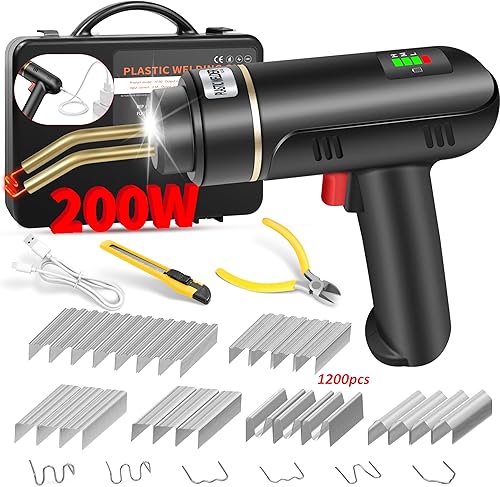
Best for: Bumper and trim repair on a budget of space
This is a different tool for a different job — it melts hot staples into cracked plastic rather than joining metal. The decision that matters here is the staple count, and the listing is specific: 1200 pieces across six types, from 0.8mm wave to 0.6mm M staples. It runs on a built-in 3.8V 5000mAh battery with USB charging, stated to work up to 3 hours when full.
The 200W heating and an LED battery indicator that shows the charge in steps cover the runtime question, and a side heat dissipation hole vents the housing. An LED on top helps in dim areas. The trade-off is power source: the listing describes a built-in battery charged over USB.
Pros
- 1200 staples in six types
- Built-in 5000mAh battery, USB rechargeable
- Stated up to 3 hours of work
- 4-level battery indicator
- LED light for dim work areas
Cons
- Plastic repair only, no metal
4. Katerk Cordless Plastic Welder with 400 Staples

Best for: Beginners doing varied plastic repairs
The feature that decides this one is temperature control. Three presets — 752°F, 932°F, and 1112°F — with a stated 2-3 second heat-up let you match heat to the plastic instead of guessing. That matters because toy plastic and automotive engineering plastic behave very differently, and uncontrolled heat is how you burn through a panel.
It lists ABS, PP, TPO, and TPE as suitable materials, plus 400 staples in a range of shapes, a wire cutter, and a knife. The anti-slip rubber handle and built-in LED address the comfort and visibility questions. A built-in sensor cuts power if it overheats.
Pros
- Three temperature presets
- Heats in a stated 2-3 seconds
- 400 staples in four shapes
- Auto power cutoff on overheat
- Anti-slip handle and LED light
Cons
- The box lists a USB-C charging cable and not a power adapter, so that is a second purchase.
5. SEESII Battery Spot Welder

Best for: Building and repairing battery packs
This is the specialist pick, and the job question rules it in or out fast. It’s a spot welder for nickel strip on cylindrical cells, phone batteries, and button batteries — not a stick welder for steel plate. The listing states a maximum output of 3360W and tested welds on nickel-plated sheet up to 0.2mm and pure nickel up to 0.15mm, with quality tied to battery charge level.
The welding pen detaches from the main unit with no cable between them, and a pen cover prevents accidental triggers. Note the listing’s own care advice: charge fully before first use and monthly if unused.
Pros
- Fully cordless with no pen cable
- 99 adjustable gears
- Auto and manual trigger modes
- Screen shows temperature and battery
- Tweezers unscrew the pens for replacement
Cons
- Battery packs only, no general metal work
- Needs monthly charging when stored
Who Should Buy Which
Match yourself to the job first. If you weld steel and want the fewest things to go wrong, the Cordless Battery MMA Welder gives you two batteries and a shoulder strap. If you weld all day away from power, the Klutch KLiQ 20V Welder’s full set of batteries and dual charger keep you running. Repairing a cracked bumper? The Cordless Plastic Welder Kit’s 1200 staples cover repeat jobs, while the Katerk Cordless Plastic Welder suits a first-timer who wants temperature presets. And if you’re rebuilding battery packs, the SEESII Battery Spot Welder is the only one here built for it.
Mistakes That Catch Buyers Out
- Buying on the headline wattage instead of the job — a spot welder and a stick welder are built for different work.
- Choosing an electrode range or staple count you’ll never use, while ignoring whether spare batteries are included and swappable.
- Assuming the box includes items the package list doesn’t name — check the package list line by line before ordering.
- Taking “professional” and “endless possibilities” at face value instead of reading the stated materials, thicknesses, and electrode sizes.
Frequently Asked Questions
Can a cordless welder really weld without an outlet?
Yes, if it runs on batteries rather than a cord. The stick and spot models here are powered by rechargeable battery packs, so you can work on elevated areas or outdoors. Runtime depends on the battery charge level and the job.
What’s the difference between a stick welder and a spot welder?
A stick welder joins metal using coated electrodes, and it’s the tool for steel fabrication and repair. A spot welder passes current through a pen to fuse thin nickel strip onto battery cells. They’re not interchangeable.
How many batteries do I need?
Two is the practical minimum, because you can charge one while the other runs. A full set, as on the Klutch kit, suits long sessions away from power. A built-in battery, like the plastic welders here, means you stop and charge.
Can these welders join aluminum?
The listings here name carbon steel, low alloy steel, plastic, and battery nickel strip. None states aluminum, so don’t count on it. Match the listed materials to your job before you order.
Do I need extra safety gear?
Yes. The stick welder package list covers clamps, cables, batteries, and a charger. Welding arcs are bright and hot, and the CDC’s NIOSH welding safety page sets out the eye and respiratory protection this kind of work calls for.
Conclusion
Before you buy, check the return window and try the tool on scrap metal first. If it feels right in your hands, you’ll know it’s the one. Don’t rush — a little patience now saves you from a frustrating purchase later.

Hi, I’m Zachary Ford. I’m passionate about welding and dedicated to helping both beginners and experienced welders make informed decisions. I research, test, and write about welding helmets, welding machines, safety equipment, and essential workshop tools. My goal is to provide honest reviews, practical buying guides, and easy-to-follow tutorials that help you weld more safely, work more efficiently, and choose the right gear with confidence.