
As an Amazon Associate, we earn from qualifying purchases. This post contains affiliate links – if you buy through them, we may earn a commission at no extra cost to you.
Most people shopping for a gas powered welder get the amps wrong. They buy big, thinking more power always means better welds, then find the machine is heavy, loud, and more than their work needs. This page starts with the four traps that cause returns, then a short list of the few units that hold up. The hardest mistake to undo is buying a welder that can’t run your tools at the same time — the Tomahawk 15 HP avoids it.
What Gas Welder Buyers Get Wrong
Buying amps you’ll never use
A gas powered welder with a big amp number feels safer, so people buy up. But duty cycle matters more than the headline figure. A 210 amp unit at 60% duty cycle lets you weld for most of every ten minutes. Match the amps to your thickest metal, not to the biggest number on the page.
Chasing features you won’t touch
TIG capability, digital readouts, LCD screens — these sound like upgrades. If you only stick weld fence posts and trailers, you’ll pay for a mode you never switch on. Decide what you actually weld first, then check whether the extra modes earn their place on the machine.
The detail sellers skip
Listings shout about amps and watts, then go quiet on duty cycle, weight, and whether you can weld and run tools at once. Those three things decide whether the unit works on a real jobsite. Read the spec block, not the headline, and treat anything unstated as something to confirm before you buy.
The compromise that comes back
People buy a welder that can’t also power their grinder, or a generator that can’t hold a stable arc. A week later it’s in the return box. Buy for the whole job — welding plus the tools around it — or you’ll be doing this twice.
What Did Not Make the List
Several kinds of listings got set aside. Some were the wrong category entirely — plain generators with no welding output, or welders that need a wall outlet. Others gave no useful detail: no duty cycle, no amp figure, no electrode sizes. A few were near-duplicates of a stronger pick with nothing to separate them.
1. TOMAHAWK 15 HP Engine Driven Portable 2

Avoids the trap of: buying a welder that can’t run tools too
This unit pairs 210 amps of welding output with a 2,000 watt generator, and the listing says you can weld and run electric tools at the same time. That combination is what separates it from a plain welder. The inverter design gives a stable sine wave, which the listing ties to a steadier arc, and the 60% duty cycle covers normal repair work.
Amperage is set with an electronic reader and a knob, so you’re not guessing at your setting. It welds 1/3, 1/4, and 3/8 inch material, which covers most farm, fence, and trailer jobs. This isn’t for someone who only needs light sheet metal work — the capacity is more than that job asks for.
Pros
- Welds and runs power tools at once
- Stable sine wave for a steady arc
- Electronic amperage reader with knob control
Cons
- 60% duty cycle means rest periods during long welds
2. Hobart Champion Elite 225 Engine-Driven Generator and Stick Welder

Avoids the trap of: running out of power on thick material
It puts out 225 amps of DC welding current for stick electrodes, and the listing describes the arc as smooth and consistent. Alongside that, it delivers 10,000 watts peak and 9,500 watts continuous AC power — enough to run a jobsite or a house circuit during an outage.
The design is 20% lighter than the previous model, which the listing says makes it easier to lift and maneuver. That matters, because a machine with this much output isn’t something you want to drag around. It suits someone welding thick steel or needing serious backup power.
Pros
- 225 amp DC output for stick electrodes
- 10,000 watt peak, 9,500 watt continuous AC
- 20% lighter than the previous model
Cons
- Large output suits heavy work, not light jobs
- AC power figures are the listing’s own, not verified here
3. Champion 145 Engine-Driven Welder

Avoids the trap of: overbuying features you won’t switch on
This is the simplest machine here, and the listing is just as plain: recoil start, gas engine, 4,750 watts peak, and a note that it’s made in the United States. There’s no inverter mode, no digital readout, no TIG. You pull the cord, and it welds.
For someone who wants a stick welder that starts and runs without menus or settings, that simplicity is the point. It suits a buyer with one clear job — fence repair, gate work, light structural welding — who doesn’t want to learn a control panel. It isn’t for anyone who needs TIG, fine amperage control, or a large generator output.
4. TOMAHAWK Welder Generator Stick Welder Engine Driven 120 Amp 7
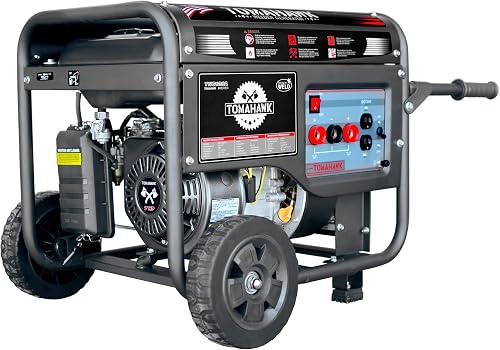
Avoids the trap of: buying a unit too heavy to move alone
At 120 amps with a 60% duty cycle, this is the compact pick. It runs a 2,200 watt inverter generator with what the listing calls stable power for smooth welding and tool operation, and the permanent magnet generator is credited with steady arc control. It welds 1/3, 1/4, and 3/8 inch stick electrodes.
The frame is lightweight with never-flat wheels, so one person can move it across a jobsite. Tomahawk backs it with a 2-year warranty and a nationwide network of certified technicians. This isn’t for someone welding thick plate all day — 120 amps is a lighter ceiling than the bigger units here.
Pros
- 120 amps with a 60% duty cycle
- 2-year warranty with US-based support
- Never-flat wheels on a lightweight frame
Cons
- The output here is best suited to lighter work
5. Engine Driven 4500W Welder

Avoids the trap of: dragging extension cords to a jobsite
This 2-in-1 unit combines a 4,500 watt generator with 160 amp stick welding. The listing says it uses high-frequency IGBT technology and DC output for an ultra-stable arc with clean, spatter-free welds, and it holds a 60% duty cycle. It welds rods from 1/32 inch up to 5/32 inch, covering thin sheet up to medium steel.
The power side gives 4.2kW continuous and 4.5kW surge with a pure sine wave, which the listing says is safe for sensitive electronics — so it doubles as household backup. It suits a buyer fixing fences, gates, and beams away from an outlet.
Pros
- 160 amps with a 60% duty cycle
- Welds rods from 1/32″ to 5/32″
- Pure sine wave output for sensitive electronics
Cons
- 160 amp ceiling is below the larger units here
- IGBT and arc claims are the listing’s own wording
Also worth considering
The Klutch 11kW Welder/Generator LCD Screen offers a 260 max amp DC output with 120/240 volt power and 11kW max output, plus an LCD screen for settings. The Miller Electric Bobcat 230 runs a 23.5 hp Kohler CH730 gasoline engine.
Before You Order
- Check the thickest metal you’ll weld, then match the amp figure to it.
- Measure your truck bed or trailer space against the unit’s footprint and wheel setup.
- Confirm your total wattage need if you’ll run tools or appliances off the generator side.
- Decide whether you need electric start or can live with recoil, based on how often you’ll use it.
Frequently Asked Questions
Is the simplest one on this list enough?
For fence posts, gates, and light repairs, yes. The Champion 145 covers stick welding with 4,750 watts peak and no settings to learn. If you weld thick plate or need TIG, step up to a unit with more amps and a stated duty cycle.
What if it turns out to be the wrong one?
Check the return window before you buy, and keep the packaging until you’ve run a few welds. Match the duty cycle and amp figure to your real work first — that’s what most often sends a machine back. Confirm the warranty terms, since coverage length varies by brand.
What gives out or runs out first?
Consumables and fuel. Electrodes, and gas for the engine, run out long before the machine does. On the power side, duty cycle is the limit — a 60% rating means rest periods during long welds.
Which trap catches most people twice?
Buying on amps alone. A big number feels like a safe choice, so people buy up, then find the unit is heavier than they want and can’t run their tools at the same time. The Tomahawk 15 HP avoids that by welding and powering tools together.
Conclusion
The trap that bites hardest is a welder that can’t run your tools while it welds — you find out on the job, not in the listing. The Tomahawk 15 HP covers both. Pick your thickest metal, match the amps, then send the button and check the listing.

Hi, I’m Zachary Ford. I’m passionate about welding and dedicated to helping both beginners and experienced welders make informed decisions. I research, test, and write about welding helmets, welding machines, safety equipment, and essential workshop tools. My goal is to provide honest reviews, practical buying guides, and easy-to-follow tutorials that help you weld more safely, work more efficiently, and choose the right gear with confidence.