
As an Amazon Associate, we earn from qualifying purchases. This post contains affiliate links – if you buy through them, we may earn a commission.
Choosing a spot welder depends on your power needs and preferred workflow. Some users want a simple, handheld device for quick repairs, while others need a bench-mounted unit for building large battery packs from scratch. Models differ in power, trigger modes, and heat management. Incorrect tools can cause weak welds or cell damage.
1. AWithZ UF20B Spot Welder
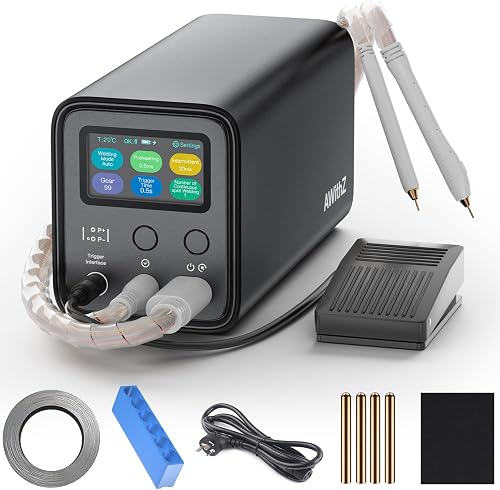
Best for: Hobbyists building battery packs who need versatile trigger modes.
This capacitor-based spot welder reaches its welding mark in five minutes. It offers automatic, manual, and foot pedal modes for probe positioning. The flame-retardant aluminum shell supports materials including nickel and stainless steel.
Strengths:
- Fast five-minute quick start capability
- Includes three distinct welding operation modes
- Durable and flame-retardant aluminum shell
- Wide voltage input for global use
- Compact design with no sharp corners
Trade-offs:
- Must stay connected to wall power
- Faraday capacitor stores very little electricity
- Requires power supply during every weld
This welder requires a dedicated workspace near a power outlet.
| Best for | Why |
|---|---|
| DIY enthusiasts | Versatile modes for different cells |
| Battery builders | Handles various nickel sheet thicknesses |
| First-time users | Simple setup and clear instructions |
2. 11500W Battery Spot Welder

Best for: Users needing precise control over delicate battery tasks.
This unit features a rotary knob for fine-tuning its 100 power gears. It includes intelligent thermal protection to prevent damage during intense sessions.
Strengths:
- High 11.5KW power for robust jobs
- Intelligent thermal protection prevents overheating
- Large rotary knob for precise settings
- Automatic shut-down after eight minutes
- Clear control panel for easy adjustments
Trade-offs:
- Requires manual charging before use
- Limited to specific battery types
- Slightly more complex control interface
Monitor the control panel during long builds.
| Best for | Why |
|---|---|
| Delicate tasks | Fine-tune strength for small cells |
| Power users | High 11.5KW output capacity |
| Safety-focused | Built-in thermal monitoring system |
3. AWithZ 10000mAh Spot Welder

Best for: Professionals requiring long runtime for continuous battery assembly.
The 10,000mAh battery allows for extended operation without being tethered to a wall. It features a 1650A output and 6-gauge copper welding pens to minimize resistance. Built-in temperature and voltage alarms protect the unit during use.
Strengths:
- High 10,000mAh capacity for long runtime
- Includes three pairs of welding pens
- Strong 1650A maximum output current
- Built-in alarms for unit safety
- Supports thick nickel and steel sheets
Trade-offs:
- Larger footprint than portable pens
- Requires periodic battery recharging
- More accessories to keep organized
This welder allows for more assembly time and fewer power cable issues.
| Best for | Why |
|---|---|
| Professional builders | Large battery supports continuous use |
| Heavy-duty tasks | High 1650A output current |
| Frequent users | Reduced need for constant charging |
4. FNRSI SWM-20 Battery Spot Welder

Best for: Field repairs and users needing high portability.
This handheld welder features a 2.4-inch HD display that shows real-time parameters like pre-heat and pulse width. It doubles as a power bank with its 5000mAh internal battery, supporting fast charging for your mobile devices. Its compact design fits easily into a toolbox.
Strengths:
- Highly portable, pocket-sized design
- Clear 2.4-inch HD color display
- Doubles as a mobile power bank
- Precision encoder for parameter tuning
- Supports 0.5mm sheet thickness
Trade-offs:
- Battery capacity is lower than others
- Smaller display size for complex settings
- Primarily for smaller, quick tasks
This tool fits easily in your pocket.
| Best for | Why |
|---|---|
| Field technicians | Compact size for mobile repairs |
| Multi-taskers | Includes power bank functionality |
| DIY hobbyists | Easy to store in toolboxes |
5. Hoteche Portable Spot Welder Single Phase Spot Welding Machine

Best for: Industrial-style sheet metal welding and repairs.
This single-phase machine provides an 8KW input capacity for heavy-duty welding. The 50% duty cycle allows for long work sessions without overheating.
Strengths:
- Strong 8KW input capacity
- High 50% duty cycle efficiency
- Capable of welding 1.2mm+1.2mm sheets
- Simple American plug connection
- Reliable for industrial-grade tasks
Trade-offs:
- Not designed for small battery cells
- Larger physical footprint than handhelds
- Less precise for delicate electronics
This is a workhorse for metal projects, not fine battery work.
| Best for | Why |
|---|---|
| Automotive repair | Handles thick sheet metal welding |
| Metal fabrication | High 8KW input capacity |
| Long sessions | Efficient 50% duty cycle |
Side by Side
The table below allows you to quickly compare the core technical specifications and features of these five spot welders, helping you determine which model aligns with your specific power requirements, desired portability, and the types of materials you plan to weld in your upcoming projects.
How to Judge One of These
Power Output and Consistency
The most important factor is the welder’s ability to deliver a consistent pulse. A stable current prevents burning through battery cells or causing structural damage. Before ordering, verify if the welder provides a “double pulse” feature, as this technology is often cited by the Occupational Safety and Health Administration as a way to manage heat input for professional-grade results.
Battery Capacity vs. Wall Power
Decide if you need a portable battery-powered unit or a stationary one that plugs into the wall. Wall-powered units, especially capacitor-based models, provide instant, constant power for long-term projects but limit your mobility to the length of the cord.
Control Modes and Flexibility
Consider how you prefer to trigger the weld. A foot pedal allows for precise positioning of the welding probes on small battery cells.
Related guides
- 7 Best Spot Welder for Battery Packs | Pro Picks 2026
- How to Make a Spot Welder from a Battery Charger
- Expert Tips for How to Spot Weld Lithium Batteries.
Frequently Asked Questions
Does this welder work for all battery types?
These welders are designed for common cylindrical cells like 18650 or 21700 batteries. Industrial-grade machines may be too powerful for delicate button cells, while smaller units might struggle with thicker strips.
How do I know if the weld is strong enough?
A strong weld should hold the nickel strip firmly to the battery terminal without leaving large burn marks or holes. Adjust the power gears, starting at a lower setting to test on scrap material first. If the strip peels off easily, you likely need to increase the gear or pulse width until you achieve a firm, secure connection.
Is the first week with a new welder difficult?
The first week involves learning the “feel” of the probes and finding the right gear settings. Practice on scrap pieces to avoid damaging battery cells. Once you have a consistent technique for positioning the probes, the process becomes straightforward.
What parts will I need to replace over time?
Welding pen tips are the most common wear items, as they degrade after many welds. Many kits include extra tips or a file to clean them, so keep these handy to maintain good conductivity.
Is the simplest model enough for my needs?
A basic portable unit is sufficient for occasional repairs or simple DIY packs. Upgrade to high-power models only if building large packs or working with thick materials. If you don’t need industrial-grade power, a simpler model will save you time on setup and maintenance.
Conclusion
Before you start your first project, take a moment to inspect your battery terminals for any debris. A clean surface makes a world of difference for a strong, lasting connection. You’ll find that practicing on some scrap nickel strips first really helps you get a feel for the settings before diving in.

Hi, I’m Zachary Ford. I’m passionate about welding and dedicated to helping both beginners and experienced welders make informed decisions. I research, test, and write about welding helmets, welding machines, safety equipment, and essential workshop tools. My goal is to provide honest reviews, practical buying guides, and easy-to-follow tutorials that help you weld more safely, work more efficiently, and choose the right gear with confidence.