
Many welders preparing thick-plate fabrications, such as pressure vessels or structural beams, hit the same roadblock when switching from GMAW or FCAW setups. They ask: does submerged arc welding use shielding gas? The question matters because it directly impacts equipment requirements, operating costs, and weld consistency on jobs demanding high deposition rates.
Without external gas, SAW relies entirely on a granular flux blanket to protect the arc and molten pool, eliminating cylinder logistics while enabling deposition rates that reach 10–15 kg/h with a single wire.
This distinction drives decisions on automation viability, joint design, and parameter selection for carbon and low-alloy steels up to 50 mm thick. Getting it right means faster throughput and fewer defects in flat-position production.
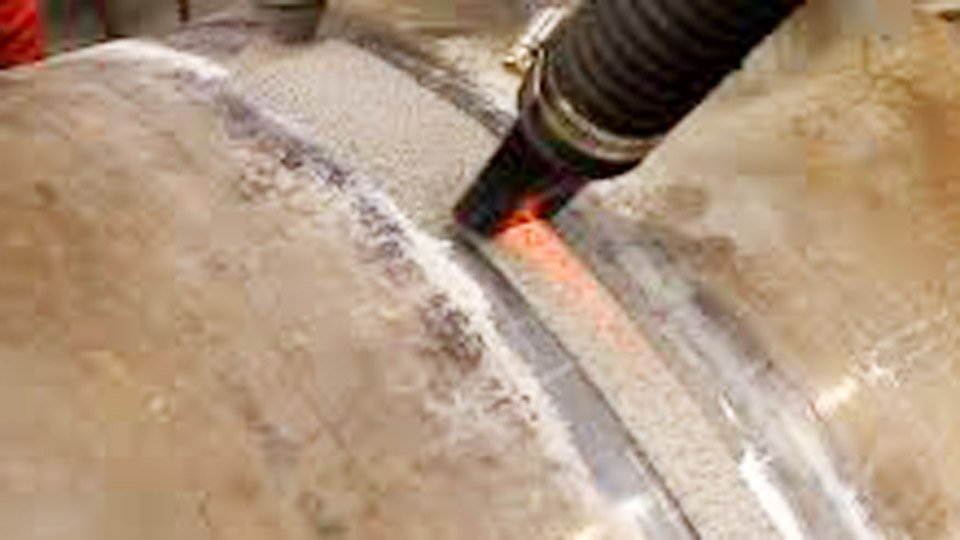
Image by westermans
The Direct Answer: No External Shielding Gas in Standard SAW
Submerged arc welding operates without any external shielding gas. The process submerges the arc beneath a continuous blanket of granular flux delivered ahead of the electrode. This flux melts under arc heat, generating its own protective atmosphere and forming a slag layer that shields the weld pool from oxygen and nitrogen.
Flux Shielding Mechanism Versus Gas Delivery Systems
Flux performs three simultaneous functions that gas cannot replicate in this setup: it creates a reducing environment through chemical decomposition, forms a conductive path for stable current flow, and produces a floating slag that insulates the solidifying bead.
External gas would simply displace the flux pile, exposing the pool and causing immediate porosity or oxidation. Welders who attempt hybrid gas addition quickly discover ruined beads and wasted material.
Why Gas Absence Simplifies Heavy Fabrication Decisions
Eliminating gas cylinders removes wind sensitivity, hose management, and flow-rate calibration from the workflow. On-site or shop-floor jobs gain mobility because flux hoppers travel with the carriage. This freedom favors automated gantry or tractor systems for longitudinal seams where travel speeds hit 40–60 cm/min without arc instability.
Decision point: if your job involves plates thicker than 12 mm in flat position and volume exceeds 50 linear meters per shift, SAW’s no-gas design cuts setup time by 30–40 % compared to gas-dependent processes.
How Flux Provides Complete Arc and Pool Protection
Flux chemistry dictates shielding performance far beyond simple coverage. Manufacturers formulate blends from lime, silica, manganese oxide, and calcium fluoride that decompose at arc temperatures of 6000–8000 °C to release CO, CO₂, and metallic vapors that displace air.
Granular Flux Types and Their Shielding Characteristics
Fused fluxes offer high density and consistent grain size for deep-penetration single-pass welds but absorb less moisture. Agglomerated fluxes allow precise alloy additions and higher basicity indices (1.5–3.0) for superior toughness in multi-pass work.
Neutral fluxes maintain weld metal chemistry close to the electrode wire, ideal for unlimited-thickness builds. Active fluxes deliberately boost silicon and manganese to counter dilution in high-heat-input passes, reducing porosity risk on dirty plate surfaces.
Slag Formation and Post-Weld Cleanup Implications
Molten flux creates a glassy slag layer 3–6 mm thick that solidifies slower than the weld metal, allowing dissolved gases to escape. Basicity index above 2.0 produces easier-peeling slag and lower oxygen content (typically <300 ppm), directly improving Charpy impact values at –40 °C.
Operators must monitor slag removal between passes; incomplete cleaning traps inclusions that propagate cracks under fatigue loading.
SAW Compared to Gas-Shielded Processes: Practical Trade-Offs
When evaluating does submerged arc welding use shielding gas against MIG, TIG, or FCAW, focus on protection reliability under real production constraints rather than theoretical purity.
Shielding Effectiveness Across Environments
Gas processes lose efficiency outdoors or in drafts above 5 km/h; argon/CO₂ mixtures dilute rapidly, forcing flow rates above 15 L/min. SAW’s flux blanket remains intact regardless of air movement, making it the default for shipyard or pipeline work. Thermal efficiency reaches 60 % because heat stays trapped under the flux, versus 25–30 % for open-arc methods.
Deposition Rate and Penetration Data for Decision Making
Single-wire SAW at 500 A and 32 V deposits 8–12 kg/h on 20 mm plate with 4 mm wire—triple the output of 1.2 mm GMAW at equivalent heat input. Dual-wire setups push 20+ kg/h while maintaining bead width under 25 mm.
Gas processes cap at 4–6 kg/h before spatter and undercut appear. Use this metric: for joints requiring 50 kg of filler metal per meter, SAW completes the run in under 5 minutes versus 15+ for gas-shielded alternatives.
Equipment Setup Optimized for Flux-Only Operation
Successful SAW demands precise flux delivery matched to electrode feed and travel speed. No gas lines means the welding head simplifies to wire feeder, contact tip, and flux hopper.
Hopper Design and Flux Flow Control
Standard hoppers hold 20–50 kg and deliver flux at 2–4 kg/min through adjustable gates. Maintain 25–35 mm pile depth ahead of the torch; shallower piles allow arc flare and air entrainment, deeper piles trap gases and create surface porosity. Recovered unfused flux (up to 50 % reusable) requires magnetic separation and sieving to remove slag particles larger than 0.5 mm.
Power Source and Polarity Selection for Stable Arcs
Constant-voltage DC machines (600–1200 A capacity) paired with DC+ polarity maximize penetration on carbon steel. AC operation reduces arc blow on long seams but requires 2–3 V higher settings.
Electrode extension (stick-out) of 25–38 mm balances resistive heating with stable droplet transfer—longer extensions lower current for the same wire speed, flattening beads on thin root passes.
Parameter Selection and Bead Geometry Control
Real-world SAW success hinges on balancing current, voltage, and speed to achieve desired penetration without excessive reinforcement or undercut.
Voltage, Current, and Travel Speed Relationships
| Wire Diameter (mm) | Current Range (A) | Voltage Range (V) | Travel Speed (cm/min) | Deposition Rate (kg/h) | Typical Use |
|---|---|---|---|---|---|
| 2.4 | 250–450 | 28–32 | 50–70 | 4–7 | Root passes, thin sections |
| 3.2 | 300–600 | 29–34 | 40–60 | 7–11 | Standard butt joints |
| 4.0 | 400–800 | 30–35 | 30–50 | 10–15 | Heavy plate fill passes |
| 5.0 | 600–1200 | 32–38 | 25–40 | 15–22 | Multi-wire high-speed seams |
Higher voltage widens and flattens the bead while increasing slag volume; excessive values above 38 V risk centerline cracking. Current primarily controls penetration depth—every 100 A increase adds roughly 1 mm depth on 25 mm plate. Travel speed must maintain heat input between 2.5–4.5 kJ/mm to avoid hydrogen cracking in low-alloy steels.
Wire Extension and Polarity Effects on Productivity
Increasing stick-out from 25 mm to 38 mm at fixed wire feed speed drops current by 50–80 A, useful for capping passes where deep penetration is undesirable. DC+ polarity concentrates 70 % of heat at the workpiece for deeper fusion; switch to DC– only for surfacing applications needing minimal dilution.
Applications Where No Shielding Gas Delivers Maximum Value
SAW excels on carbon and low-alloy steels in shipbuilding, pressure vessel fabrication, and heavy structural work where flat-position access exists and joint volume exceeds 200 cm³ per meter.
Thick-Section and High-Volume Production Choices
Single-pass capability on 25 mm plate with 5 mm wire at 900 A eliminates multi-process switching. Flux recovery systems cut consumable costs by 40 % on long runs. For stainless grades, neutral agglomerated fluxes paired with matching wires maintain corrosion resistance without chromium loss.
Flux Selection Decisions by Base Metal and Service Conditions
Match flux basicity to toughness requirements: index >2.5 for –60 °C service in offshore structures. Active fluxes suit single-pass fillet welds on mill-scale plate; neutral fluxes preserve chemistry in multi-layer nuclear or boiler work. Always verify moisture content below 0.1 % before use—baked fluxes at 300 °C for 2 hours restore performance.
Troubleshooting Shielding Failures and Defect Prevention
Even with correct flux, process variables create predictable defects that experienced operators correct through targeted adjustments.
Porosity Sources and Flux Management Fixes
Air entrainment from shallow flux piles or damp flux produces scattered porosity. Solution: increase hopper flow rate and preheat flux to 120 °C. Contaminated plate edges require grinding 3 mm back. Monitor recycled flux for fines accumulation that blocks gas escape.
Slag Inclusions and Bead Shape Corrections
High travel speeds trap slag at bead toes. Reduce speed 10 cm/min and raise voltage 2 V for better wetting. Undercut signals excessive current or forward torch angle—maintain 90° perpendicular and 10–15° drag angle on circumferential joints.
Real-World Application Insight
Submerged arc welding delivers unmatched productivity precisely because it needs no external shielding gas. Select it when your workflow involves flat or horizontal positions, thick sections, and volumes that justify automated flux handling. The flux blanket not only replaces gas but surpasses it in protection and efficiency for high-deposition jobs.
The advanced insight for pro-level operators: integrate twin-wire or triple-wire configurations with synchronized AC/DC power sources to exceed 25 kg/h deposition while holding heat input constant.
This maintains weld metal oxygen below 250 ppm and Charpy values above 70 J at –40 °C—performance that gas-shielded processes cannot approach on the same equipment footprint. Master flux chemistry and parameter windows, and SAW becomes the benchmark for heavy fabrication profitability.
FAQs
Does Submerged Arc Welding Require Any External Gas at All?
No. Standard SAW uses only granular flux for shielding. Adding gas disrupts the flux blanket and introduces defects.
Can Submerged Arc Welding Be Used in Outdoor or Windy Conditions?
Yes. The flux pile remains stable regardless of wind, unlike gas-shielded processes that lose protection above 5 km/h breeze.
What Flux Type Works Best for Multi-Pass Carbon Steel Welds?
Neutral or slightly basic agglomerated fluxes provide consistent chemistry and high toughness across unlimited layers without excessive alloy pickup.
Is SAW Suitable for Stainless Steel Fabrication?
Yes, when paired with neutral fluxes and matching stainless wires. It delivers clean beads with minimal chromium loss and excellent corrosion resistance

Hi, I’m Zachary Ford. I’m passionate about welding and dedicated to helping both beginners and experienced welders make informed decisions. I research, test, and write about welding helmets, welding machines, safety equipment, and essential workshop tools. My goal is to provide honest reviews, practical buying guides, and easy-to-follow tutorials that help you weld more safely, work more efficiently, and choose the right gear with confidence.