
Building your own spot welder with capacitor can open up many possibilities for DIY metalwork, battery pack repairs, and electronics projects. A homemade spot welder offers control, saves money, and gives you hands-on experience. While it may look complicated at first, breaking down the process makes it approachable, even for beginners. This guide walks you through every step: from understanding spot welding basics to safely assembling your own welder and troubleshooting common issues. With careful attention and the right parts, you’ll be able to create a practical spot welder that rivals store-bought machines.
Understanding Spot Welding And Capacitor Discharge
Spot welding is a process where two metal pieces are joined by applying pressure and electrical current at a small point. The metals heat up and fuse together. This is widely used for battery tabs, sheet metal, and electronics.
A capacitor discharge spot welder uses the stored energy in capacitors to deliver a quick, powerful pulse. This pulse melts the metal at the contact point and creates a strong weld. Compared to transformer-based welders, capacitor discharge models are:
- More precise
- Safer for sensitive electronics
- Capable of welding thin metals
The capacitor releases its energy in a split second. This reduces the risk of overheating and allows you to weld small parts accurately.
Essential Parts And Tools
Before you start building, gather the necessary parts. You’ll need some basic electronics tools and components. Here’s a rundown:
- Capacitors: For most small welders, use electrolytic capacitors rated at 200V or higher, with a total capacitance of 4000–8000 µF.
- Power Supply: A DC supply (12V–24V) or battery bank for charging the capacitors.
- Switching Circuit: A solid-state relay, thyristor (SCR), or MOSFET for releasing the stored energy.
- Electrodes: Copper rods or thick wire tips (diameter: 6–10 mm) for transferring current.
- Welding Arms: Insulated holders for the electrodes.
- Chassis: Non-conductive box (plastic or wood) for mounting all parts.
- Wiring: Heavy-gauge wires (AWG 10 or thicker) for power connections.
- Safety Gear: Gloves, goggles, and fireproof surface.
You’ll also need:
- Soldering iron and solder
- Screwdrivers and wrenches
- Drill and bits (for mounting electrodes)
- Multimeter (for testing voltage and continuity)
Example Component Specifications
| Component | Recommended Specs | Notes |
|---|---|---|
| Capacitors | 200V, 6800 µF x 2 | Connect in parallel for higher capacity |
| Switching Device | SCR (800A, 200V) | Handles high discharge currents |
| Electrodes | Copper rod, 8 mm diameter | Good conductivity and durability |
| Power Supply | 24V, 10A DC | Fast capacitor charging |
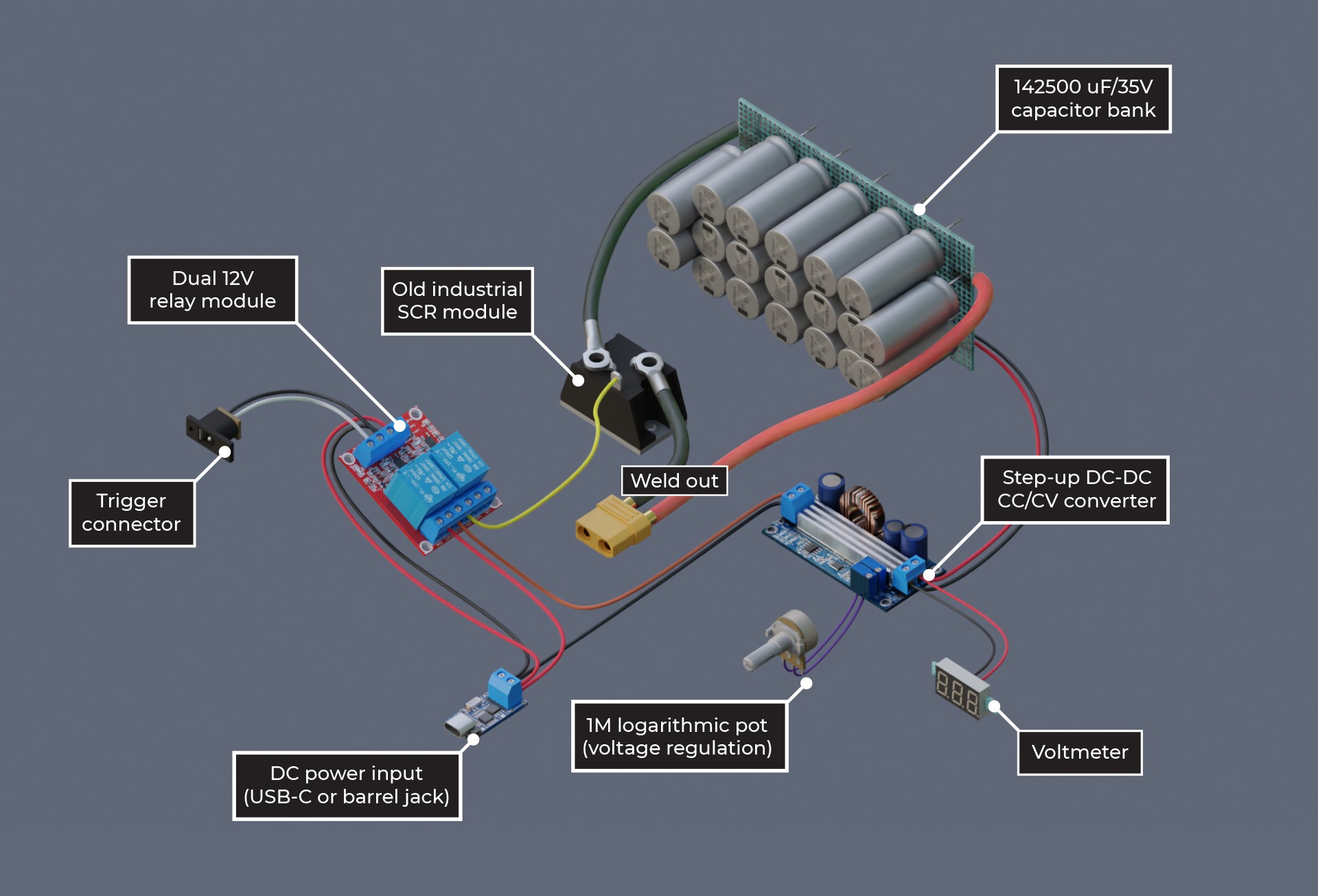
Credit: hackaday.io
Building The Spot Welder: Step-by-step
Creating a spot welder with capacitors involves careful assembly and wiring. Follow these steps closely for a safe and functional device.
Step 1: Planning And Layout
Sketch your design before building. Decide where each component fits in the chassis. Keep wires short for minimal resistance. Place capacitors, switching device, and electrodes apart to reduce heat buildup.
Step 2: Preparing The Chassis
Choose a sturdy, non-conductive box. Drill holes for electrodes and wires. Mount capacitors securely so they don’t shift during operation. Create ventilation holes if needed.
Step 3: Mounting Capacitors
Connect capacitors in parallel for higher energy storage. Secure them with brackets or zip ties. Use thick wires for connections—thin wires may overheat or fail.
Tip: Always double-check polarity. Electrolytic capacitors explode if connected backward.
Step 4: Wiring The Switching Circuit
Install your SCR or MOSFET close to the capacitors. Wire the gate/control line to a push-button or trigger switch. Connect the main terminals to the electrodes. Use heat sinks on the switching device to prevent overheating.
Common mistake: Using small or thin switches. These can melt or fail under high current. Always use switches rated for at least 50A.
Step 5: Attaching Electrodes
Shape copper rods to a point or flat tip. Mount them in insulated holders. Attach heavy wires from the switching circuit. Ensure electrodes are firmly fixed—they must not move during welding.
Non-obvious insight: The electrode tip shape affects weld quality. Sharp points focus energy, while flat tips spread it. Choose based on your material thickness.
Step 6: Connecting The Power Supply
Wire the power supply to the capacitor bank. Add a fuse between supply and capacitors for safety. Use a charging circuit or resistor to limit current if your supply is powerful.
Step 7: Testing The Assembly
Before welding, test the circuit with a multimeter. Check for shorts, correct voltages, and secure connections. Charge capacitors and trigger the switching device without electrodes in place to see if discharge happens.
Safety tip: Never touch capacitors when charged. They can deliver a dangerous shock.
Step 8: Making Your First Weld
Place metal pieces between electrodes. Press down firmly. Charge capacitors, then press the trigger. The weld should happen instantly, leaving a small melted spot.
If weld is weak: Increase capacitance or voltage. If weld burns through: Reduce voltage or capacitor size.
Choosing The Right Capacitors
Selecting the best capacitors is critical for performance and safety. Here’s what matters:
- Voltage Rating: Must be higher than your supply voltage.
- Capacitance: Determines energy delivered. More capacitance means stronger welds.
- Type: Electrolytic for cost, film for reliability (film capacitors are more expensive but durable).
Capacitor Comparison
| Type | Cost | Durability | Size |
|---|---|---|---|
| Electrolytic | Low | Moderate | Compact |
| Film | High | Excellent | Large |
Non-obvious insight: Capacitor ESR (Equivalent Series Resistance) affects discharge speed. Lower ESR allows faster, more powerful welds. Always check datasheets for ESR ratings.
Safety Precautions For Homemade Spot Welders
Working with high-voltage capacitors and spot welding can be risky. Follow these safety rules:
- Always wear insulated gloves and goggles
- Keep your workspace clean and dry
- Never touch charged capacitors
- Add a safety fuse between the power supply and capacitors
- Discharge capacitors with a resistor before repairs
- Use only fireproof surfaces
If you’re new to electronics, read up on capacitor safety at Wikipedia.
Tuning And Troubleshooting Your Spot Welder
Getting the best performance may require some adjustment. Here’s how to improve weld quality and fix common issues:
Adjusting Weld Power
Change the capacitance or supply voltage to tune weld strength. For thin metals, lower power is safer. For thick tabs, increase power.
Electrode Alignment
If welds are inconsistent, check electrode alignment. Both tips must touch the metal evenly. Reposition or reshape tips as needed.
Common Problems And Solutions
- Weak welds: Increase capacitance, clean electrode tips, check wire connections.
- Blown capacitors: Use higher voltage-rated capacitors, check polarity.
- Switch not triggering: Verify wiring, replace faulty switches or SCRs.
- Electrodes overheating: Use thicker copper, add cooling fans.
Experienced tip: Cleaning electrode tips with sandpaper before each session improves conductivity and weld quality.

Credit: www.youtube.com
Spot Welder Applications
A homemade capacitor spot welder can be used for:
- Battery pack assembly (nickel tab welding)
- Sheet metal joining for small projects
- Repairing metal jewelry
- Electronics prototyping (welding leads and contacts)
Example: Battery Pack Welding
Spot welders are essential for building custom lithium-ion battery packs. Soldering battery cells can damage them due to heat. Spot welding attaches tabs safely and quickly.
Comparing Homemade Vs Commercial Spot Welders
If you’re unsure whether to build or buy, consider these factors:
| Feature | Homemade Spot Welder | Commercial Spot Welder |
|---|---|---|
| Cost | Low (under $80) | High (over $200) |
| Customization | Full control | Limited |
| Reliability | Depends on build quality | Consistent |
| Safety | Requires extra care | Built-in protection |
| Performance | Variable | High |
A homemade welder suits hobbyists and tinkerers. Commercial models are best for frequent, professional use.
Tips For Better Results And Long-term Use
- Use quality capacitors from trusted brands (avoid cheap, untested parts)
- Keep wires short and thick for maximum current
- Insulate all exposed terminals
- Test welds on scrap metal first
- Store the welder in a dry, cool place
- Regularly check for loose connections
Non-obvious insight: Adding a digital voltmeter to your welder lets you monitor capacitor charge and avoid accidental overcharging.
What To Remember
Building a spot welder with capacitor is an exciting project that blends electronics and metalworking skills. With the right parts, careful assembly, and a focus on safety, you can create a tool that handles battery tabs, thin metals, and repairs with ease. Pay attention to capacitor quality, electrode shape, and wiring. Always test on scrap metal before working on your main project. Homemade welders offer customization and cost savings, but require careful handling and maintenance. If you’re patient and detail-oriented, your DIY spot welder will become a reliable asset in your workshop.

Credit: www.pcbway.com

Hi, I’m Zachary Ford. I’m passionate about welding and dedicated to helping both beginners and experienced welders make informed decisions. I research, test, and write about welding helmets, welding machines, safety equipment, and essential workshop tools. My goal is to provide honest reviews, practical buying guides, and easy-to-follow tutorials that help you weld more safely, work more efficiently, and choose the right gear with confidence.