
Thin metal is highly sensitive to heat input, and flux-cored wire naturally runs hotter and produces deeper penetration than solid MIG wire. That makes understanding How to Weld Thin Metal With Flux Core critical if you want to avoid burn-through, excessive spatter, and panel distortion.
Without proper voltage control, wire feed adjustment, and travel speed, thin sheet can quickly overheat, leading to weak joints, warped panels, and costly rework.
Flux core can be used effectively on light-gauge steel, but it requires tight heat management, short weld intervals, and strategic tack sequencing to control arc energy. Joint fit-up and proper grounding also play a major role in arc stability and penetration consistency.
I’ll explain the correct machine settings, wire selection, welding technique, and heat control methods needed to produce clean, structurally sound welds on thin metal using flux core.
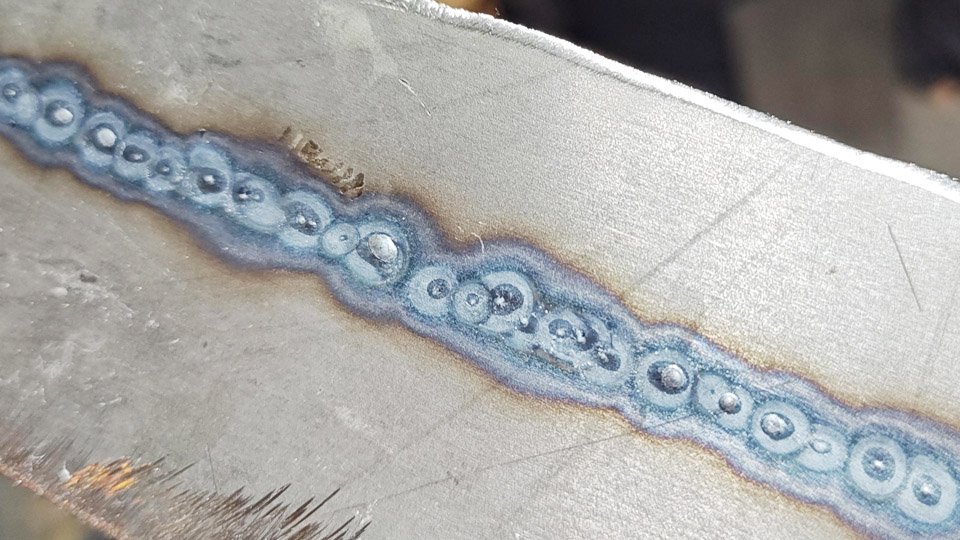
Image by reddit
Flux Core Welding Basics for Thin Applications
Flux core welding involves an electric arc between the wire electrode and the base metal, melting both to form a joint. The flux inside the wire creates a protective slag and gas shield, preventing oxidation. For thin metal, the key is minimizing heat to avoid melting through the material.
Thin metal refers to sheets under 1/8 inch thick, often 16- to 24-gauge. Common examples include exhaust systems, body panels, or light brackets. Flux core can work here, but it’s not ideal compared to solid wire MIG with gas, which offers finer control. Still, with self-shielded flux core, you gain portability and wind resistance.
The process runs on direct current electrode negative (DCEN) polarity, where the torch is negative and the workpiece positive. This setup concentrates heat on the wire, aiding in lower penetration for thin work. Always confirm your welder’s polarity; reversing it can lead to unstable arcs.
Selecting the Right Wire and Equipment
Choose wire designed for all-position welding with good performance on thin stock. The American Welding Society (AWS) classifies flux core wires like E71T-11, which supports vertical and overhead positions and provides decent arc stability.
For thin metal, opt for smaller diameters:
- 0.030-inch wire: Ideal for 18- to 22-gauge, offering lower heat and better control.
- 0.035-inch wire: Suitable for slightly thicker thin metal (16-18 gauge) but requires precise settings to avoid excess heat.
Examples include Lincoln NR-211 or Hobart Fabshield 21B, both E71T-11 types known for minimal spatter on thin materials. Avoid wires meant for heavy deposition, as they burn hotter.
Your welder must handle low output ranges. Entry-level machines like the YesWelder YWM-200 or Arccaptain MIG200 can dial down to 15 volts and 90 inches per minute (IPM) wire feed speed. Ensure it supports flux core without gas nozzles—remove them for self-shielded operation to prevent interference.
Drive rolls should match the wire size; knurled rolls grip flux core better. A contact tip sized for your wire (e.g., 0.030 tip for 0.030 wire) maintains consistent feeding.
| Wire Diameter | Recommended Thickness | AWS Class | Key Benefits |
|---|---|---|---|
| 0.030 inch | 18-22 gauge | E71T-11 | Low heat, reduced spatter, good for stitching |
| 0.035 inch | 16-18 gauge | E71T-11 | Slightly higher deposition, stable arc on mild overlaps |
Preparing the Metal and Joint
Preparation ensures fusion without defects. Start by cleaning the surface: Remove rust, paint, oil, or mill scale within 1 inch of the joint using a wire brush, grinder, or flap disc. Contaminants cause porosity or weak bonds.
For joint types:
- Butt joints: Align edges tightly with no gaps over 1/16 inch; bevel if needed for better penetration.
- Lap joints: Overlap by 1/2 to 1 inch; clamp to prevent movement.
- T-joints: Position for easy access, favoring flat or horizontal welds.
Use backing bars for butt welds on very thin metal (22 gauge). A copper or steel strip behind the seam dissipates heat and supports the molten pool, reducing burn-through risk.
Clamp pieces securely to minimize warping from heat expansion. For long seams, tack weld every 2-3 inches before full welding.
Measure material thickness accurately with calipers. Test settings on scrap of the same gauge to dial in parameters before the actual job.
Optimal Machine Settings for Thin Metal
Settings control heat input, crucial for thin welding. Too high, and you burn holes; too low, and the arc sputters without fusion.
Base settings on wire size and thickness:
- Voltage: 15-17 volts for 0.030 wire on 18-22 gauge. Lower voltage shortens the arc, reducing penetration.
- Wire feed speed: 90-140 IPM. Slower speeds deposit less wire, keeping heat low.
- Amperage: Automatically adjusts with voltage and speed; aim for 50-80 amps on thin stock.
Test on scrap: Listen for a steady “sizzle” like frying bacon—indicating proper arc. Adjust in small increments: Increase speed if the arc is too hot; decrease voltage for less spatter.
For welding thick to thin (e.g., 1/8 inch to 18 gauge), bias heat toward the thicker piece. Set slightly higher (17 volts, 140 IPM) but direct the arc mostly at the thick side.
| Material Thickness | Wire Diameter | Voltage | Wire Feed Speed (IPM) | Approximate Amps |
|---|---|---|---|---|
| 22 gauge (0.030 in) | 0.030 in | 15 V | 90-110 | 50-60 |
| 18 gauge (0.050 in) | 0.030 in | 15.5-16 V | 110-130 | 60-70 |
| 16 gauge (0.060 in) | 0.035 in | 16-17 V | 120-140 | 70-80 |
Maintain 3/4-inch wire stickout: Shorter increases heat; longer cools the arc. Position the gun at 10-15 degrees from perpendicular, dragging the puddle.
Welding Techniques to Avoid Burn-Through
Employ intermittent methods to dissipate heat. Continuous runs overheat thin metal quickly.
Stitching technique: Make short welds (1/2-1 inch) spaced 1-2 inches apart. Return after cooling to fill gaps. This builds the joint gradually without warping.
Tack welding: Spot weld every few inches, then connect with short bursts. Overlap tacks slightly for full coverage.
For lap joints: Weld in a “C” pattern—start on one edge, curve across, and end on the other. Lay subsequent Cs overlapping the previous.
In butt joints with backing: Run straight, short beads at higher travel speed (10-15 inches per minute) to limit heat dwell.
Travel speed influences penetration: Faster speeds (12-18 IPM) reduce heat input on thin metal. Aim the wire at the leading edge of the puddle to control fusion.
For vertical welds: Use downhill progression on thin stock—gravity aids flow, and faster travel minimizes penetration.
Grind or wire brush slag between passes; flux core leaves heavy slag that must be removed for multi-pass work.
Practice on scrap: Weld a lap joint on 18-gauge sheet, adjusting until you achieve flat, uniform beads without holes.
Managing Common Issues in Thin Flux Core Welding
Porosity often stems from dirty metal or wind disrupting the flux shield. Weld indoors or use wind blocks; reclean if needed.
Excess spatter indicates high voltage—drop it by 0.5 volts. Anti-spatter spray on the nozzle helps, but clean tips regularly.
Warping: Alternate weld locations (e.g., weld one side, then the opposite) to balance heat. Use heat sinks like wet rags on non-weld areas.
Undercut: Slow travel or wrong angle causes edges to melt away. Increase speed or adjust gun to 15 degrees drag.
If burn-through occurs: Patch with a backing plate or switch to stitching. On very thin (24 gauge), flux core may not be viable—consider TIG if available.
Monitor arc stability: A spitting arc means wrong polarity or poor ground. Ensure a solid clamp connection.
Integrating Practical Tips for Better Results
In shop settings, preheating thin metal slightly (under 150°F) can reduce cracking on cold days, but avoid it on very thin stock to prevent distortion.
For exhaust repairs, use wires tolerant of galvanized coatings, like those with deoxidizers, to minimize zinc fumes.
One insight from extensive use: On mixed-thickness joints, measure puddle size—keep it under 1/4 inch diameter to maintain control.
These adjustments turn flux core into a versatile option for thin work, extending its use beyond thick plates.
Final Thoughts
Flux core welding thin metal demands precision in heat management. By selecting appropriate wire, dialing in low settings, and using intermittent techniques like stitching, you can create durable joints without defects.
This approach reinforces the fundamentals: Control the arc, prepare thoroughly, and test iteratively. For those advancing, consider experimenting with gas-shielded flux core on thin galvanized sheets—it enhances slag removal and reduces spatter, offering cleaner finishes in controlled environments.
FAQs
What wire size is best for welding 20-gauge metal with flux core?
Use 0.030-inch E71T-11 wire for 20-gauge to balance heat and deposition. It feeds smoothly at low speeds, minimizing burn risk compared to 0.035-inch.
Can I weld thin metal vertically with flux core?
Yes, but use downhill technique with short stitches at 16 volts and 120 IPM. This controls penetration better than uphill on thin stock.
How do I reduce warping when flux core welding sheet metal?
Clamp securely, use tacks spaced evenly, and alternate weld segments. Allow cooling between passes, and employ backing for heat dissipation.
What causes holes in thin metal flux core welds?
Excessive heat from high voltage or slow travel. Drop to 15 volts, increase speed to 15 IPM, and focus on thicker areas in uneven joints.
Is flux core suitable for welding galvanized thin metal?
It works, but choose wires with silicon for better tolerance. Weld in well-ventilated areas to avoid zinc oxide fumes, and remove coating first if possible.

Hi, I’m Zachary Ford. I’m passionate about welding and dedicated to helping both beginners and experienced welders make informed decisions. I research, test, and write about welding helmets, welding machines, safety equipment, and essential workshop tools. My goal is to provide honest reviews, practical buying guides, and easy-to-follow tutorials that help you weld more safely, work more efficiently, and choose the right gear with confidence.