
Spot welders vary widely in price, and understanding how much a spot welder costs is critical before investing in equipment that directly affects weld consistency and production efficiency.
Whether you’re handling thin sheet metal or repetitive fabrication work, choosing the wrong machine can lead to weak weld nuggets, excessive heat distortion, or costly rework due to inconsistent current delivery.
Costs typically reflect output capacity, duty cycle, and control precision, factors that directly influence weld strength, penetration, and long-term reliability.
A low-cost unit may struggle with thicker materials or sustained operation, while higher-end systems offer stable amperage control and repeatable weld quality.
I’ll clarify realistic price ranges and what drives those costs, helping you match your budget to actual welding demands without compromising performance or durability.
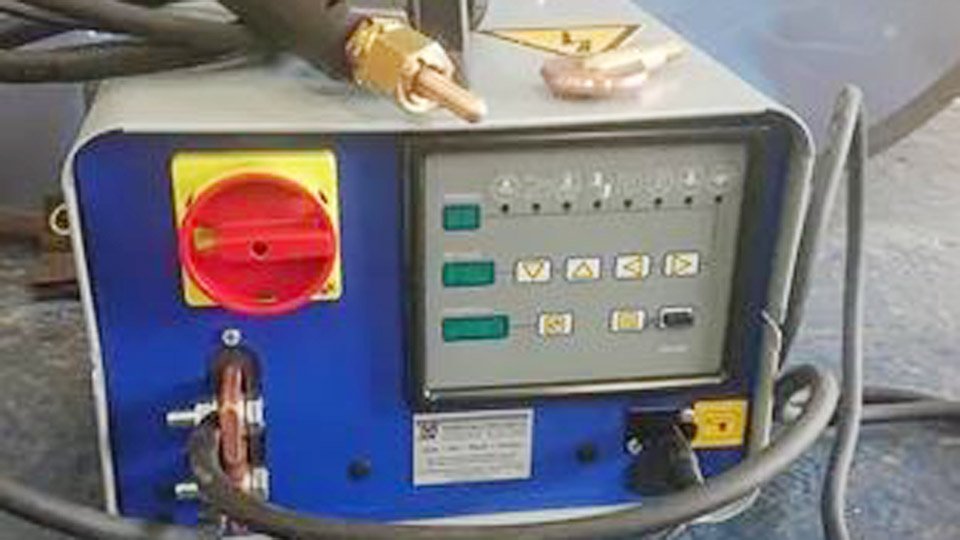
Image by westermans
Current Spot Welder Prices by Category
Entry-Level DIY and Hobbyist Models ($50–$500)
Battery-powered handheld units dominate this segment, built for 18650/21700 lithium packs, thin nickel strip (0.1–0.3 mm), and occasional sheet-metal tacks up to 0.040 inch combined thickness.
Chinese 8000 W–14,600 W capacitor-discharge models with adjustable pulse (1–99 levels) sell for $30–$150 on major retail sites. Premium German kWeld full kits with ultracapacitor modules and precise current control land at $254–$600 once you add cabling and power supply.
AC transformer portables like the Harbor Freight Chicago Electric 240 V unit list around $99 after discounts and weld uncoated mild steel up to 1/8 inch total thickness at low duty cycle.
Stark USA 120 V single-phase models sit at $300–$350 and handle 13.5 A draw with similar capacity. These tools deliver 5–8 kA peaks for 6–12 cycles (0.1–0.2 seconds) but overheat after 10–15 spots without cooldown.
Mid-Range Professional Portable and Benchtop Units ($1,000–$3,500)
Italian Tecna hand-held guns set the benchmark here. The 2.5 KVA manual model costs $1,780 and provides 6,000 A short-circuit current with synchronous SCR timing (2–65 cycles) and phase-shift compensation for oxidized or painted surfaces.
The 6 KVA pneumatic gyroscopic version at $2,890 adds water cooling, automatic clamping, and 2,000 spots per hour at 33 spots per minute. Both accept standard RWMA electrodes and deliver consistent 120 daN (270 lbf) force at short arms.
Bench-mounted 15 KVA digital units from Electroweld reach $2,100 and suit light fabrication with throat depths up to 18 inches. These machines bridge hobbyist and small-shop needs, offering 50 % duty cycle at 50–70 % output while running on 220 V single-phase 20 A service.
Industrial Floor-Standing and High-Volume Machines ($10,000–$40,000+)
200 KVA Sciaky or T.J. Snow units command $14,950–$39,500 with 24–36 inch throats and water-cooled transformers rated for continuous three-shift production. Dengensha projection spot welders with nut feeders start at $12,500.
These systems weld 3 mm + 3 mm mild steel at 8,000–12,000 A in under 20 cycles and maintain 50–80 % duty cycle under full load. Three-phase 480 V power and closed-loop current feedback justify the price when you run 500+ spots per hour.
Technical Factors That Drive Spot Welder Cost
KVA Rating and Secondary Current Output
KVA directly sets available welding current after accounting for impedance losses in the secondary loop. A 2.5 KVA gun delivers roughly 6,000 A at short arms; a 6 KVA unit holds the same current at longer arms with less voltage drop.
Higher KVA costs more because it requires thicker copper windings, larger core steel, and better cooling. For 0.060-inch mild steel, you need at least 7,000–9,000 A; anything less forces longer weld times that risk expulsion and electrode mushrooming.
Power Supply Requirements and Input Voltage
110/120 V single-phase units stay under $400 but limit output to 13–15 A draw and shorter duty cycles. 220/240 V single-phase doubles available power for $1,000–$3,000 machines.
Three-phase 480 V industrial models eliminate voltage sag under load but require electrician installation and higher transformer costs. Every volt of secondary drop costs weld consistency; premium units add constant-current feedback to compensate.
Throat Depth, Electrode Force, and Cooling
Longer arms (18–36 inches) increase secondary loop inductance, demanding higher KVA to maintain current. Pneumatic force systems (up to 565 daN on Pro Spot i5 models) cost more than manual springs but deliver repeatable nugget size.
Air-cooled guns stay cheaper; water-cooled transformers and arms add $800–$1,500 but support 2–3× higher duty cycle before thermal shutdown.
Control Systems and Automation Features
Basic synchronous timers (2–65 cycles) keep prices low. Microprocessor controls with constant-current regulation, slope-up/slope-down, and data logging add $500–$2,000. Projection models with nut feeders or robotic integration push into the $15,000+ range because they eliminate manual positioning errors on high-volume lines.
Matching Cost to Application
Auto Body Repair and Restoration
You need 0.030–0.080 inch mild steel or galvanized panels at 50–200 spots per job. A $99–$350 AC portable or $1,780 Tecna 2.5 KVA gun gives clean tacks without warping. Water-cooled arms prevent electrode sticking on galvanized coatings. Spending over $3,000 buys faster cycle times but rarely pays back unless you run a full collision shop.
Lithium Battery Pack Fabrication
Nickel strip 0.15–0.3 mm or copper tabs demand precise pulse energy (100–800 A for 3–10 ms) to avoid cell damage. $50–$150 capacitor units suffice for prototypes; the $254 kWeld kit with ultracapacitors gives repeatable 1,500–2,500 A pulses for production. Battery-powered handhelds eliminate cord drag and voltage sag when welding inside packs.
Sheet Metal Fabrication and Light Production
1–3 mm mild steel at 100–1,000 spots daily justifies $2,000–$5,000 benchtop units with 18-inch throats and digital timing. Consistent 8–10 kA at 12–18 cycles produces 0.25–0.35 inch nugget diameters with 25 % max indentation. Industrial 200 KVA machines only make sense above 2,000 spots per shift.
Calculating Total Cost of Ownership
Initial price is only 40–60 % of five-year cost. Energy consumption scales with KVA and duty cycle. A 6 KVA gun running 30 % duty at 220 V draws roughly 18 A average; multiply by local kWh rate and annual hours.
Electrodes last 5,000–20,000 spots depending on current, force, and material coating—expect $0.02–$0.08 per replacement tip set on mid-range guns. Water-cooled systems add pump and chiller maintenance but halve electrode wear.
Downtime costs more than the machine on production floors. A $2,000 unit with 50 % duty cycle and quick-change arms keeps you welding; a $100 toy that overheats every 10 spots forces frequent breaks. Factor electrode life, power draw, and service intervals before signing the purchase order.
| Price Range | Typical KVA | Max Current | Duty Cycle (approx.) | Best Application | 5-Year Ownership Cost Factor |
|---|---|---|---|---|---|
| $50–$500 | 1–8 kW equiv. | 5–8 kA | 10–20 % | Battery packs, light DIY | Low energy, high electrode wear |
| $1,000–$3,500 | 2.5–15 | 6–10 kA | 40–60 % | Auto body, small fab | Balanced power & maintenance |
| $10,000–$40,000 | 60–200 | 10–20 kA | 70–80 % | High-volume production | Lowest per-spot cost at scale |
Performance Tradeoffs at Each Price Level
Under $500 machines deliver usable welds when you stay within their thermal limits and accept occasional tip dressing. Mid-range portables give repeatable nugget size across shifts because current compensation circuits hold output steady despite line voltage fluctuation.
Industrial units add closed-loop feedback that adjusts for electrode wear in real time, producing statistically identical welds at 95 % confidence—critical for aerospace or automotive certification.
Real-World Decision Framework
Choose the spot welder whose KVA, throat depth, and duty cycle exactly match 80 % of your daily workload. Overbuying by two KVA classes wastes capital on idle transformer capacity. Underbuying forces slower cycles, more heat input, and distorted panels.
Track your actual spot count and material mix for one week, then size the machine so it runs at 60–70 % of rated output during peak production. That single data point separates machines that pay for themselves in six months from those that become expensive paperweights.
The most advanced insight comes from modern inverter-based controls: they let you program true RMS current instead of raw time, delivering the same nugget diameter on 0.040-inch galvanized as on bare 0.060-inch steel without changing electrodes.
When your process hits that level of repeatability, spot welding stops being an art and becomes a measurable, certifiable manufacturing step.
FAQs
How much does a spot welder cost for 18650 battery packs?
Expect $50–$150 for a capable capacitor-discharge handheld that handles 0.15–0.3 mm nickel strip at 400–800 A pulses. The $254 kWeld kit adds precision and ultracapacitor stability for production work.
What budget delivers reliable spot welds on auto body sheet metal?
$99–$350 AC portables handle 0.030–0.080 inch mild or galvanized steel for weekend restorers. Professional collision shops step to $1,780 Tecna 2.5 KVA guns for 6,000 A consistent output and faster cycle times.
Do water-cooled spot welders justify the extra cost?
Yes when you exceed 200 spots per hour. Water cooling doubles duty cycle and extends electrode life 2–3×, dropping cost per weld below $0.01 once volume justifies the $800–$1,500 premium over air-cooled models.
Should I buy new or look at used industrial spot welders?
Used 60–200 KVA machines sell for 40–60 % of new price ($8,000–$20,000) but verify transformer insulation, SCR condition, and water-cooling integrity. New mid-range portables often deliver better reliability for small shops.

Hi, I’m Zachary Ford. I’m passionate about welding and dedicated to helping both beginners and experienced welders make informed decisions. I research, test, and write about welding helmets, welding machines, safety equipment, and essential workshop tools. My goal is to provide honest reviews, practical buying guides, and easy-to-follow tutorials that help you weld more safely, work more efficiently, and choose the right gear with confidence.