
Burn-through holes and warped panels ruin hours of work when standard MIG parameters hit material under ⅛ inch. How to weld thin metal with MIG welder comes down to matching low heat input, correct wire diameter, and short-circuit transfer to the exact gauge while still achieving full fusion.
Auto body panels, HVAC ductwork, and light fabrication demand these decisions, otherwise distortion or weak joints force rework or scrap.
Thin metal (typically 24 gauge to ⅛ inch, or 0.020–0.125 inch) loses heat slowly, so even slight over-voltage or slow travel speed creates holes or buckles. Proper settings keep the weld pool small and controlled, producing clean beads that require minimal finishing.
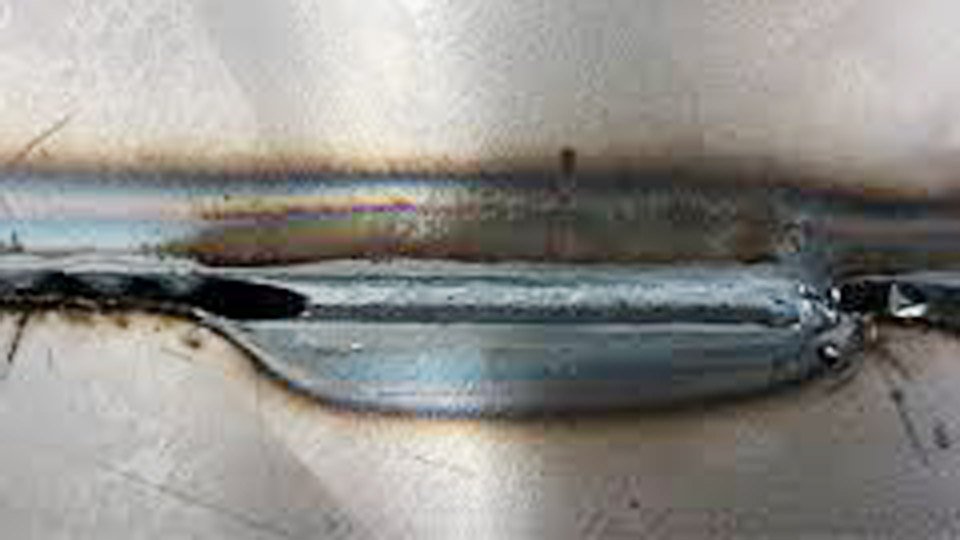
Image by tooliom
Understanding Thin Metal MIG Welding Challenges
Heat Input Dynamics in Short-Circuit Mode
Short-circuit transfer (the only practical mode for thin stock on most machines) creates 90–200 shorts per second. Each short melts a droplet but also spikes current momentarily. On thin material the base metal cannot dissipate this energy fast enough, so voltage must stay low enough to limit arc energy while wire feed speed (WFS) supplies just enough filler.
Exceeding 18 V on 20-gauge steel almost guarantees burn-through because the arc length lengthens and heat spreads wider than the joint can absorb.
Defining Thin Metal Thicknesses for MIG Applications
- 24–20 ga (0.024–0.036 in): demands 0.023–0.024 in wire and 30–60 A.
- 18–16 ga (0.048–0.060 in): 0.030 in wire at 60–90 A still works but requires faster travel.
- Up to ⅛ in (0.125 in): borderline thin—0.030 in wire at 90–125 A is the upper limit before switching to thicker wire or pulsed mode.
Above these ranges the same machine can jump to spray transfer, but thin work stays strictly short-circuit or pulsed short-circuit.
Selecting MIG Equipment Suited for Thin Gauge Work
Power Source Capabilities and Synergic Features
Choose a machine with true short-circuit performance down to 30 A and voltage trim in 0.1 V increments. Synergic or “one-knob” modes on modern inverters automatically link WFS and voltage but still require manual fine-tuning for thin metal because factory presets often target ⅛–¼ in plate. Look for machines rated for 0.023 in wire at low amperage without stubbing.
Torch and Wire Feed Precision Requirements
A 150–200 A torch with ⅜–½ in gas cup gives better shielding at low flow. Use a Teflon liner and polished drive rolls sized exactly for the wire diameter—any slippage at 100 ipm destroys arc stability. Keep contact-tip-to-work distance (CTWD) at ⅜–½ in maximum; longer stickout increases resistance and heat in the wire instead of the pool.
Wire and Gas Combinations for Minimal Heat and Clean Beads
Wire Diameter Selection by Material Gauge
Smaller wire melts at lower current and produces a smaller, faster-freezing puddle.
| Material Thickness | Recommended Wire | Typical Amperage Range | Reason |
|---|---|---|---|
| 24–20 ga (0.020–0.036 in) | 0.023–0.024 in | 30–60 A | Lowest heat, fastest puddle freeze |
| 18–16 ga (0.048–0.060 in) | 0.030 in | 60–90 A | Balanced deposition without burn-through |
| ⅛ in (0.125 in) | 0.030 in (or 0.035 in max) | 90–125 A | Still short-circuit but higher travel speed |
ER70S-6 wire (higher silicon) gives better wetting on mill-scale or lightly rusted thin stock than ER70S-3.
Shielding Gas Blends for Short-Circuit Stability
75% argon / 25% CO₂ (C25) remains the standard for thin mild steel. It produces a softer arc than 100% CO₂, reduces spatter by 30–40%, and allows lower voltage while maintaining penetration.
Flow rate: 15–20 CFH—higher creates turbulence that pulls air into the puddle on thin material. Avoid pure argon (too cold, narrow bead) or mixes over 25% CO₂ (excessive spatter and undercut).
Establishing MIG Parameters for Different Thin Thicknesses
Start every session on scrap of the exact same gauge and alloy. The 1 amp per 0.001 in rule gives a baseline, but real-world settings are lower for thin work to stay in short-circuit.
MIG Settings Reference Table (Mild Steel, ER70S-6, 75/25 Gas, Short-Circuit)
| Thickness | Wire Size | Voltage | Wire Feed Speed (ipm) | Approx. Amps | Travel Speed (ipm) |
|---|---|---|---|---|---|
| 24 ga (0.024 in) | 0.023 in | 13–15 V | 130–160 | 30–50 | 15–20 |
| 20 ga (0.036 in) | 0.023 in | 15–16 V | 140–180 | 50–70 | 12–18 |
| 18 ga (0.048 in) | 0.030 in | 16–17 V | 100–140 | 60–85 | 12–16 |
| 16 ga (0.060 in) | 0.030 in | 16.5–17.5 V | 120–160 | 75–95 | 10–15 |
| ⅛ in (0.125 in) | 0.030 in | 17–18 V | 180–220 | 100–125 | 8–12 |
These are starting points. Increase voltage 0.5 V only if the arc sounds harsh or the bead is convex; decrease if it hisses or burns through.
Voltage and Wire Feed Speed Calibration Process
Set voltage first for desired arc length (short and crisp, not popping or hissing). Then dial WFS until the arc stabilizes without stubbing or excessive spatter. Listen for the bacon-frying sound—steady crackle means correct short-circuit frequency. On digital machines use the trim knob to fine-tune once the synergic program is selected.
Amperage Guidelines and Real-Time Adjustments
Monitor actual amperage with a clamp meter. If it spikes above the target range during welding, reduce WFS 10–20 ipm and increase travel speed. On very thin stock (under 0.040 in) many welders drop voltage another 0.5–1 V and stitch-weld instead of running continuous beads.
Executing Effective Short-Circuit MIG Techniques on Thin Metal
Gun Positioning and Travel Parameters
Push at 10–15° travel angle with a 45° work angle. This directs shielding gas ahead of the puddle and flattens the bead. Maintain ⅜ in CTWD—any longer and voltage drop raises heat in the wire instead of the joint. Travel speed must stay fast enough that the puddle solidifies ½–¾ in behind the arc; slower speeds create excessive heat buildup.
Stitch Welding and Skip Sequencing Patterns
Continuous beads are rarely viable below 18 ga. Instead, lay ¼–½ in stitches, pause ½–1 second for the metal to cool below red heat, then advance. On long seams alternate ends (weld 4 in at one end, jump to the opposite end, return) to balance shrinkage. This “skip-weld” method keeps peak temperature low and prevents cumulative distortion.
Leveraging Pulse MIG for Superior Control on Ultra-Thin Sheets
Pulse Parameters and Waveform Benefits
Machines with pulsed short-circuit or pulse-spray capability drop average heat input 20–40% while maintaining deposition.
Typical settings: peak voltage 22–26 V at 100–150 Hz, background 12–14 V, wire speed matched to average 40–80 A. The puddle freezes between pulses, giving the operator time to move without burning through.
Transitioning from Standard Short-Circuit to Pulsed Operation
Start in standard short-circuit to establish baseline parameters, then switch to pulse and reduce WFS 15–25%. Use push technique and slightly longer stickout (½–⅝ in). Pulse excels on 20–24 ga where even stitch welding still shows some warp.
Preparing Joints and Controlling Distortion in Thin Assemblies
Surface Preparation Standards for Optimal Fusion
Grind or wire-brush both sides to bright metal within ½ in of the joint. Remove mill scale, paint, oil, and rust—any contaminant increases required voltage and widens the heat-affected zone. For butt joints on 20 ga or thinner, leave a 0–0.010 in gap; tighter fit-ups force higher heat to achieve fusion.
Fixturing, Tacking, and Heat Sink Tactics
Clamp or fixture every 4–6 in with copper or aluminum bars behind the joint to act as heat sinks. Place ¼–½ in tacks every 2–3 in, allowing full cool between tacks. On large panels use a copper backing bar or even a wet rag (applied away from the weld) between passes to pull heat out faster.
Troubleshooting Persistent Defects in Thin Metal MIG Welds
Correcting Burn-Through and Excessive Penetration
Immediate fix: drop voltage 0.5–1 V and WFS 20 ipm, increase travel speed 20%, and switch to shorter stitches. If holes already exist, back the area with copper, lower settings further, and weld from the opposite side or use a skip pattern around the hole first.
Addressing Porosity, Undercut, and Lack of Fusion
Porosity almost always traces to insufficient gas flow, dirty metal, or excessive voltage creating turbulence. Undercut appears when voltage is too high for the travel speed—reduce voltage and slow travel slightly. Lack of fusion on thin material usually means travel speed was too fast or CTWD too long; shorten stickout and verify push angle.
Real-World Application Insight
The right combination of 0.023–0.030 in wire, 75/25 gas, short-circuit (or pulsed) parameters, and deliberate stitch sequencing turns thin-metal MIG welding from a trial-and-error frustration into a repeatable process.
Test every new thickness on scrap, record the exact voltage/WFS pair that produces a flat bead with no burn-through, and you will consistently hit full penetration without distortion.
The advanced insight pros use: once settings are dialed, the final control variable is duty cycle management—on production runs of thin panels, alternate two identical machines or pause every 5–7 minutes so the welder stays in its optimal thermal window, preventing the voltage creep that suddenly creates burn-through on the 20th panel.
Frequently Asked Questions
What are the best MIG settings for welding 18 gauge steel with a MIG welder?
Use 0.030 in ER70S-6 wire, 16–17 V, 100–140 ipm WFS (≈70–85 A), 75/25 gas at 15–20 CFH, and travel at 12–16 ipm with ¼ in stitches and ½-second pauses.
Should I use 0.023 or 0.030 wire for thin metal MIG welding?
0.023 in for 20 ga and thinner (lowest heat); switch to 0.030 in for 18 ga and up to ⅛ in when you need faster deposition without raising voltage.
How do I prevent warping when MIG welding thin sheet metal?
Stitch weld with short ¼–½ in segments, alternate ends of the seam, fixture tightly with copper heat sinks, and allow full cooling between stitches. Never run continuous beads on material under 0.060 in.
Can flux core wire be used effectively for thin metal with MIG?
Only in a pinch and with extreme caution—flux core requires higher voltage and produces more spatter and heat. Solid wire with 75/25 gas is vastly superior for thin metal; flux core is better reserved for thicker outdoor work.

Hi, I’m Zachary Ford. I’m passionate about welding and dedicated to helping both beginners and experienced welders make informed decisions. I research, test, and write about welding helmets, welding machines, safety equipment, and essential workshop tools. My goal is to provide honest reviews, practical buying guides, and easy-to-follow tutorials that help you weld more safely, work more efficiently, and choose the right gear with confidence.