
We may earn a commission when you buy through the Amazon affiliate links in this article. We are an Amazon Associate and earn from qualifying purchases, at no extra cost to you.
Finding the right spot welder foot pedal is about matching your specific machine to the correct control method. Whether you’re building battery packs or welding thin metal sheets, a pedal allows you to focus on probe placement while keeping your hands steady. Always check the connection type, as a mismatched plug will prevent the unit from working.
1. AWithZ UF20B Spot Welder
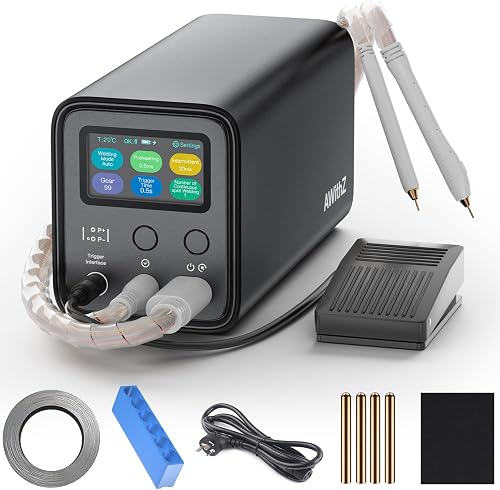
Best for: Battery pack builders needing versatile welding modes.
This unit offers automatic, manual, and foot pedal modes.
Owning this device means managing a capacitor-based system that requires a constant connection to a power source during use.
Who it fits
- Battery pack builders working with 18650, 14500, or 21700 cells.
- Users who want a professional-grade welder with 99 adjustable gears.
Who should pass
- People looking for a cordless, battery-operated welder for remote jobs.
- Users who don’t have a nearby power outlet for constant charging.
2. 11500W Battery Spot Welder

Best for: High-power welding on delicate or robust battery cells.
This welder features a rotary knob for precise control across 100 power levels.
Intelligent thermal protection disables the trigger if it detects overheating. An auto-shutoff feature powers down the unit after 8 minutes of inactivity to save energy.
Snapshot:
- Maximum current of 1,380 A.
- 100-level power control for fine-tuning.
- Built-in thermal monitoring for safety.
- Automatic 8-minute shutdown feature.
- Includes a foot switch and nickel-plated sheets.
3. SEESII 10KW Battery Spot Welder
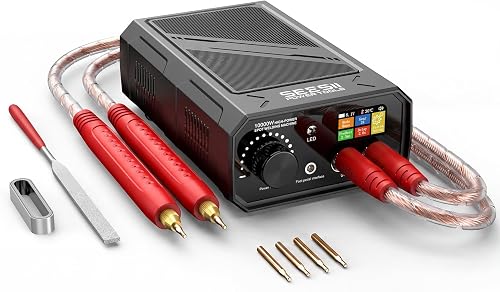
Best for: Portable repair work and compact workspaces.
This welder features an integrated 10,000mAh battery for cordless operation. It offers 25 power levels and a screen displaying real-time voltage for consistent welding quality.
What goes smoothly:
- Cordless design is perfect for mobile repairs.
- Color screen provides clear parameter feedback.
- Compact size fits easily on small workbenches.
- Dual modes allow for automatic or pedal-controlled welding.
What you have to accept:
- Requires manual charging once the internal battery depletes.
- Not suitable for welding aluminum or copper materials.
4. YESWELDER TIG Welding Foot Pedal Amp Control Pedal

Best for: TIG welders needing simple, reliable amperage control.
This pedal connects to compatible TIG machines without assembly. The 16ft control cord allows you to move freely while maintaining precise control over the arc.
Step on the pedal to activate gas and increase amperage; release to stop.
| Feature | Trade-off |
|---|---|
| 16ft control cord | Requires space for cable management |
| No assembly needed | Limited to specific machine compatibility |
| Simple step-to-activate method | Requires practice for smooth arc control |
5. ARCCAPTAIN TIG Welding Foot Pedal
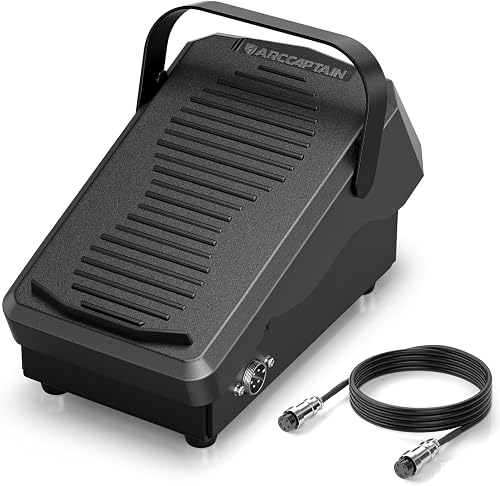
Best for: TIG welders who prioritize stability and comfort.
The 2025 version features a wider 15 cm contact area. An adjustable strap prevents your foot from slipping during long tasks.
What goes smoothly:
- Wider contact area improves overall stability.
- Adjustable strap keeps the foot secure.
- Smooth adjustment via the internal gear system.
- Includes two cables for wider machine compatibility.
What you have to accept:
- Designed exclusively for ARCCAPTAIN models.
The Decision Filter
First, identify the connection port on your welder. For battery work, choose between corded or cordless based on power access. For TIG welding, choose based on pedal size and feel.
The Quick Start Checklist
- Does the pedal’s plug match the specific pin-out of my welding machine?
- Will I be working near a wall outlet, or do I need battery power?
- Is the control cable long enough to reach my workspace comfortably?
- Does the unit require a specific voltage to operate at full power?
- Do I need a pedal with an adjustable strap for better stability?
- Is the welder compatible with the specific amperage range of the pedal?
Three Regrets Worth Avoiding
Regret #1: Buying a pedal without checking the pin configuration.
Regret #2: Ignoring the power requirements for capacitor-based spot welders.
Regret #3: Underestimating the need for thermal protection. Look for units that explicitly mention thermal monitoring to avoid damage during long sessions.
If You Want This, Look for That
| If you want… | Look for | Avoid |
|---|---|---|
| Cordless freedom | High capacity battery | Corded-only models |
| Precise TIG control | Potentiometer pedals | Simple on/off switches |
| Battery pack builds | 99+ adjustable gears | Standard TIG pedals |
| Stability for feet | Wide contact area | Narrow, small pedals |
Check the official Occupational Safety and Health Administration guidelines regarding electrical safety to ensure your workspace setup complies with safety regulations for welding equipment. Once you have confirmed the pin compatibility and power needs, you’re ready to make your selection.
Frequently Asked Questions
Will this pedal work with any brand of welder?
No, most pedals are designed for specific brands and pin configurations. You must check your welder’s manual to see if it requires a 5-pin, 14-pin, or another specific connector.
Can I use a spot welder pedal for TIG welding?
No, these are two different types of equipment. Spot welder pedals are designed for triggering a quick pulse of energy, while TIG welding pedals are designed to act as a variable resistor to control amperage throughout the weld. They aren’t interchangeable.
How do I know if my battery is fully charged?
Most battery-powered spot welders feature an LCD screen that displays real-time voltage. If your unit doesn’t have a screen, look for indicator lights that change color when the charging cycle is complete. Always follow the specific charging instructions provided in your device’s manual.
What should I do if the welding tips wear down?
Most spot welding pens allow you to remove and replace the tips. When the tips become pitted or worn, the contact quality drops, leading to weaker welds. Keep extra tips on hand and replace them as soon as you notice a decrease in weld quality.
Is it safe to use these welders on lithium batteries?
Yes, these welders are designed for battery pack assembly, but you must use the correct settings. Always perform a test weld on a scrap piece of nickel strip to ensure you have the correct gear setting before working on your actual cells.
How do I maintain the welding pen?
Keep the contact points clean and free of debris. If the tips become oxidized, use the included file or gauze to lightly sand them until they’re bright and clean. Regular maintenance ensures consistent electrical contact and better welding results.
Conclusion
Once you’ve secured the right connection, take a moment to practice your timing on some scrap metal. Getting a feel for the pressure will help you produce consistent, clean welds every time. You’ll find that your workflow becomes much smoother, so don’t hesitate to start your next project today.

Hi, I’m Zachary Ford. I’m passionate about welding and dedicated to helping both beginners and experienced welders make informed decisions. I research, test, and write about welding helmets, welding machines, safety equipment, and essential workshop tools. My goal is to provide honest reviews, practical buying guides, and easy-to-follow tutorials that help you weld more safely, work more efficiently, and choose the right gear with confidence.