
As an Amazon Associate, we earn from qualifying purchases. This post contains affiliate links – if you buy through them, we may earn a commission at no extra cost to you.
No single portable welder for pipe welding suits everyone. What decides it’s how thick the pipe wall is, whether you’ve got a 220V outlet or only a household socket, and whether you want stick only or a wire-feed option too. These machines differ on process, weight, and power input, not on some ranking of good to bad. Stick welders from YESWELDER and Hpoouo are the two that split most buyers: the YESWELDER 205A Stick Welder for its dual voltage and 205 amps, the Hpoouo 200Amp Stick Welder for its 3.7 lb body.
1. YESWELDER 205Amp Stick Welder Digital Inverter IGBT ARC Welding Machine

Best for: Someone welding mild steel pipe on mixed power sources.
This machine’s dual voltage support means you don’t need two welders. The listing states up to 205 amps with Hot Start and Arc Force, both adjustable across 1-10 levels. The IGBT inverter is listed as producing a smoother arc, which matters when you’re running 6010 or 7018 rods on pipe.
At about 8.4 lbs with a carry handle, it’s light enough to move around a site. It’s also not for you if you want to run flux core wire or MIG – this is a stick and Lift TIG unit, and Lift TIG needs a torch the listing doesn’t include.
Good if:
- You weld pipe in more than one location with different power available
- You want to read settings without removing your helmet
- You run 6010, 6011, 6013, or 7018 rods
Skip it if:
- You want wire-feed MIG or flux core welding
- You need something that fits in a backpack
2. Lincoln Electric 90i FC Flux Core Wire Feed Weld-PAK Welder

Best for: A beginner doing small flux core pipe and repair jobs.
This is a wire-feed machine, not a stick welder. Two knobs control wire speed and voltage, and infinite voltage adjustment lets you fine-tune the arc – that’s a simpler learning curve than reading a stick arc by feel.
A welding gun, nozzle, contact tip, work cable, and clamp come in the box. The metal case protects it from weather, and a shoulder strap makes it carryable at 15 lbs. For flux core work on pipe and general repair, the wire feed keeps a steady bead without you feeding a rod by hand.
Good if:
- You’re new to welding and want a simple two-knob setup
- You need to weld where only 120V power is available
- You want the gun, tips, and cables included from the start
Skip it if:
- You’re welding heavy or thick-wall pipe
- You want stick or TIG processes in the same machine
3. YESWELDER 135A MIG Welder

Best for: Someone who wants MIG, Stick, and TIG without buying separate machines.
This machine handles gasless flux core MIG, Stick, and Lift TIG. Flux core means no shielding gas cylinder to haul around.
The synergic control is the feature worth understanding. It automatically matches recommended voltage to your wire feed speed. There’s also a ±3V micro-adjustment so you can fine-tune beyond the automatic setting.
At 11.4 lbs it’s portable, and the listing states it handles mild steel up to 3/32″ (2.5mm) thick.
Good if:
- You want flux core MIG, Stick, and Lift TIG without juggling separate units
- You weld outdoors or in wind where gas shielding is a problem
- You’re learning and want automatic voltage matching
Skip it if:
- Your pipe walls are thicker than 3/32″ (2.5mm)
- You want to avoid buying a separate Lift TIG torch
4. 200Amp Stick Welder Dual Voltage

Best for: Someone who wants to start welding without buying gear separately.
The dual voltage setup switches automatically between 110V and 220V, and includes a 110V to 220V adapter. The 20-200A output range covers home maintenance, auto repair, and construction work per the listing.
What separates this one is what ships with it. The listing names thick welding gloves, an argon arc welding gun, a welding helmet, an electrode holder, a ground clamp, a shoulder strap, a cleaning brush, and 20 welding rods. The argon arc gun supports TIG-style welding on stainless steel and aluminum.
Good if:
- You want helmet, gloves, rods, and a TIG torch included
- You need automatic switching between 110V and 220V
- You want to store accessories inside the machine body
Skip it if:
- You already own the safety gear and accessories
- You want the lightest possible machine to carry
5. Hpoouo 200Amp 20PCS Rods Stick Welder

Best for: Someone welding in tight spots or carrying gear far.
At 3.7 lbs and 7.8 x 3.9 x 5.3 inches, this is the machine to pick when the weld is somewhere awkward. The 20-200A adjustable current handles metal from 0.06 to 0.2 inch thick, and 20 rods come in the box.
The IGBT inverter control adjusts output current in microseconds per the listing, and Hot Start, Arc Force, and Anti-Stick are all included to keep the arc stable and stop rods sticking in the pool. It also notes a polarity detail worth reading: the included rods are acidic, so the holder and clamp go to the “+” and “-” terminals, and alkaline rods need the opposite.
Good if:
- You carry your welder to the work rather than the other way around
- You want rods, gloves, and chip hammers included
- You weld a range of rod types on thin and thick metal
Skip it if:
- You need 220V input for heavier work
- You’re welding stainless with rods other than E308L-16
Where These Overlap
The YESWELDER 205A and the 200Amp Dual Voltage are close on paper. Both do stick and Lift TIG, both run on 110V and 220V, and both list Hot Start, Arc Force, and Anti-Stick. What separates them is the kit: the 200Amp machine ships with a helmet, gloves, a TIG gun, and rods, while the YESWELDER leans on its display and adjustment range. If you own safety gear already, the choice comes down to which feature set you’d rather have.
The Hpoouo and the Lincoln 90i sit at opposite ends – one is a stick machine built for carrying, the other a wire-feed unit built for simple small jobs. They’re genuinely different tools, and your process picks between them, not your budget.
Still Not Sure?
Will I actually use a stick welder often enough to learn it?
Stick has a feel you build with repetition, so a machine that’s easy to set up helps you practice more. The YESWELDER 205A Stick Welder’s LED display and 1-10 Hot Start levels let you adjust without pulling your helmet.
Do I have the right power outlet for pipe welding at home?
Check your outlet before you buy. The Hpoouo 200Amp Stick Welder runs on 110V only, while the YESWELDER 205A Stick Welder and the 200Amp Stick Welder Dual Voltage both accept 110V and 220V.
What will I regret most about my first stick welder?
Usually the weight or the process limits. The Lincoln Electric 90i FC Weld-PAK caps at 1/4″ and is aimed at small jobs, so heavy pipe work isn’t its purpose.
Frequently Asked Questions
What size stick welder do I need for pipe welding?
It depends on wall thickness and rod size. The YESWELDER 205A Stick Welder lists up to 205 amps and supports 6010, 6011, 6013, and 7018 rods, which covers common pipe work.
Can a 110V welder handle pipe welding?
Yes, within limits. The Lincoln Electric 90i FC Weld-PAK welds up to 1/4″ on 120V input, and the Hpoouo Stick Welder runs 110V with 20-200A output for metal from 0.06 to 0.2 inch thick. For heavier walls, a dual voltage machine gives you more headroom.
What’s the difference between stick and flux core MIG for pipe?
Stick uses a coated electrode you feed by hand, and it handles outdoor and dirty metal well. Stick suits heavier joints; flux core suits thinner material and beginners.
Do I need a welding helmet and gloves with these machines?
Some include them and some don’t. The 200Amp Stick Welder Dual Voltage ships with a helmet, thick gloves, a TIG torch, and 20 rods, and the Hpoouo Stick Welder includes gloves, two chip hammers, and rods. The YESWELDER 205A Stick Welder and Lincoln Electric 90i FC Weld-PAK don’t list a helmet, so plan for one.
Conclusion
If you weld pipe in more than one place with different power, the YESWELDER 205A Stick Welder fits that habit. If the work is up a ladder or far from the truck, the Hpoouo Stick Welder’s 3.7 lb body is the one to grab. Check your outlet, then pick the machine that matches it.
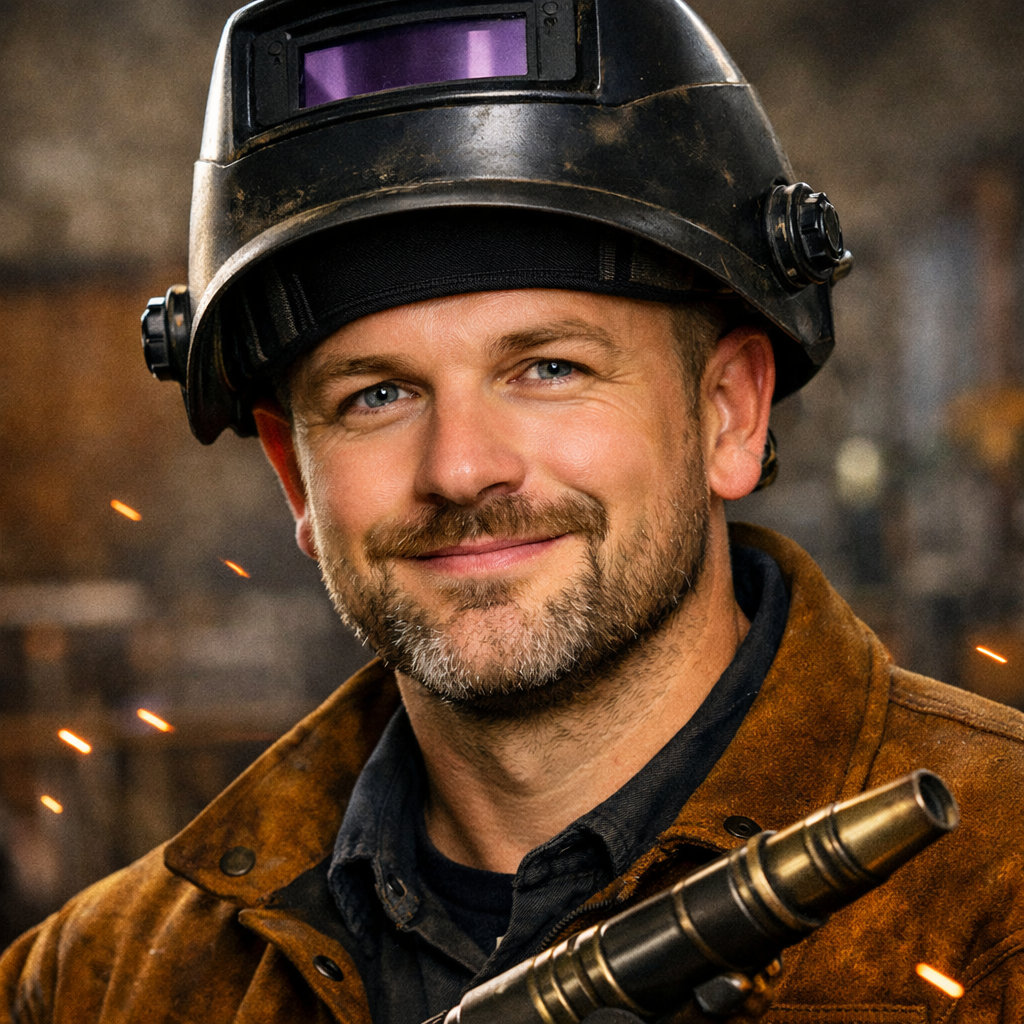
Hi, I’m Zachary Ford. I’m passionate about welding and dedicated to helping both beginners and experienced welders make informed decisions. I research, test, and write about welding helmets, welding machines, safety equipment, and essential workshop tools. My goal is to provide honest reviews, practical buying guides, and easy-to-follow tutorials that help you weld more safely, work more efficiently, and choose the right gear with confidence.