
Welders draining a 60-gallon shop compressor after a full day of plasma cutting or MIG runs often see orange sludge and rust flakes instead of clean condensate. That internal corrosion doesn’t stay contained—it migrates through regulators, clogs torch lines, and introduces moisture that causes porosity in welds or premature failure of pneumatic grinders.
Coating inside of your air compressor tank stops this cycle by forming a durable barrier that blocks oxygen and moisture from reaching the steel. In untreated carbon-steel tanks operating at 175 PSI with typical shop humidity, wall loss runs 0.1–0.5 mm per year; a correctly applied internal coating drops that rate to near zero and doubles or triples tank service life.
I’ll discuss the exact material choices, preparation sequences, application volumes, and verification steps needed for reliable results on 20- to 120-gallon tanks without guesswork or repeated failures.
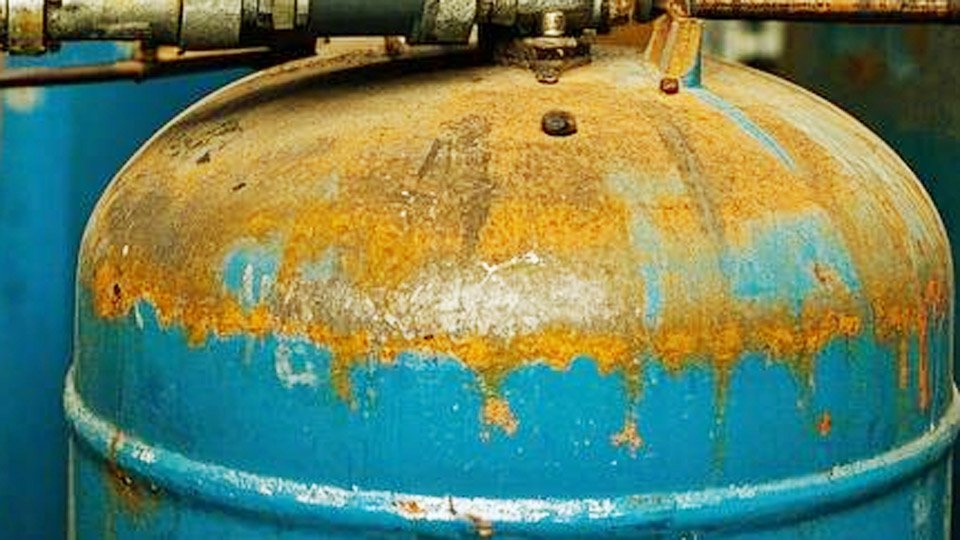
Image mncompressor
Why Internal Rust Develops Faster in Welding Shop Compressors
Compressed air holds 1–2% water vapor by volume at ambient conditions. Each compression cycle cools the air inside the tank below its dew point, dropping free water onto the bottom and sides. In a welding shop running 4–8 hours daily, the tank experiences 200–400 pressure cycles per shift, accelerating electrochemical oxidation at heat-affected zones near welds.
ASTM A36 or A516 Grade 70 steel forms rust (Fe₂O₃·nH₂O) that expands 7–8 times its volume, creating stress risers that reduce burst margins from the ASME-required 4:1 safety factor.
Condensation Dynamics Under Cyclic Loading
Vertical tanks collect water at the lowest point where drain valves rarely reach every drop. Horizontal tanks trap moisture along the seam lines. At 175 PSI working pressure, even 50 ml of standing water per cycle creates a continuous electrolyte film.
Shops without aftercoolers or dryers see pH 5–7 condensate that attacks bare steel at 0.2–0.4 mm/year—fast enough to thin a 0.093-inch wall tank to code minimum in under 8 years.
Impact on Downstream Welding Equipment
Rust particulates travel at 300–400 ft/min through ⅜-inch lines and embed in plasma electrode tips, causing double-arcing and consumable life drops of 40–60%. In MIG setups, moisture-laden air raises hydrogen content in the weld pool, producing porosity visible only after X-ray or bend testing. Coated tanks deliver dew points 20–30°F lower at the tool, eliminating these variables.
Evaluating If Internal Coating Is the Right Choice for Your Setup
Not every tank needs internal treatment. New factory tanks with intact external paint and daily draining may last 12–15 years. Older units showing external scale at the base or more than 5% wall loss on ultrasonic testing should be replaced rather than coated. Hydrostatic test to 1.3× MAWP (maximum allowable working pressure) first; any leak or bulge disqualifies the tank.
Tank Condition Assessment Criteria
Use a borescope through the drain port or regulator hole to check for scale thicker than 1/16 inch or pitting deeper than 0.030 inch. Measure wall thickness at three points on the bottom head with a 5 MHz ultrasonic gauge.
If minimum thickness falls below 0.080 inch on a 0.093-inch nominal tank, scrap it. Tanks with baffles or internal braces limit access and reduce coating success rates below 70%.
Cost-Benefit Analysis: Coating vs. Replacement
A KBS or POR-15 kit costs $60–90 and covers a 60-gallon tank. Labor runs 4–6 hours. Replacement tanks run $250–450 plus shipping and downtime. Coated tanks show zero measurable corrosion after 10–15 years when paired with automatic drains, delivering ROI in under 18 months for shops running 5+ days per week.
Compatible Coating Systems for Pressurized Air Tanks
Coatings must handle 200 PSI continuous, resist abrasion from high-velocity condensate, and maintain adhesion at 50–90°F shop temperatures. Solvent-based paints flake; two-part epoxies and polyurethanes bond chemically after proper etching.
Epoxy vs. Polyurethane vs. Zinc-Rich Options
| Coating Type | Thickness (mils) | Cure Time at 70°F | Key Advantage | Best For | Expected Life (years) |
|---|---|---|---|---|---|
| Epoxy Phenolic | 4–8 | 24–48 h | Highest chemical resistance | Humid welding shops | 10–15 |
| Polyurethane | 5–10 | 12–24 h | Flexibility under vibration | Portable compressors | 8–12 |
| Zinc-Rich Epoxy | 3–6 | 48–72 h | Cathodic protection at micro-damage | Post-weld repairs | 12–20 |
| Novolac Epoxy | 6–12 | 24–36 h | Acid resistance in condensate | High-cycle production | 15–20 |
Zinc-rich formulas protect heat-affected zones even if abrasion occurs. Avoid linseed oil or motor oil; they remain tacky and migrate into air lines.
Product Recommendations Based on Tank Volume
For 20–30 gallon tanks use 1 quart kits (POR-15 Fuel Tank Sealer or KBS Tank Sealer). 60-gallon verticals need 1–1.5 quarts. 120-gallon horizontal units require 2 quarts applied in two stages. Always verify coverage on the product data sheet; excess leaves pools that never fully cure.
Critical Surface Preparation for Maximum Adhesion
Adhesion below 1,500 psi (ASTM D4541) causes delamination within 2 years. Remove all mill scale, old rust, and oil films before coating.
Degreasing and Rust Removal Protocols
Flush with alkaline degreaser (pH 9–11 at 140°F) for 30 minutes with agitation, then rinse until pH neutral. Follow with 10–20% phosphoric acid solution (or commercial rust remover) sloshed for 30–60 minutes to etch to a clean gray surface. For heavy scale, drop a 20-ft length of ¼-inch chain through the drain port and rotate the tank for 10 minutes to mechanically loosen flakes, then vacuum or flush.
Etching and Drying Techniques for Confined Spaces
After acid treatment, rinse three times with clean water and force-dry with 120–140°F compressed air for 4–6 hours. Residual moisture creates bubbles; verify dryness by taping a mirror inside overnight—no fogging allowed. In cold shops, use portable kerosene heaters (indirect fire only) to reach 110°F internal temperature for 2 hours.
Precise Application Procedures That Deliver Full Coverage
Work in 50–90°F with <85% relative humidity. Mix two-part coatings exactly 4:1 by volume and use within pot life (usually 45–90 minutes).
Pour-and-Rotate for Standard Shop Tanks
Plug all ports except the drain. Pour the full kit volume through the lowest fitting. Roll the tank slowly on its side at 10–20 RPM for 10–15 minutes, then stand it upright, invert, and repeat until every surface shows wet film. Drain excess back into the mixing cup for disposal. Rotate every 15 minutes during the first hour to prevent runs.
Spray Methods for Large Vertical Tanks
For tanks over 80 gallons or with baffles, fabricate a ⅜-inch wand with a 60° fan tip. Pressurize to 2,000–3,000 PSI with an airless sprayer and mist 4–6 mils wet film thickness in overlapping passes while rotating the tank. This achieves uniform coverage where pouring leaves shadows behind welds.
Verification, Curing, and Initial Pressure Testing
Leave ports open during cure to vent solvents. Full hardness (Shore D 80–90) develops in 7 days, but tanks can return to low-pressure service after 24 hours.
Holiday Detection and Cure Monitoring
Insert a borescope after 48 hours to confirm no dry spots or runs thicker than 12 mils. Holiday detectors set to 50–100 V/mil reveal pinholes; touch up immediately with brush-applied coating.
Hydrostatic Testing Requirements for Welders
Fill with water, bleed all air, and pressurize to 1.3× MAWP (typically 225–260 PSI for 175 PSI tanks) for 30 minutes. Acceptable leak rate is zero visible drips. Drain and dry again before returning to compressed-air service.
Integrating Coated Tanks into Professional Welding Workflows
A coated tank still requires moisture management. Install an aftercooler dropping outlet temperature 15–20°F and a refrigerated or desiccant dryer achieving –40°F dew point.
Pairing with Air Treatment Systems
Route discharge through a 0.01-micron coalescing filter before the tank to strip 99% of oil and water aerosols. Add an automatic electronic drain that pulses 1–2 seconds every 15–30 minutes during operation—far more effective than manual valves for 8-hour shifts.
Daily Drain Schedules Optimized for 8-Hour Shifts
Open the drain valve at shift start and again at lunch break. In 70%+ humidity shops, add a third drain at end of day. Coated tanks produce 40–60% less sludge, making the routine faster and cleaner.
Monitoring and Maintaining Coated Tank Performance Over Years
Annual inspection prevents surprises. Remove the drain fitting and insert a borescope; look for chalking, cracking, or bare metal spots larger than ¼ inch.
Inspection Intervals Using Borescopes
Schedule borescope checks every 12 months for hobby tanks, every 6 months for production shops. Record photos of the bottom head and seam lines for trend analysis.
Signs of Coating Degradation and Remediation
Small blisters or color change signal moisture entrapment—strip locally with methylene chloride, re-etch, and patch. Delamination over 5% of surface area requires full reapplication after complete removal. Re-coat every 8–12 years in aggressive environments.
Final Thoughts
Coated tanks paired with disciplined drainage and downstream drying deliver rust-free performance that keeps plasma consumables lasting 50% longer and eliminates porosity rejects on structural welds.
The real pro-level decision is choosing zinc-rich epoxy when your tank sees frequent pressure cycling or post-weld repairs—its cathodic protection continues working even after minor abrasion, giving the highest margin of safety in high-output fabrication shops.
FAQs
Can I coat the inside of my air compressor tank without removing all fittings?
Yes, but only if you can access the drain port and at least one top port for venting and pouring. Remove the drain valve and pressure switch for best results; leaving them installed risks incomplete coverage around threads.
What is the best coating for air compressor tank rust in a humid welding shop?
Zinc-rich epoxy or novolac epoxy systems outperform standard primers. They combine barrier protection with cathodic action and resist acidic condensate better than polyurethane in 70%+ humidity environments.
How long does the coating last before reapplication is needed?
Properly prepared and cured coatings deliver 10–15 years of zero measurable corrosion when tanks are drained daily and paired with an aftercooler. Inspect annually; reapply at the first sign of bare metal exposure.
Does coating inside of your air compressor tank affect air tool lubrication or weld quality?
No. Fully cured two-part epoxies are chemically inert and release no VOCs or oils into the airstream. They actually improve weld quality by eliminating moisture that causes hydrogen porosity in MIG and FCAW.

Hi, I’m Zachary Ford. I’m passionate about welding and dedicated to helping both beginners and experienced welders make informed decisions. I research, test, and write about welding helmets, welding machines, safety equipment, and essential workshop tools. My goal is to provide honest reviews, practical buying guides, and easy-to-follow tutorials that help you weld more safely, work more efficiently, and choose the right gear with confidence.