
A Vevor welder review usually starts with the same question: what will you actually weld? The wrong pick shows up on day one, when the machine won’t run the wire size you bought, or it can’t handle the metal thickness in front of you.
These five picks differ on process count, duty, and what’s in the box. Every pick below is judged on the same three things: what it’s strong at, what it gives up, and what living with it would ask of you.
As an Amazon Associate, we earn from qualifying purchases. This post contains affiliate links – if you buy through them, we may earn a commission at no extra cost to you.
1. Vevor 250A MIG Welder

Best for: The buyer who wants one machine for many jobs
This is a 6-in-1 unit from FEMEROL. It covers gas MIG, gasless flux core, stick, spot, and Lift TIG, and it takes a spool gun for aluminum.
Strengths:
- Six welding processes in one machine
- Synergic control sets current and wire speed
- Welds aluminum two ways, including spool gun
- Listed for mild steel up to 14.0mm plate
- Two-year guarantee from the seller
Trade-offs:
- TIG torch and spool gun sold separately
- Aluminum needs a teflon liner or spool gun
Living with this one means learning its menus. The trade is that two of the six processes need gear that isn’t in the box, so the aluminum work you bought it for waits until that arrives. A buyer who only ever sticks two pieces of steel together would be paying for modes they’ll never open.
| Best for | Why |
|---|---|
| Home shop with mixed jobs | Runs steel, stainless, and aluminum |
| Beginner welder | Synergic control sets the current |
| Fabricator doing repairs | Stick mode for dirty outdoor metal |
2. 200A MIG Welder 110V 220V 6 in 1 Aluminum Welding
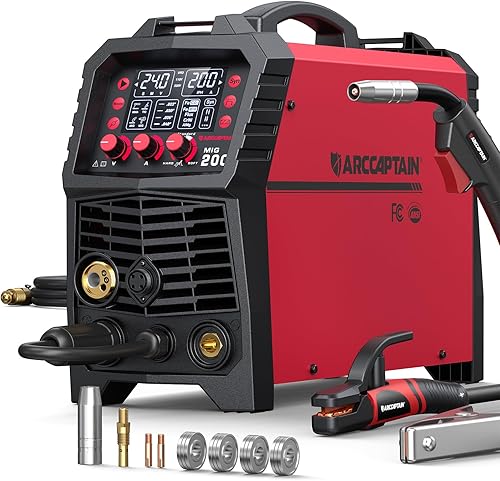
Best for: The welder who works aluminum most often
The ARCCAPTAIN MIG200 is a multi-process machine built around aluminum work. It runs gas MIG, gasless flux core, stick, spot, and Lift TIG, with a spool gun connector as an option.
Strengths:
- Handles.035″ and.040″ aluminum wire
- Stores 10 preset welding settings
- Large LED screen readable in a helmet
- Cooling fan runs only when needed
- Shoulder strap included for carrying
Trade-offs:
- .023″ and.040″ rollers sold separately
- Spool gun and TIG torch not included
This one asks you to use its memory. Save a job and the next repair starts faster. The fan cycling on demand means less noise. Two things to plan for: some rollers come separately, and the listing warns you not to switch between 110V and 220V while the screen is on. Follow that and the machine stays out of trouble. A buyer who mostly sticks steel plate would pay for features they won’t use.
| Best for | Why |
|---|---|
| Aluminum repair work | Supports.035″ and.040″ wire |
| Repeat jobs | 10 stored preset settings |
| Mobile work | Shoulder strap and LED screen |
3. 205A Tig Welder Pulse STICK/DC TIG/PULSE TIG 3 in 1

Best for: The welder who wants clean TIG beads
The YESWELDER TIG-205P is a 3-in-1 machine: stick, DC TIG, and pulse TIG. It’s the pick here for anyone whose work is stainless and mild steel rather than aluminum.
The case it makes is control. Pulse TIG gives you separate settings for pulse frequency, duty cycle, and current, which helps on thin material. HF start ignites the arc without touching the work, and hot start plus anti-stick smooths stick mode. It weighs 10.7lb, and it senses 110V or 220V on its own.
Strengths:
- Pulse TIG with separate frequency and duty controls
- HF non-touch arc starting
- Auto-sensing 110V/220V input
- Auto memory saves settings after power-off
- 5-pin foot pedal interface reserved
Trade-offs:
- Can’t weld aluminum at all
- Foot pedal not included
Owning this one is mostly about the arc. The foot pedal port is there, but the pedal is a separate buy. If your work is stainless and steel, it covers the ground well.
| Best for | Why |
|---|---|
| Stainless work | Pulse TIG on thin material |
| Shop and site use | 10.7lb with dual voltage |
| Stick welding too | Hot start and anti-stick |
4. 200Amp 20PCS Rods Stick Welder

Best for: The buyer who needs a welder that travels
The Hpoouo 200A stick welder is the small one. It measures 7.8 x 3.9 x 5.3 inches and weighs 3.7 lbs, so it fits in a backpack or a toolbox. It runs on 110V with adjustable current from 20-200A.
The listing stakes its case on being ready to work. It ships with 20 welding rods, two chipping hammers, and a pair of gloves. It uses IGBT inverter control, with hot start, arc force, and anti-stick.
Strengths:
- 3.7 lb, fits in a backpack or toolbox
- 20 welding rods included in the box
- Welds 0.06 to 0.2 inch thick metal
- Hot start and anti-stick functions
- Gloves and two chipping hammers included
Trade-offs:
- Stainless needs E308L-16 rods only
- Rod polarity must be set by rod type
Living with this one is simple and limited. There’s no wire, no gas, and no feed system to jam, which suits outdoor work and rooftop repairs. For a buyer who wants a single compact tool for repairs, it’s enough. For anyone chasing clean thin-metal welds, it isn’t.
| Best for | Why |
|---|---|
| Remote job sites | 3.7 lb and 110V power |
| First-time welders | Rods and gloves included |
| Cast iron and steel repair | 20-200A current range |
5. Vevor 135A MIG Welder

Best for: The beginner who wants to start today
The synergic control matches voltage to your wire feed speed, which takes the guesswork out of setup. There’s also a ±3V micro-adjustment for finer tuning. The listing points this at thin auto body panels, where burn-through is the usual problem. It weighs 11.4 lbs and puts out 135A on 110V.
Strengths:
- Flux core wire included, no gas needed
- Synergic control matches voltage to feed speed
- ±3V micro-adjustment for fine tuning
- 11.4 lb with a carrying handle
- Over-current, over-load, and over-heating protection
Trade-offs:
- Lift TIG needs a separate torch
- 135A limits it to thin steel
This one asks the least of its owner. Lift TIG is listed, but the torch comes separately, so most buyers will stay on flux core. It’s a good first welder for body panels and small brackets.
| Best for | Why |
|---|---|
| First welder | Wire included, no gas needed |
| Auto body panels | Synergic control stops burn-through |
| Outdoor work | Flux core handles wind |
Side by Side
The table below lines up all five machines on process count, output, and what comes in the box.
How to Judge One of These
Process count and what it really adds
A multi-process label sounds like a whole shop in one box. On these listings, TIG torches and spool guns are the common extras.
The mode that matters most is the one you’ll use weekly. If you weld steel outdoors, flux core or stick covers it. If you weld aluminum, you need the spool gun path or a teflon liner. Before ordering, check which modes run with only what’s in the box. That tells you what you can do on day one.
Input voltage and where you’ll plug it in
Two of these machines sense 110V and 220V on their own, and the others run on 110V.
Confirm your breaker and outlet. A welder pulls high current on startup. Check the outlet you plan to use. Do that before the box arrives.
Duty cycle and heat
Every machine here lists over-heating protection, and that protection exists for a reason. Welding builds heat inside the unit, and the machine shuts down when it gets too hot.
For home work, this rarely bites. Most garage projects run in short beads anyway. For long seams on thick plate, a higher-output machine recovers faster. Think about your longest single weld, not your average one. That decides whether a small machine keeps up.
Wire, rods, and running supplies
The welder is the start of the spending.
Check what’s included too. One machine ships with wire, another with 20 rods, gloves, and hammers. The American Welding Society publishes filler metal classifications, and the wire or rod label will name one. Matching that label to your base metal is the check the listing points you toward.
Frequently Asked Questions
Will a 110V welder handle my project?
It depends on thickness, not on the brand. The 110V machines here are listed for specific thicknesses: the 135A unit handles mild steel up to 3/32″ (2.5mm), and the stick machine covers 0.06 to 0.2 inch. That fits trailer repairs, gates, brackets, and body panels. Check the thickness of your thickest piece before you choose.
What does the first week with one of these look like?
You’ll unpack the machine, fit the wire or rod, set the current, and run beads on scrap. Nothing here needs a class, but an hour on scrap steel saves ruined work later.
What do I have to buy separately?
TIG torches and spool guns are the big ones. The 250A and MIG200 machines list Lift TIG and spool gun compatibility, but neither torch nor spool gun is in the box. Read the included-items list before ordering.
What will these welders not do?
None of them cuts metal, and none is a plasma torch. Every one pauses when it gets hot, because over-heating protection is built in.
Is the simplest pick here enough?
For many buyers, yes. The 135A MIG Welder ships with flux core wire, needs no gas, and its synergic control sets voltage from your wire feed speed. If your work is thin steel, body panels, and small repairs, it covers that ground without extra purchases. Step up only when you need aluminum, thicker plate, or TIG control. Buy for the jobs you have, not the ones you might take on someday.
Closing
For most home shops, the Vevor 250A MIG Welder covers the widest range of jobs, with synergic control that helps a beginner get a bead down. If your need is unusual, the Vevor 200A Stick Welder suits the buyer who works far from an outlet, since it weighs 3.7 lbs and runs on 110V. The next step is simple: pick the metal you weld most, confirm the machine runs it with what’s in the box, then check your outlet and breaker before you order. That order of thinking helps you choose with confidence.
Hi, I’m Zachary Ford. I’m passionate about welding and dedicated to helping both beginners and experienced welders make informed decisions. I research, test, and write about welding helmets, welding machines, safety equipment, and essential workshop tools. My goal is to provide honest reviews, practical buying guides, and easy-to-follow tutorials that help you weld more safely, work more efficiently, and choose the right gear with confidence.