
Correct amperage settings are critical to arc stability, penetration depth, and electrode performance in shielded metal arc welding. A Stick Welder Settings Chart provides recommended amperage ranges based on electrode type and diameter, helping welders maintain consistent arc characteristics and avoid common defects such as undercut, slag inclusion, and lack of fusion.
In real welding conditions, improper current settings can quickly lead to unstable arcs, excessive spatter, poor bead shape, or insufficient penetration, especially when working across different material thicknesses and positions.
Electrodes such as E6010, E6011, E6013, and E7018 each require specific amperage ranges to burn correctly and produce sound welds.
Using a reliable settings chart allows welders to quickly match electrode size to the correct current range, improving efficiency and reducing trial-and-error adjustments at the machine.
In this guide I’ll explain how to interpret stick welding settings charts and apply them effectively for consistent weld quality across common fabrication and repair applications.
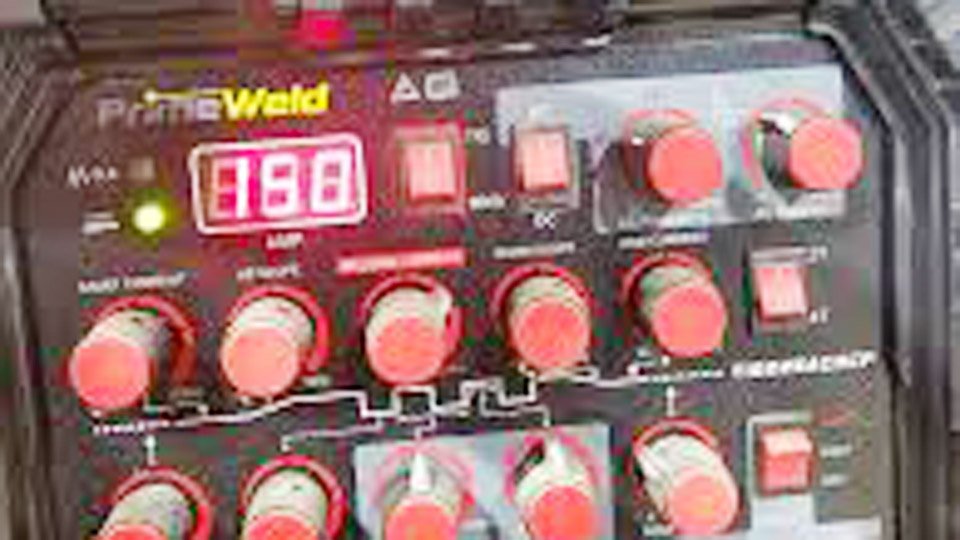
Image by PRIMEWELD EQUIPMENT USERS
Electrode Classification Breakdown
Stick welding electrodes are classified under AWS standards, with the “E” prefix indicating suitability for arc welding. The first two or three digits denote tensile strength in ksi; for example, E60XX offers 60 ksi minimum, while E70XX provides 70 ksi.
The third digit specifies usable positions: 1 for all positions, 2 for flat and horizontal fillets, 4 for all positions with downhill progression.
The fourth digit defines coating type and polarity. EXX10 and EXX11 feature high cellulose coatings for deep penetration, compatible with DC+ or AC. EXX13 uses rutile coatings for smooth arcs and minimal spatter, operable on AC, DC+, or DC-.
EXX18 incorporates iron powder low-hydrogen coatings for high-strength welds, requiring DC+ or AC and strict moisture control to prevent hydrogen cracking.
Diameter selection correlates with amperage capacity and material thickness. Common sizes include 3/32 in (2.4 mm), 1/8 in (3.2 mm), 5/32 in (4.0 mm), and 3/16 in (4.8 mm). Larger diameters handle higher amperages for thicker sections, increasing deposition rates up to 0.25 lb/hr per 10 amps.
Electrode length typically ranges from 12 to 18 in, with shorter lengths preferred for overhead work to maintain control. Storage conditions are paramount for low-hydrogen types; maintain ovens at 250-300°F to limit diffusible hydrogen below 8 ml/100g.
Factors Influencing Stick Welder Settings
Amperage selection depends on electrode diameter, material thickness, and welding position. For mild steel, increase amperage by 10-20% for thicknesses exceeding 1/4 in to ensure fusion. Stainless steel requires 20-30% lower amperage than mild steel due to higher electrical resistance, preventing overheating and carbide precipitation.
Joint preparation affects settings; bevel angles of 30-45° for V-grooves demand higher initial amperage for root passes. Travel speed, typically 6-12 in/min, modulates heat input; slower speeds at constant amperage increase penetration depth by 15-25%.
Machine type influences output. Constant current (CC) power sources maintain stable arcs despite voltage fluctuations, essential for SMAW. Duty cycle ratings, such as 60% at 200 amps, dictate maximum continuous operation without overheating.
Environmental factors like wind necessitate amperage adjustments; increase by 5-10 amps outdoors to compensate for arc blow. Base metal cleanliness is non-negotiable; remove mill scale to avoid porosity, which can reduce weld strength by up to 30%.
Comprehensive Stick Welder Settings Chart
The following tables outline amperage ranges by electrode type, diameter, polarity, and typical material thickness for mild steel.
All values are approximate; test welds on scrap material to verify compliance with specifications. Amperage increases with thickness to maintain penetration; use lower ends for thin sections to avoid burn-through.
E6010 and E6011 Electrodes (Deep Penetration, All Positions)
| Electrode | Diameter (in/mm) | Amperage Range (DC+) | Polarity | Metal Thickness (in) | Arc Characteristics |
|---|---|---|---|---|---|
| E6010 | 3/32 / 2.4 | 40-85 | DC+ | 3/32-3/16 | Forceful, digging arc with high spatter |
| E6010 | 1/8 / 3.2 | 75-125 | DC+ | 1/8-1/4 | Deep penetration, fast freeze slag |
| E6010 | 5/32 / 4.0 | 110-165 | DC+ | 1/4-3/8 | Suitable for root passes in pipe |
| E6011 | 3/32 / 2.4 | 40-85 | AC/DC+ | 3/32-3/16 | Similar to E6010, AC compatibility |
| E6011 | 1/8 / 3.2 | 75-125 | AC/DC+ | 1/8-1/4 | Versatile for rusty surfaces |
| E6011 | 5/32 / 4.0 | 110-165 | AC/DC+ | 1/4-3/8 | Good arc start on contaminated metal |
E6013 Electrodes (General Purpose, Smooth Arc)
| Electrode | Diameter (in/mm) | Amperage Range (AC/DC+/-) | Polarity | Metal Thickness (in) | Arc Characteristics |
|---|---|---|---|---|---|
| E6013 | 3/32 / 2.4 | 50-90 | AC/DC+/- | 1/16-1/8 | Soft arc, low spatter, easy slag removal |
| E6013 | 1/8 / 3.2 | 80-130 | AC/DC+/- | 1/8-1/4 | Ideal for sheet metal, shallow penetration |
| E6013 | 5/32 / 4.0 | 105-180 | AC/DC+/- | 3/16-3/8 | Stable in all positions, minimal undercut |
| E6013 | 3/16 / 4.8 | 140-225 | AC/DC+/- | 1/4+ | Higher deposition for fillets |
E7018 Electrodes (Low Hydrogen, High Strength)
| Electrode | Diameter (in/mm) | Amperage Range (DC+/AC) | Polarity | Metal Thickness (in) | Arc Characteristics |
|---|---|---|---|---|---|
| E7018 | 3/32 / 2.4 | 70-110 | DC+/AC | 1/8-3/16 | Smooth, low hydrogen, requires dry storage |
| E7018 | 1/8 / 3.2 | 90-160 | DC+/AC | 3/16-1/4 | Excellent toughness, crack-resistant |
| E7018 | 5/32 / 4.0 | 130-220 | DC+/AC | 1/4-3/8 | High deposition rate, all-position |
| E7018 | 3/16 / 4.8 | 200-300 | DC+/AC | 3/8+ | For structural welds, controlled heat input |
For stainless steel, reduce amperage by 20% from mild steel values; for cast iron, use nickel-based electrodes like ENi-CI at 80-120 amps for 1/8 in diameter.
Polarity Recommendations
Direct current electrode positive (DCEP or DC+) is standard for most SMAW electrodes, providing 70% heat at the workpiece for deeper penetration up to 0.25 in. This polarity minimizes electrode melting rate, extending rod life by 20-30%.
Direct current electrode negative (DCEN or DC-) concentrates 70% heat at the electrode, increasing deposition rates by 25% but reducing penetration. Used for E6013 in thin sections or high-speed applications.
Alternating current (AC) stabilizes arcs on magnetized materials, reducing arc blow. It balances penetration and deposition, suitable for E6011 and E6013 in field repairs where DC sources are unavailable.
Polarity mismatch causes unstable arcs; for E6010, DC+ ensures forceful digging, while AC leads to excessive spatter and poor fusion.
Adjustments for Welding Positions
Flat position (1F/1G) allows highest amperages for maximum deposition, typically 10-15% above vertical settings.
Horizontal position (2F/2G) requires 5-10% amperage reduction to control molten pool; maintain 45-60° electrode angle to prevent undercut.
Vertical up (3F/3G) demands 15-20% lower amperage than flat, with weave patterns to build shelf; travel speed 4-6 in/min prevents sagging.
Overhead (4F/4G) uses shortest arcs at 20-25% reduced amperage; E6010 excels here with fast-freeze slag.
Pipe welding (5G/6G) combines positions; root passes at 80-100 amps for 1/8 in E6010 ensure 0.06-0.1 in penetration.
Material Compatibility and Joint Preparation
Mild steel pairs with E6010/E6011 for contaminated surfaces, achieving 85-95% joint efficiency. Stainless steel uses E308-16 at 70-120 amps for 1/8 in, with 1/32 in root gaps to accommodate expansion.
Cast iron demands preheat to 500-1200°F; ENiFe-CI electrodes at 100-150 amps minimize cracking.
Joint types influence settings. Butt joints require full penetration; set amperage for 1.5-2 times thickness depth. Fillet welds prioritize leg size; 1/8 in E7018 at 120 amps yields 0.25 in legs.
Preparation includes 60° included angles for grooves, with 1/16-1/8 in lands. Clean to bare metal within 1 in of joint to ensure fusion.
Arc Characteristics and Travel Speed Influence
Arc length should equal electrode diameter; longer arcs increase voltage 2-5V, widening beads but reducing penetration by 20%. Short arcs concentrate heat for narrow, deep welds.
Travel speed affects heat input: 8-10 in/min for 1/8 in electrodes balances penetration and bead profile. Slower speeds raise input to 40-60 kJ/in, risking distortion in thin plates.
Arc force in modern machines adds 10-20% current surge for starts, improving stability on low-hydrogen rods.
Deposition Rate and Slag Behavior
Deposition efficiency averages 60-70% for SMAW; E7018 achieves 0.15-0.25 lb/hr at 150 amps. Higher amperages boost rates linearly, but exceed limits cause slag entrapment.
Slag from cellulose coatings (EXX10) is friable, self-peeling in flat positions. Rutile slags (EXX13) are dense, requiring chipping; low-hydrogen (EXX18) forms glassy coverings for protection against atmospheric contamination.
Manage slag by interpass cleaning; incomplete removal causes inclusions, reducing fatigue strength by 40%.
Common Failure Causes
Insufficient amperage results in lack of fusion, with penetration depths below 0.1 in. Excessive amperage causes burn-through in materials under 1/8 in thick.
Improper polarity leads to globular transfer instead of spray, increasing spatter by 30%. Inadequate joint preparation amplifies undercut risks, deepening to 0.03 in.
Moisture in low-hydrogen electrodes introduces hydrogen, causing cracks at stresses over 50 ksi.
Performance Summary
Optimized stick welder settings ensure welds meet AWS D1.1 standards, with penetration, strength, and minimal defects. Amperage calibration to electrode and material yields arc stability, controlling heat input for distortion-free fabrications.
Polarity selection enhances deposition or penetration as required, while position adjustments maintain quality across applications.
In advanced scenarios, integrating pulse modes on inverter machines reduces heat-affected zone by 15%, improving mechanical properties in high-alloy steels.
FAQs
What amperage range is recommended for 1/8 in E6013 on 1/4 in mild steel?
For 1/8 in E6013 on 1/4 in mild steel, set 100-120 amps on AC or DC+/- for balanced penetration and smooth bead, adjusting +10 amps for vertical positions.
How does polarity affect E7018 electrode performance?
DC+ with E7018 provides deeper penetration and lower spatter; AC is viable for magnetized workpieces but increases hydrogen risk if rods are not oven-dried.
What adjustments are needed for overhead welding with E6010?
Reduce amperage 20% from flat settings, maintain 1/8 in arc length, and use stringer beads at 4-5 in/min travel speed to control pool and slag.
Why use lower amperage for stainless steel?
Stainless steel’s higher resistance generates more heat; 20% reduction prevents warping and maintains corrosion resistance by limiting carbide formation.
How to select electrode diameter for thick plates?
For plates over 3/8 in, choose 5/32 in or larger diameters to support 150+ amps, ensuring fusion without multiple passes.

Hi, I’m Zachary Ford. I’m passionate about welding and dedicated to helping both beginners and experienced welders make informed decisions. I research, test, and write about welding helmets, welding machines, safety equipment, and essential workshop tools. My goal is to provide honest reviews, practical buying guides, and easy-to-follow tutorials that help you weld more safely, work more efficiently, and choose the right gear with confidence.