
Determining What Size Welder You Need for 1/4-inch Steel is a foundational decision that affects weld penetration, travel speed, heat control, and overall joint integrity.
At 1/4 inch thickness, steel requires enough amperage to achieve full fusion without excessive pass count or burn-through, especially on butt and fillet joints. Undersized machines can lead to cold, weak welds; Oversized settings can cause warping and spatter.
Understanding the relationship between welder capacity (amperage range), process type (MIG, Stick, TIG), and electrode or wire selection is critical to reliably weld 1/4-inch steel in fabrication, repair, or structural applications. The right setup minimizes grinding, gouging, and rework while ensuring sound penetration and acceptable bead profile.
This guide frames why matching your welder’s power output to material thickness matters in real shop conditions and sets up practical guidance on choosing the correct machine and settings for consistent, high-quality welds.
Photo by I See You Don’t Know Shit About Welding
Steel Thickness And Welding Challenges
Steel thickness is usually measured in inches or millimeters. 1/4 inch steel is about 6.35 mm thick, which puts it in the range where light-duty welders can struggle and industrial machines are often used. At this thickness:
- You need enough heat (amperage) for proper penetration.
- Too little power leads to weak, shallow welds.
- Too much heat can burn through or distort the steel.
Welding 1/4 inch steel is a bit of a balancing act. It’s thicker than what small hobby welders are made for but not as heavy as industrial plate steel. Most home and farm projects, trailer builds, and equipment repairs use steel in the 1/8″ to 1/4″ range.
Factors When Choosing A Welder For 1/4 Steel
Before you choose a welder, consider these factors:
- Welding process (MIG, Stick, TIG, Flux-Cored)
- Minimum and maximum amperage
- Duty cycle (how long you can weld before overheating)
- Power source (120V household vs. 240V industrial)
- Portability and workspace
- Material preparation
- Your skill level
Each welding process has its strengths and weaknesses for 1/4 steel. Let’s look at each one in detail.
Mig Welder Size For 1/4 Inch Steel
MIG welding (Metal Inert Gas) is popular for welding 1/4 inch steel because it’s fast, relatively easy to learn, and gives clean welds with little spatter. It uses a wire feed and shielding gas (usually CO₂ or a mix).
What Size Mig Welder Do You Need?
For 1/4 inch steel, the recommended settings for MIG are:
- Minimum amperage: 180 amps
- Voltage: 22–25 volts
- Wire size: 0.035″ (0.9 mm) or 0.045″ (1.2 mm)
- Power requirement: 240V is strongly recommended
Most 120V MIG welders top out around 140 amps, which is not enough for full penetration on 1/4″ steel in a single pass. You need a 240V MIG welder with at least 180 amps output.
Example: Practical Settings
Suppose you want to weld a 1/4″ steel plate to a frame. A 200 amp 240V MIG welder, set at 22 volts and using 0. 035″ wire, will provide a solid, single-pass weld with good penetration.
Why Duty Cycle Matters
Duty cycle is the percentage of time a welder can run in a 10-minute period before needing to cool down. For example, a 30% duty cycle at 200 amps means you can weld for 3 minutes, then rest for 7.
If you plan to weld long beads or many joints, look for a welder with at least a 30% duty cycle at your chosen amperage. For occasional small welds, a lower duty cycle is acceptable.
Advantages And Limitations
- Pros: Fast, clean welds, easy to learn, good for production work
- Cons: Needs shielding gas, not ideal outdoors in wind, higher cost
Beginner Insights
New welders often think “more amps are always better. ” In reality, using too high of a setting can burn through thin spots or cause excess spatter. Always test on scrap steel first, and adjust wire speed and voltage for smooth arc and good bead appearance.
Stick Welder Size For 1/4 Inch Steel
Stick welding (SMAW or Shielded Metal Arc Welding) is a classic process that’s well-suited for 1/4 inch steel, especially outdoors or on dirty/rusty metal. It uses metal rods (electrodes) that provide both filler metal and shielding.
What Size Stick Welder Do You Need?
To weld 1/4 inch steel with stick welding:
- Minimum amperage: 180 amps
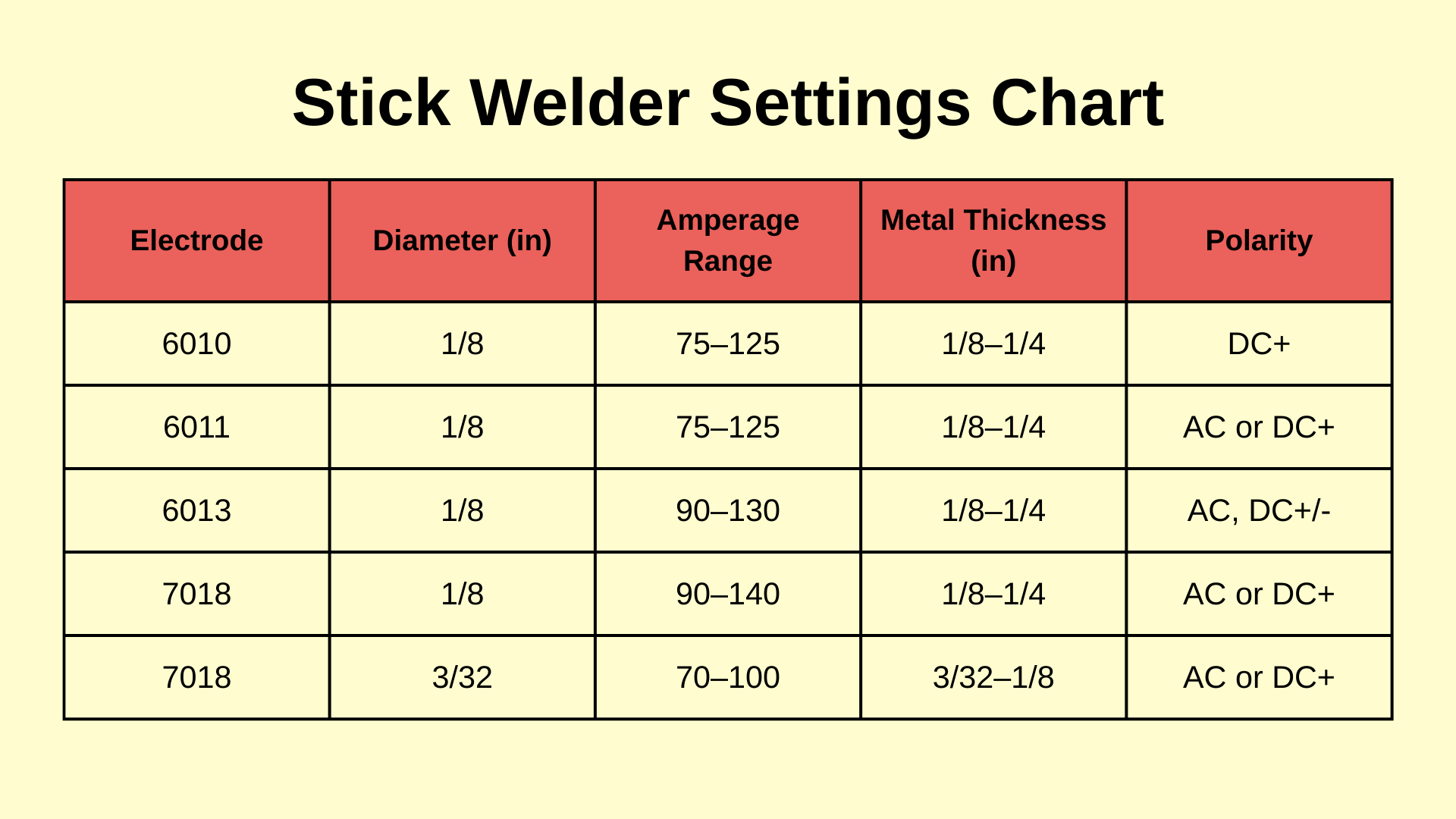
- Electrode size: 1/8″ (3.2 mm) or 5/32″ (4 mm), usually E6010, E6011, E7018
- Power requirement: 240V preferred (some large 120V units can work, but with limits)
A 180–200 amp stick welder will handle 1/4″ steel comfortably. Many farm and shop stick welders are rated for this.
Practical Example
If you use a 1/8″ E7018 rod, set the welder to about 125–135 amps for a flat weld. For a 5/32″ rod, 150–180 amps is typical. Weld in multiple passes if needed for thick joints.
Duty Cycle For Stick Welders
Stick welders often have robust duty cycles—40% or higher at 180 amps is common. For short welds, even small machines can handle the job.
Advantages And Limitations
- Pros: Handles rusty/painted steel, works in wind, no gas needed, low cost
- Cons: More spatter, more slag to chip, harder to learn smooth beads
Insights For Beginners
Many new users try to run long beads without stopping, but stick welding benefits from short, controlled beads and regular cleaning of slag. Also, running too cold (low amperage) causes the rod to stick and poor fusion.

Credit: stvcnc.com
Tig Welder Size For 1/4 Inch Steel
TIG welding (Tungsten Inert Gas) is famous for precise, clean welds. It’s used for thin metals, stainless steel, and critical welds. For 1/4″ steel, TIG is less common due to its slower speed, but it produces strong, neat welds.
What Size Tig Welder Do You Need?
- Minimum amperage: 200 amps (AC/DC machine)
- Electrode: 3/32″ or 1/8″ tungsten
- Filler rod: ER70S-6 or similar, 1/16″ to 3/32″
- Power requirement: 240V only
Welding 1/4″ steel with TIG requires a powerful machine. A 200 amp AC/DC TIG welder is the minimum for single-pass welds.
Practical Example
To weld a 1/4″ steel bracket, use a 1/8″ tungsten electrode, set to 180–200 amps, and a steady hand for a slow, smooth pass. You may need to preheat thick steel for best results.
Duty Cycle
TIG welders have lower duty cycles at high amps. Look for at least 20–25% at 200 amps for steady work. Industrial units offer more.
Advantages And Limitations
- Pros: Cleanest, strongest welds, precise control, no spatter
- Cons: Slow, higher cost, hard to learn, requires clean metal and shielding gas
Insights For Beginners
Many beginners underestimate the importance of clean metal in TIG welding. Even small spots of rust or oil can ruin a weld. Always grind and degrease before starting. Also, TIG is much slower—don’t rush the bead.
Flux-cored Welder Size For 1/4 Inch Steel
Flux-cored arc welding (FCAW) is similar to MIG but uses a special wire with flux inside, so it doesn’t always need a gas tank. It’s very popular for outdoor or farm work and can handle dirty steel.
What Size Flux-cored Welder Do You Need?
- Minimum amperage: 175–200 amps
- Wire size: 0.035″ (0.9 mm) or 0.045″ (1.2 mm) flux-cored wire
- Power requirement: 240V is best
Some higher-end 120V units can weld 1/4″ steel with flux-cored wire in multiple passes, but for single-pass welds and reliability, a 240V unit with at least 175 amps is much better.
Practical Example
If you’re building a trailer frame from 1/4″ steel, a 200 amp flux-cored welder set at 21 volts with 0. 045″ wire will provide deep penetration and a strong joint.
Duty Cycle
Flux-cored welders generally have a 20–30% duty cycle at high amps. For short welds, this is enough, but for bigger projects, take cooling breaks.
Advantages And Limitations
- Pros: Works outdoors, no gas bottle needed, handles rusty steel, good penetration
- Cons: More spatter and slag, less clean than MIG/TIG, wire is more expensive
Insights For Beginners
Beginners often forget to adjust the wire speed for different thicknesses. Too slow = poor arc and cold welds; too fast = spatter and uneven bead. Practice on scrap steel to dial in your settings.
Comparing Welder Types For 1/4 Inch Steel
To help you visualize the main differences, here’s a comparison of the four welder types for 1/4″ steel:
| Welder Type | Min. Amps Needed | Power Needed | Speed | Skill Level | Notes |
|---|---|---|---|---|---|
| MIG | 180–200 | 240V | Fast | Beginner-Friendly | Clean welds, needs gas |
| Stick | 180–200 | 240V | Medium | Moderate | Rough steel, outdoor use |
| TIG | 200 | 240V | Slow | Advanced | Best quality, slow process |
| Flux-Cored | 175–200 | 240V | Medium-Fast | Beginner-Friendly | No gas needed, spatter |
Power Source: 120v Vs. 240v Welders
One of the most common mistakes is trying to weld 1/4″ steel with a small 120V welder. While technically possible with some flux-cored wires in multiple passes, you’ll get better, safer results with a 240V machine.
Why 240v Matters
- More amps available: Means more heat for thick steel
- Better duty cycle: Weld longer without stopping
- More stable arc: Smoother, cleaner welds
If you only have access to 120V, consider hiring out the job or using multiple passes, but do not expect strong, single-pass welds on 1/4″ steel.
Duty Cycle: What You Need For 1/4 Inch Steel
Duty cycle is often misunderstood. For welding 1/4″ steel, you’ll need higher amperage, which lowers the duty cycle on smaller machines.
| Welder Output | Duty Cycle (%) | Welding Time (per 10 min) | Cooling Time (per 10 min) |
|---|---|---|---|
| 200A | 30% | 3 minutes | 7 minutes |
| 180A | 25% | 2.5 minutes | 7.5 minutes |
| 150A | 20% | 2 minutes | 8 minutes |
Choose a welder with a duty cycle that matches your project size. For long welds, higher duty cycles (30–40%) are best.
Common Mistakes When Choosing A Welder For 1/4 Steel
- Buying too small: Many people buy 120V welders rated for “up to 1/4 inch steel,” but these ratings are often optimistic. Real-world welding of 1/4″ steel needs more power.
- Ignoring duty cycle: If your machine overheats, you’ll have to stop often, slowing you down and risking damage to the welder.
- Wrong process for the job: For outdoor work, MIG is less ideal due to wind blowing away shielding gas. Stick or flux-cored is better outside.
- Not matching wire/rod size: Using wire or rods that are too small for 1/4″ steel leads to weak welds.
- Not preparing metal: Dirty, rusty, or oily steel causes poor welds, especially with MIG and TIG.
Other Practical Considerations
Portability
240V welders are heavier and less portable than 120V models. If you need to move your welder to job sites, look for one with wheels or a carrying cart.
Future-proofing
If you plan to weld thicker steel in the future, buy a welder with extra capacity. A 250 amp machine can weld anything 1/4″ and below, plus heavier plate steel.
Consumables And Costs
- MIG: Wire and gas needed
- Stick: Rods (inexpensive, widely available)
- TIG: Tungsten electrodes, filler rods, gas (argon)
- Flux-Cored: Wire only, but pricier than stick rods
Factor these into your budget.
Safety
Always wear the right safety gear: welding helmet, gloves, jacket, and boots. For 1/4″ steel, the arc is bright and hot, so protect your eyes and skin.
Real-world Examples
- Building a trailer: A 200 amp MIG or stick welder on 240V can weld 1/4″ steel channel and plate in a single pass.
- Farm repairs: Stick or flux-cored welders excel on equipment with rust, paint, or mild contamination.
- Custom fabrication: TIG is slower but gives the strongest, neatest welds for visible joints.
How To Test Your Welds On 1/4 Steel
Don’t just trust the look of your weld. Always test for strength:
- Visual inspection: Look for even, smooth beads with no cracks or large holes.
- Hammer test: Try to break the joint with a hammer and see if the weld holds.
- Bend test: If possible, bend the welded area to check for cracks or separation.
If your welds fail these tests, adjust your settings or process.
Basic Weld Settings For 1/4 Inch Steel
Here’s a quick reference for typical settings:
| Process | Amps | Voltage | Wire/Rod Size |
|---|---|---|---|
| MIG | 180–200 | 22–25V | 0.035″–0.045″ |
| Stick | 125–180 | N/A | 1/8″–5/32″ |
| TIG | 180–200 | 22–25V | 3/32″–1/8″ |
| Flux-Cored | 175–200 | 21–24V | 0.035″–0.045″ |
Always start at the lower end and increase as needed based on your results.

Credit: www.mmsonline.com
When To Use Multi-pass Vs. Single-pass Welding
- Single-pass: Best for smaller joints, when your machine has enough power for full penetration.
- Multi-pass: For larger or structural joints, or when using a smaller welder. Weld in layers to build up the joint.
Test your settings on scrap first to ensure good penetration.
How To Prepare 1/4 Inch Steel For Welding
- Clean the metal: Grind off rust, paint, and oil.
- Fit up joints tightly: Gaps make welding harder.
- Bevel edges: For thick joints, bevel the edges to improve penetration.
- Preheat if needed: For very thick or critical welds, preheat with a torch to reduce cracking.
These steps are often skipped by beginners but make a big difference in strength.
Credit: www.arccaptain.com
Recommended Welders For 1/4 Inch Steel
While there are many brands, look for these features:
- Output: 180–200 amps (minimum)
- Power: 240V input
- Duty cycle: 20–40% at high amps
- Wire feed or rod holder: Compatible with common sizes
Wrapping Up
Welding 1/4 inch steel is not as hard as it seems if you choose the right equipment and settings. Take the time to match your welder size and process to your needs, and you’ll get strong, reliable results every time.
Frequently Asked Questions
What Happens If I Use A Welder That’s Too Small For 1/4 Steel?
A welder with too low amperage will not fully penetrate the steel. The weld will be weak, and the joint could break under stress. Always use a welder that matches or exceeds the recommended settings for 1/4 inch steel.
Can I Weld 1/4 Inch Steel With A 120v Welder?
Most 120V welders are not strong enough for single-pass welding on 1/4 inch steel. Some can do it in multiple passes with flux-cored wire, but for solid, reliable welds, a 240V machine with at least 180 amps is much better.
Which Process Is Easiest For Beginners On 1/4 Steel?
MIG welding is the easiest for most beginners because it offers clean welds, a stable arc, and simple settings. Stick welding is also beginner-friendly but needs more practice for smooth, neat beads.
Do I Need To Preheat 1/4 Inch Steel Before Welding?
Preheating is not usually needed for 1/4 inch mild steel unless you’re doing critical or structural welds, or the steel is very cold. For TIG welding, preheating can help avoid cracking, especially on thicker pieces.
How Do I Know If My Weld On 1/4 Steel Is Strong Enough?
Test your welds by bending or striking the joint with a hammer. Look for cracks or breaks. Visually, a strong weld will have a smooth, even bead with no holes or undercut. If in doubt, increase your amperage and practice on scrap steel.

Hi, I’m Zachary Ford. I’m passionate about welding and dedicated to helping both beginners and experienced welders make informed decisions. I research, test, and write about welding helmets, welding machines, safety equipment, and essential workshop tools. My goal is to provide honest reviews, practical buying guides, and easy-to-follow tutorials that help you weld more safely, work more efficiently, and choose the right gear with confidence.